
Punta Negra and the New Chapter of Mallorcan Luxury
On a rocky outcrop where mid-century modernism meets Mediterranean ease, a heritage hotel returns as a six-restaurant resort pitched at the exact moment the island's hospitality landscape is shifting upmarket.
SI
30 Jul 2026 · 5 MIN READ · UPDATED 17 AUG 2026
A Headland Awakens
Seven in the morning, and the bay is still half-asleep. Sailboats bob at anchor, their canvas furled, their owners likely dreaming beneath deck. Pine trees, shaped over decades by salt air and wind, frame the view from the balcony. Below, the pool terrace is coming to life in the unhurried rhythm of a Mediterranean morning: towels laid out in neat rows, the scent of coffee drifting up from the breakfast tables. This is Punta Negra, a rocky finger of land jutting into the sea, and it has been welcoming guests since 1966, when the Blanes family commissioned Spanish architect Felipe Sánchez-Cuenca Martínez to design a modernist hotel on this improbable perch.
The original building, now heritage-listed, still commands the headland. But it no longer stands alone. Around it, a constellation of low-slung casas has emerged, along with a sprawling spa and half a dozen restaurants, all part of a transformation that marks Mandarin Oriental's arrival on Mallorca. The timing, as it turns out, could hardly be better.
The Island's Upmarket Pivot
At Global Chic Voyage, we have watched Mallorca evolve over the past decade from a beloved European summer staple into something more complex: a year-round destination drawing travelers from far beyond the continent. Two new long-haul routes have played a decisive role. United Airlines now connects Newark to the island, and this summer Etihad launched service from Abu Dhabi. The result is a guest mix that increasingly includes Americans, Emiratis, Saudis, Mexicans, and Brazilians, many traveling with extended family and staff in tow.
This shift has prompted hoteliers across the island to recalibrate. One property owner noted that the arrival of these flights allowed him to double his rates without losing occupancy. The new cohort tends to book longer stays, occupy multiple rooms, and spend more freely on dining and experiences. For a resort like Punta Negra, owned by Blasson Property and reportedly representing an investment north of two hundred million euros, that shift presents both opportunity and design challenge.
The property now offers 131 rooms, including 26 suites and a series of private casitas. Eighty percent of the inventory features interconnecting doors, a subtle but crucial adaptation for families and traveling parties who want proximity without sacrificing individual space. It is the kind of infrastructural detail that rarely makes headlines but defines the guest experience.
Location as Luxury
Punta Negra sits just twenty minutes from the airport and fifteen from Palma, a proximity that feels improbable given the sense of seclusion. The drive winds through residential pockets and coastal stretches before arriving at the headland, where the property unfolds across multiple levels, terraced into the rock. That accessibility matters not only for arriving guests but also for the resort's dining strategy. With six restaurants to fill, the ability to draw diners from nearby villas and the capital becomes essential.
Mandarin Oriental has adopted what it calls an open concept here. The spa and its elegant pool are available to non-guests, as are the restaurants. It is a model that works in resort settings, where the scale of the property allows for both publicness and retreat. The challenge, of course, is maintaining the discretion that high-spending guests expect while also cultivating the energy that comes from a broader clientele. The topography helps: the property is large enough, and sufficiently layered, that different zones can serve different moods.
A Culinary Constellation
Four of the six restaurants were operational at the time of our visit, with two more slated to open soon. The mix is deliberately eclectic. Thalos brings Greek flavors to the poolside, while Sobretaula offers Spanish tapas and cocktails. Leppoc takes a broader Mediterranean approach, and Leña focuses on grilled meats. Still to come: an outpost of chef Nobu Matsuhisa's Matsuhisa line, the first in Spain, and Jacinta, a Mexican concept from Miami-based DZO Hospitality.
It is an ambitious roster, and it reflects Mandarin Oriental's ability to attract high-caliber culinary partners. The risk, as with any multi-restaurant resort, is diffusion: too many concepts, not enough coherence. But the diversity also allows the property to appeal to different tastes and occasions, from casual poolside lunches to more formal evenings. The restaurants are not merely amenities; they are anchors, each one a reason to visit even if you are not staying overnight.
Design Rooted in Place
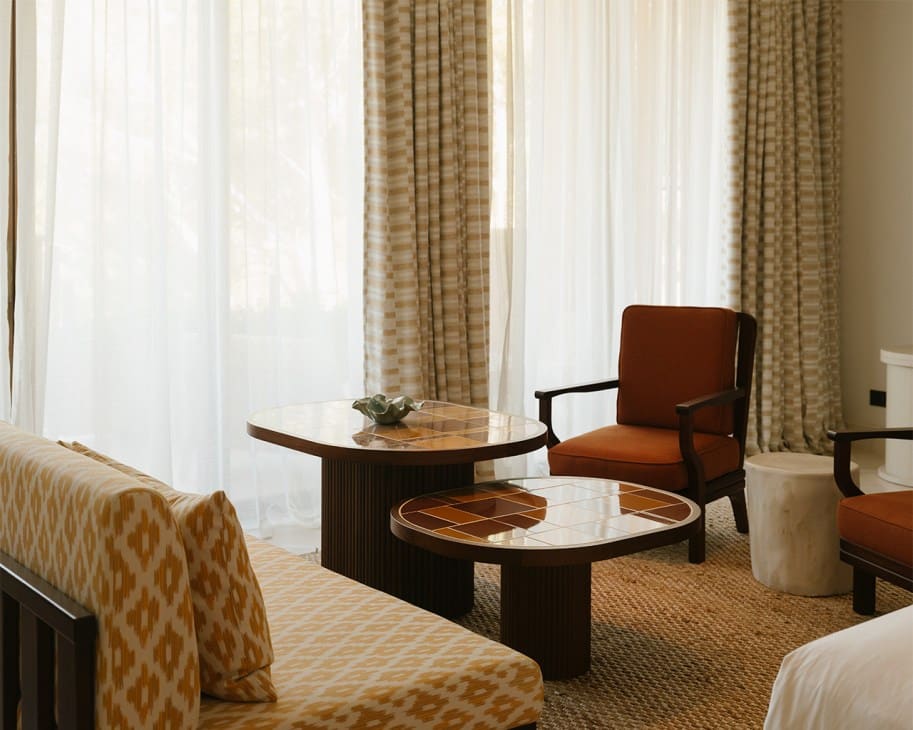
French designer Laura Gonzalez, working alongside BG Studio, has shaped the interiors with a lightness that feels right for the island. The palette is warm but not heavy, the furnishings elegant without formality. There is a sense of ease here, a refusal of ostentation. The planting throughout the property reinforces that feeling. Native and drought-tolerant species predominate, punctuated by dramatic cacti that read as sculpture. Butterflies move through the gardens in the morning, drawn to blossoms that change with the seasons.
The art program, curated by Paloma Fernández-Iriondo, elevates the property in ways that go beyond decoration. Fernández-Iriondo, who spent years building one of Spain's most significant private art collections before launching her own consultancy, has focused on artists born or based in Spain, as well as those whose work resonates with Mallorca's history as a crossroads of cultures. She traveled the island, seeking out talent without gallery representation, and commissioned pieces specifically for the hotel.
In the lobby, Fran Aniorte's tiled Balearic constellations offer a contemporary take on the island's ceramic traditions. In Casa Alma, part of the original hotel, paintings by Vera Edwards hang near a ceramic mural created by Edwards' grandmother in the 1960s, depicting the conquest of Mallorca by James I in 1229. The juxtaposition is poignant: a piece of the hotel's history, rediscovered and recontextualized alongside the work of a new generation.
Fernández-Iriondo's brief was clear: every piece must have merit, none should dominate, and all must feel relaxed and of the island. It is a philosophy that avoids the twin pitfalls of anonymous corporate art and overly precious curation. The result is a collection that rewards attention without demanding it.
The Beaches Below
Two small public beaches flank the property, accessible by a series of stone steps that descend from the pool terrace. In the early morning, before the day's heat sets in, the water is glassy and silent. It is possible to swim out a hundred meters, turn back, and see the hotel perched above, its modernist lines softened by time and vegetation. The experience is simple, almost elemental, and it offers a counterpoint to the resort's more orchestrated pleasures.
This balance between ease and refinement, between public accessibility and private retreat, is what Punta Negra is attempting to strike. It is not a hermetic sanctuary, nor is it a bustling beach club. It occupies a middle ground, one that reflects both the island's evolving identity and the changing expectations of luxury travelers.
The Lamela Legacy
The lead architect on the restoration and expansion was Estudio Lamela, a Madrid-based practice founded in 1954 by Antonio Lamela. The studio is known for its work on hotels, residential towers, and landmarks including Madrid's Torres Colón. For Estudio Lamela, the Punta Negra project represents a return to a stretch of coastline the founder knew well. In the 1960s and 70s, Antonio Lamela designed residential buildings in nearby Illetes and Palma Nova, including the Edificio Zodiac. The firm worked on Punta Negra in collaboration with HKS Architects and local studios such as Palmer Blach Arquitectos, ensuring that the expansion respected the heritage-listed original while meeting contemporary standards for luxury hospitality.
The architecture does not shout. The new casas are rendered in soft, earthy tones that recede into the landscape. The original building, with its clean lines and shuttered facades, remains the visual anchor. It is an approach that honors the past without fetishizing it, allowing the site's natural drama to do much of the work.
What Modern Luxury Demands
There is a question implicit in every new luxury opening: what does luxury mean now? At Punta Negra, the answer seems to involve a commitment to place, an attention to detail that extends beyond the obvious, and a willingness to layer experiences rather than impose a single narrative. The art program, the landscaping, the restaurant mix, the room configurations, all speak to an understanding that today's high-end traveler values context and authenticity as much as thread count and square footage.
The shift in Mallorca's visitor profile, driven by those new long-haul routes, has created space for properties like this one. Guests arriving from Abu Dhabi or Mexico City are not necessarily looking for the same things as a German family driving down from Hamburg. They may want larger suites, more interconnecting rooms, a broader range of dining options, and the kind of service that anticipates needs without intruding. They are also, often, more willing to pay for those things.
But the risk, as always, is that in chasing a global clientele, a property loses its sense of place. Punta Negra avoids that trap, in part because of the site itself. The rocky headland, the twisted pines, the view across the bay, these elements anchor the resort in a specific geography. The art and design choices reinforce that connection. The result is a property that feels both international and deeply local, a difficult balance to strike.
The Morning Swim
Standing on the small beach below the hotel, the water lapping at the rocks, it is easy to forget the logistics that make a place like this possible: the investment, the partnerships, the staff training, the supply chains. What remains is the experience itself, the particular quality of light at dawn, the coolness of the sea, the sense of being in a place that has been thoughtfully made.
Mallorca has always had this duality. It is both a mass-market destination and an enclave for discerning travelers, a place where package tourists and billionaires share the same island, if not the same beaches. Punta Negra, with its open concept and its high-end positioning, is trying to navigate that duality. The spa and restaurants welcome outside guests, but the casitas and suites offer privacy. The art program is accessible to anyone walking through the public spaces, but the experience of staying here, of waking to that view, of swimming in the silent morning water, is reserved for those who book a room.
It is a model that reflects the island's current moment, a time when Mallorca is both more crowded and more exclusive than ever. The hotels we have returned to this year, across the Mediterranean and beyond, are the ones that understand this paradox and find ways to work within it. Punta Negra, in its blend of mid-century heritage and contemporary luxury, in its commitment to place and openness to the world, seems to have found its way.
Credit: GBP
Spot something wrong? Email editors@globalchicvoyage.com. We log every correction publicly.
RELATED
SEE ALL →
8 Aug 2026 / 5 min
14 Jul 2026 / 5 min
30 Jul 2026 / 5 min
27 Jul 2026 / 5 min