
The Earth’s Landscapes That Feel Unreal, Yet Exist (Part 3)
c
ML
4 Mar 2026 · 5 MIN READ · UPDATED 17 AUG 2026
The deeper you travel, the stranger the planet becomes. Beyond the iconic wonders and viral vistas lies another tier of landscapes - places that feel glitched, exaggerated, or quietly impossible. These ten destinations prove, once again, that Earth’s imagination far exceeds our own.
1) Zhangye Danxia, China
Zhangye Danxia looks airbrushed into existence. Bands of crimson, saffron, cream, and dusty rose ripple across sandstone hills in fluid, painterly stripes. Formed by mineral deposits compressed over millions of years, the layers have been folded and exposed by tectonic shifts, creating a topography that resembles a giant abstract canvas. At sunrise and sunset, the colors intensify, glowing as if lit from within. The terrain undulates in soft curves rather than sharp peaks, giving it an almost fabric-like quality like silk draped over the earth. Walking along the ridgelines, you feel suspended between geology and art, unsure where natural process ends and visual illusion begins.

Photo Credit: China Odyssey Tours
2) Tsingy de Bemaraha, Madagascar
Imagine a forest made not of trees but of stone blades. Tsingy de Bemaraha is a labyrinth of razor-sharp limestone pinnacles rising in dense clusters, their edges so fine they slice the sky into fragments. Over millennia, rainwater carved deep fissures into ancient coral limestone, leaving behind a jagged city of spires. From above, the formation resembles shattered glass frozen mid-explosion. Suspended bridges and narrow paths thread through the formations, revealing hidden canyons and pockets of unexpected greenery below. The scale is disorienting - both vast and claustrophobic at once. It’s a place that feels less like a landscape and more like an architectural experiment conducted by time itself.

Photo Credit: Aqua-Firma
3) White Sands National Park, USA
At White Sands, the desert gleams like fresh snowfall under a blazing sun. Instead of quartz, these dunes are made of gypsum crystals, giving the landscape a luminous white glow that reflects heat and light in surreal ways. The dunes roll endlessly, sculpted into soft waves by wind, their edges crisp and shadowed in blue at dusk. Footprints disappear within hours, erased by shifting currents of air. Under a full moon, the sand seems almost phosphorescent, blurring the boundary between ground and sky. It’s a minimalist dreamscape - monochrome, expansive, and eerily silent - where the usual palette of desert gold is replaced by something almost celestial.

Photo Credit: Getty
4) The Wave, USA
The Wave looks like frozen motion. Swirling bands of red, apricot, and cream sandstone ripple across its surface in fluid curves, sculpted by wind and time. The rock appears soft and pliable, though it is solid beneath your hands. Light slides across the striations, intensifying their contrast and making the stone seem to glow from within. There are no sharp peaks here, only undulating lines that draw the eye in continuous motion. The silence of the surrounding desert amplifies the illusion. It feels less like standing on rock and more like stepping onto a paused current of color.

Photo Credit: Straw
5) Lake Kaindy, Kazakhstan
Lake Kaindy hides a forest beneath its surface. After an earthquake triggered a landslide in 1911, a natural dam formed, flooding a valley of spruce trees. Today, pale trunks rise from turquoise water like masts of a silent fleet, while branches remain eerily preserved below. The cold mountain lake is so clear that the submerged forest appears suspended in time. Mist often hovers above the surface, softening the scene into something cinematic. The vertical lines of the trees against still water create an unsettling calm - an accidental landscape that feels staged by nature’s quiet drama.

Photo Credit: @rootsabroadtravel
6) Door to Hell, Turkmenistan
In the middle of the Karakum Desert, a massive crater burns continuously, its flames flickering from a collapsed gas field ignited decades ago. Known as the Door to Hell, the pit glows orange against the night, heat radiating from its rim. The surrounding desert is silent and dark, which makes the fiery core feel even more surreal. Peer inside and the crater pulses with movement, a restless bowl of flame licking at its edges. It’s unsettling, hypnotic, and undeniably spectacular - a reminder that sometimes the most otherworldly landscapes are born not only from nature, but from human miscalculation meeting geology.

Photo Credit: Alec Connah
7) Crystal Cave of Vatnajökull, Iceland
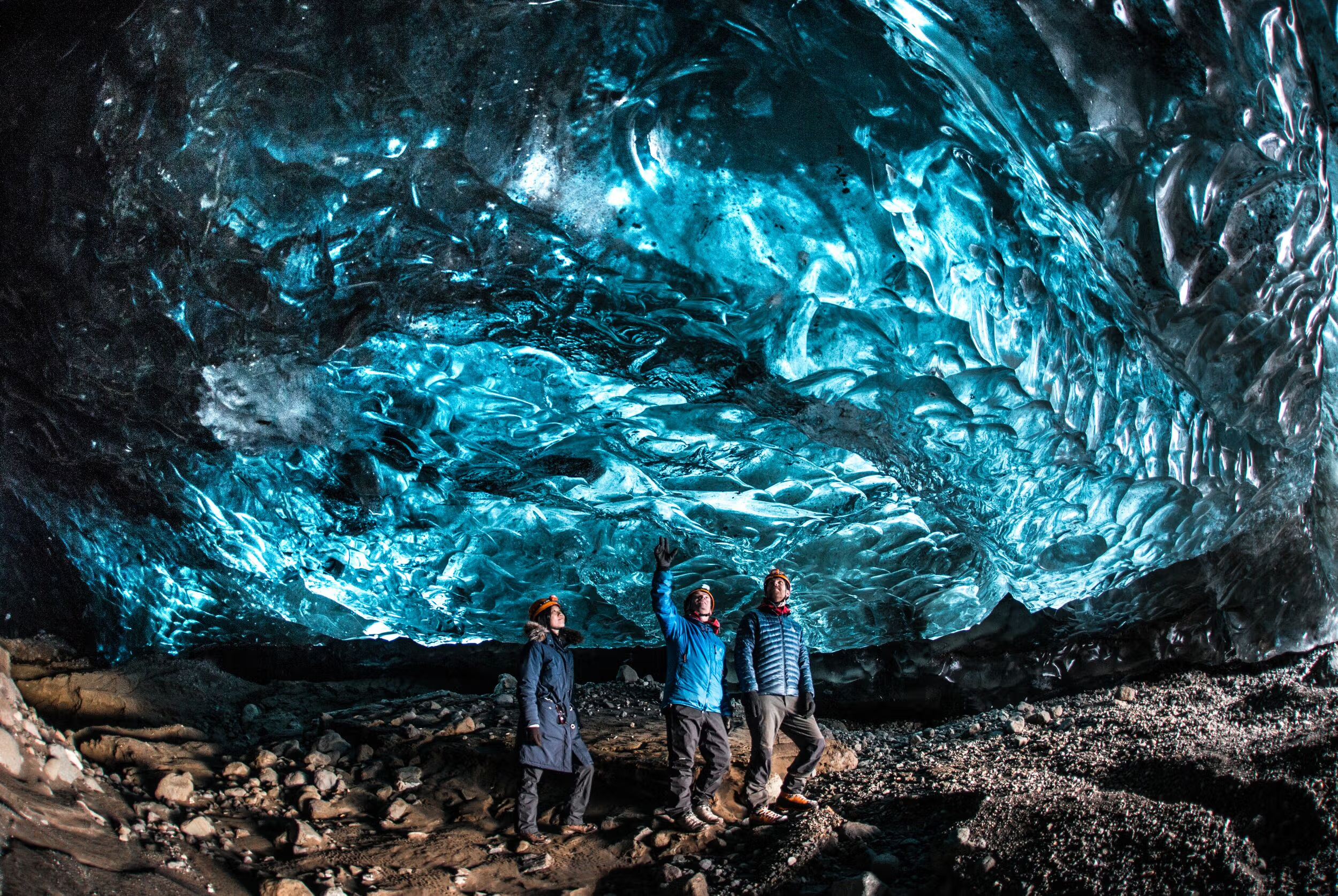
Hidden beneath Europe’s largest glacier, the Crystal Cave of Vatnajökull feels like stepping inside a living gemstone. Layers of compacted ice filter daylight into luminous shades of cobalt and sapphire, the blue deepening where the glacier has pressed air from the frozen water over centuries. The ceiling curves in smooth, glass-like waves, etched with delicate fractures that catch and scatter light. Every surface glows softly, as if illuminated from within. Meltwater trickles faintly beneath the ice, a reminder that this cathedral is temporary, reshaped each season by freeze and thaw. It’s not just a cave, but a moment in motion, carved from ancient winter.

Photo Credit: Visit Vatnajökull
8) Lake Abraham, Canada
In winter, Lake Abraham transforms into a sheet of glass suspended over frozen constellations. Beneath its crystal-clear surface, thousands of methane bubbles rise from decaying plant matter below, freezing mid-ascent into stacked white discs. The effect is surreal like stars trapped under ice. Walk across the lake and you peer straight down into these delicate, otherworldly formations, perfectly preserved in layers. Cracks spider across the surface in silver lines, echoing like distant thunder as temperatures shift. The surrounding Rocky Mountains stand silent and snow-covered, amplifying the illusion that you’re standing on a transparent portal rather than solid ground.

Photo Credit: Travel Aberta
9) Vaadhoo Island, Maldives
When night falls on Vaadhoo Island, the shoreline begins to shimmer. Each wave that rolls onto the sand glows electric blue, illuminated by bioluminescent plankton disturbed by movement. The sea appears filled with stars, flickering and dissolving with every ripple. Step into the water and light follows your footsteps, swirling around your ankles like liquid neon. The phenomenon is fleeting and unpredictable, dependent on currents and microscopic life, which makes witnessing it feel almost secret. Under a dark sky, the glowing tide blurs the boundary between ocean and cosmos - an intimate galaxy unfolding at your feet.

Photo Credit: WanderOn
10) Sólheimajökull, Iceland
Sólheimajökull looks like a canvas splashed in ink and ice. Bright blue glacial walls rise in jagged formations, streaked dramatically with black volcanic ash from past eruptions. The contrast is striking - electric color interrupted by dark ribbons that trace the glacier’s slow descent. Deep crevasses slice into the ice, revealing layers compressed over centuries, glowing sapphire where air has been forced out. Meltwater streams carve temporary channels across the surface, constantly reshaping the frozen terrain. It’s a place where fire and ice visibly coexist, where Iceland’s volcanic heart leaves its mark on ancient, moving crystal.

Photo Credit: aiaikawa@fotolia
Across continents and climates, these landscapes remind us that Earth remains the greatest illusionist of all. Ice glows blue from compressed centuries, oceans ignite with microscopic light, deserts ripple in impossible colors, and frozen lakes trap constellations beneath their surface. None are digital renderings or cinematic inventions - they are real, shifting, alive.
Spot something wrong? Email editors@globalchicvoyage.com. We log every correction publicly.
RELATED
SEE ALL →
18 Feb 2026 / 5 min
6 Mar 2026 / 5 min

21 May 2026 / 5 min
20 May 2026 / 5 min