
The Gramercy Park Apartment Where Music Has Always Been the Architecture
For forty years, a double-cube living room has hosted musical salons that honor both family legacy and the building's century-old bohemian bones.
CG
31 May 2026 · 5 MIN READ · UPDATED 17 AUG 2026
The Room That Remembers How to Sing
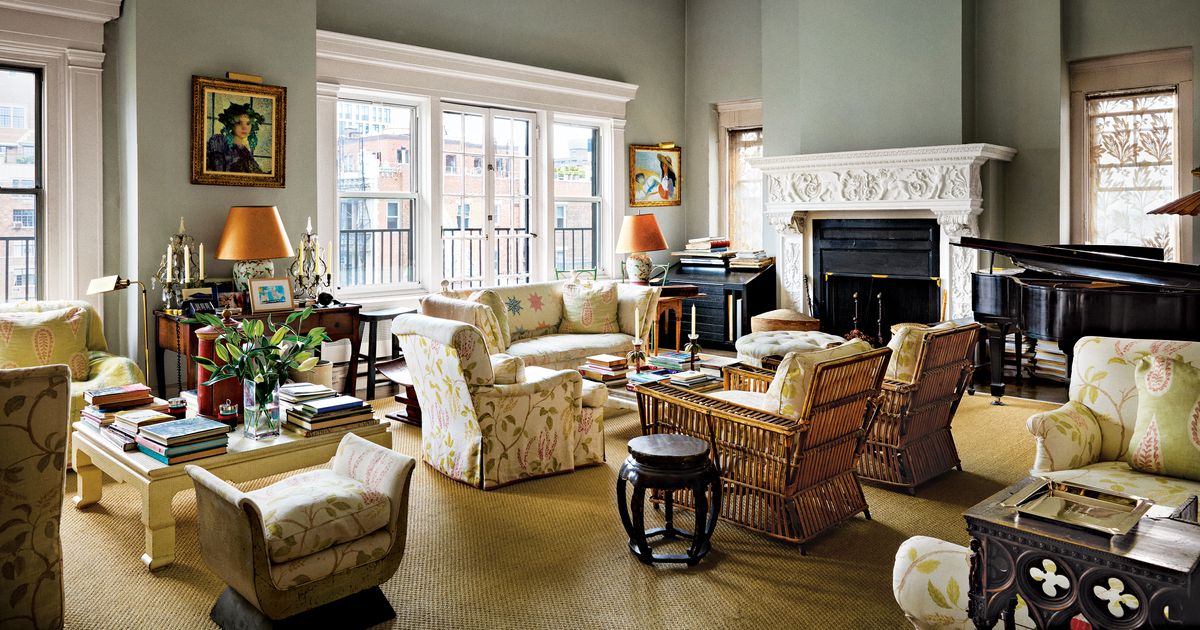
There is a particular quality to light in a double-cube room—something about the proportions, the way sound doesn't quite settle but hovers instead, held by geometry. In a Gramercy Park apartment where the walls are lined with paintings by Alexandra Cushing Howard's grandfather, the American Impressionist Howard Gardiner Cushing, that hovering takes on a different character entirely. On certain evenings, up to forty guests gather here, and the room becomes what it was always meant to be: a vessel for music. Not background music. Not recorded music. Music performed live, by a rotating cast that might include a Metropolitan Opera singer one night and a nine-year-old from downstairs the next. The rule, enforced gently but firmly by Philip Howard, is silence during the sets. No talking. No clinking of glasses. Just the integrity of the performance, and the chicken potpie that has become as much a fixture as the grand piano left behind by a previous owner.
This is not a recent innovation. Alexandra and Philip have been hosting these musical salons for over forty years, since shortly after they purchased the three-bedroom apartment in the early 1980s. The tradition began at a friend's house party, where Philip and the playwright John Guare competed over who could remember more lyrics to an obscure Cole Porter song, serenading the crowd in the process. The performance carried over to Gramercy Park, where it found a home in a building that had music written into its very bones. The 1909 structure was commissioned by the poet and editor Richard Watson Gilder, who hired architect Herbert Lucas to design living quarters for himself and five artist friends. Among them was Francis Wilson, a comic-opera singer who became one of two previous owners of the Howards' apartment. The lineage is not incidental. At Global Chic Voyage, we've long observed how certain spaces hold memory—not in the sentimental sense, but in their material DNA. This apartment is one of them.
Bohemian Infrastructure, Quietly Maintained
The couple moved in with almost no furniture. For a time, they propped a door on sawhorses to use as a dining table. With architect Richard Nash Gould, they renovated the kitchen and created an enfilade entrance hall—a telescoping circulation that Gould conceived to open up the flow and give the living room a sense of arrival. The walls, meanwhile, became a gallery. Alexandra, a docent at the Metropolitan Museum of Art for twenty-five years, has spent decades cataloguing her grandfather's work, and much of it now hangs here: harbor scenes from Majorca, studies for murals intended for Gilded Age mansions, a 1916 preparatory painting for an indoor swimming pool at the East 70th Street home of banker George Blumenthal. Her aunt Lily Cushing's watercolors, held in the collections of the Whitney and the Smithsonian, occupy the sitting area. Above the desk hangs a portrait of Alexandra's grandmother Ethel, painted by Gardiner Cushing himself.
Her sister Justine Cushing, an interior designer who worked with Sister Parish, has touched up the apartment several times over the years, always adhering to the muted palette of the original scheme. "Justine has redecorated the apartment several times, as everything has been worn out by the children and the festivities," Alexandra notes. The Knoll sofa, inherited from the estate of Joan Whitney Payson, has been reupholstered more than once by Rosenfeld Interiors in Brunschwig & Fils fabric. Bamboo armchairs sourced from Secondhand Rose in New York provide additional seating. The effect is not one of museum preservation but of lived-in continuity—a space that absorbs wear and adapts without losing its underlying character.
The Etiquette of Amateur Performance
Philip runs what he calls "a tight ship." The evenings are not raucous. They are structured, even reverent. "The rule is that you must be quiet during the sets. No one can talk. We are taking the performances seriously. There's integrity," he explains. "Even people who can't sing find a way to style a song." This is not about virtuosity. It is about participation, about honoring the act of performance itself. The dinner-party format—guests take turns performing after the meal—creates a kind of egalitarian stage where professional training and enthusiastic amateurism share equal footing. The architecture of the evening mirrors the architecture of the room: balanced, proportioned, held together by an invisible structure that everyone agrees to respect.
This approach to hospitality is increasingly rare. In an era when dinner parties often double as content opportunities and living rooms are styled for Instagram rather than conversation, the Howards' salons operate according to a different logic. They are analog, ephemeral, resistant to documentation. The performances are not recorded. The evenings are not hashtagged. What happens in the double-cube room stays there, preserved only in memory and in the accumulated patina of the space itself. It is a model of cultural production that predates the attention economy, and it persists precisely because it refuses to monetize itself.
Why Lineage Still Matters in American Interiors
Both Alexandra and Philip come from families with deep American roots. He is a lawyer and author, a distant relative of Josiah Bartlett, one of the signers of the Declaration of Independence. She is an architectural historian whose grandfather was a prominent figure in the American Impressionist movement. These lineages are not incidental to the apartment's character. They provide a kind of cultural ballast, a sense of continuity that informs how the space is used and inhabited. The paintings are not decorative objects but family documents. The furniture is not curated but inherited, reupholstered, passed down. The salons themselves are an extension of this ethos—a way of maintaining a tradition not through rigid preservation but through active, evolving practice.
What strikes us at Global Chic Voyage is how this approach to interior life resists the prevailing trends in luxury residential design, which often privilege novelty over continuity, spectacle over intimacy. The Howards' apartment is not designed to impress. It is designed to accommodate—guests, performances, children, wear and tear, the slow accumulation of decades. It is a space that has been shaped by use rather than styled for presentation, and in that sense, it offers a quietly radical model for how we might think about domestic space in the 21st century.
The Building as Co-Conspirator
That the apartment sits in a building designed for artists is not coincidental. The 1909 commission by Richard Watson Gilder—who founded The Century magazine in the late 19th century—was explicitly intended to create a bohemian enclave in Gramercy Park, a neighborhood already known for its literary and artistic residents. The building's original tenants included poets, painters, and performers. Francis Wilson, the comic-opera singer, was not an outlier but part of a broader cultural milieu. The Howards, whether consciously or not, are continuing that tradition. Their salons are not a revival but a continuation, a way of activating the space according to its original intent.
This raises a broader question about how buildings age and how their original purposes persist—or don't—over time. In many cases, early-20th-century artist residences have been converted into high-end condos, their bohemian histories scrubbed away in favor of marble countertops and smart-home systems. The Howards' apartment, by contrast, has retained its cultural DNA, not through preservation but through use. The grand piano is still there. The performances still happen. The double-cube room still sings.
What Endures When the Performance Ends
At the end of each evening, after the last guest has performed and the chicken potpie has been consumed, the apartment returns to its daytime quiet. The paintings remain on the walls. The furniture, worn by decades of use, settles back into place. The grand piano waits. This cyclical rhythm—performance and silence, gathering and solitude—is what gives the space its particular character. It is not a museum. It is not a stage. It is a home that occasionally becomes something more, and then, just as quickly, becomes a home again.
For those of us who track the ways luxury is evolving—away from ostentatious display and toward experiential depth, away from newness and toward continuity—the Howards' apartment offers a useful case study. It suggests that the most enduring interiors are not those that resist change but those that absorb it, that allow themselves to be shaped by the lives lived within them. The double-cube room in Gramercy Park has been singing for over a century. It will likely continue to sing long after the current residents are gone, as long as someone remembers to keep the tradition alive. That, in the end, is the real architecture: not the walls or the proportions, but the memory of how to use them.
Spot something wrong? Email editors@globalchicvoyage.com. We log every correction publicly.
RELATED
SEE ALL →
8 Aug 2026 / 5 min

7 Aug 2026 / 5 min

31 Jul 2026 / 5 min

27 Jul 2026 / 5 min