
The Neuroscience Suite: When a Hotel Room Becomes a Sleep Laboratory
At Equinox Hotels, sleep is no longer a byproduct of hospitality - it is the product itself, measured, optimized, and archived in a vault of human rest.
SI
17 Jun 2026 · 5 MIN READ · UPDATED 17 AUG 2026
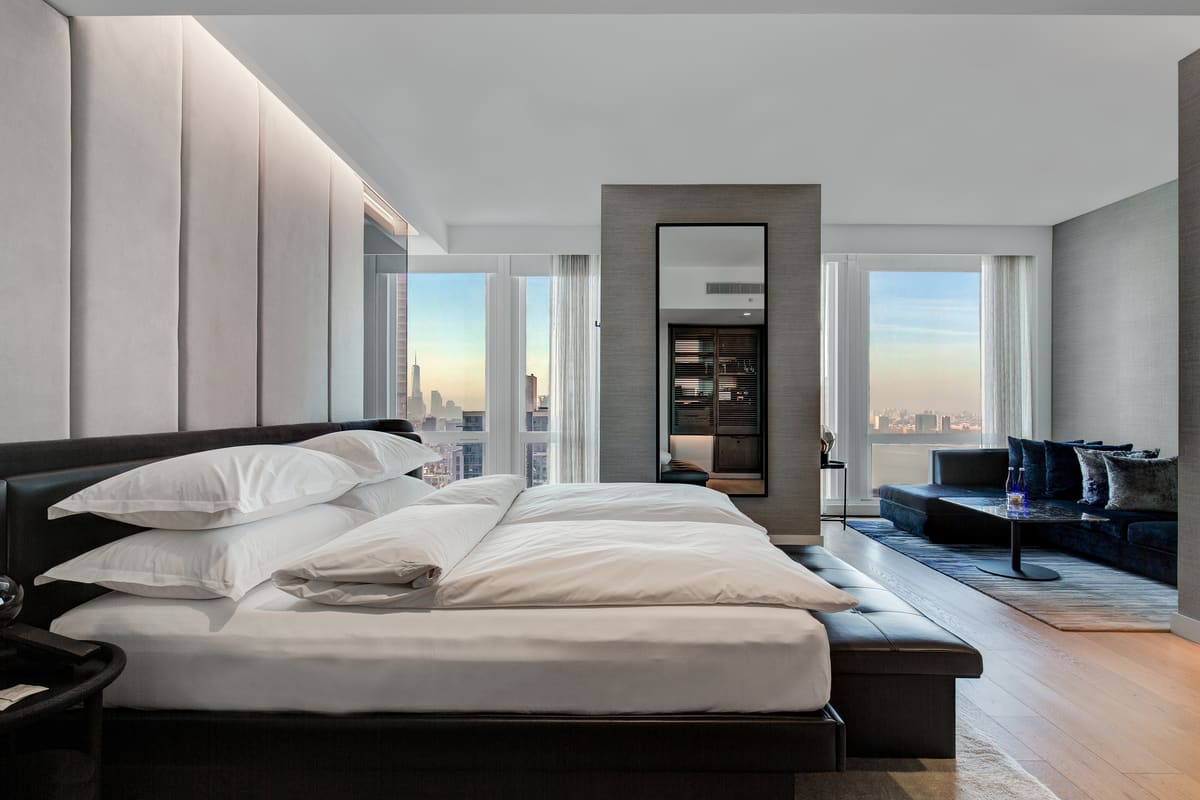
The Room That Watches You Dream
It begins with a bedside device. Not an alarm clock, not a white-noise machine, but a piece of hardware designed to assess the architecture of your sleep. In the morning, it delivers a score. Somewhere in the building, data flows into what the hotel calls the Data Vault - a term that sits uncomfortably between medical archive and wellness marketing. For seventeen hundred dollars per night, with a minimum two-night stay, you are not merely renting a room at Equinox Hotel New York. You are enrolling in a study.
The Sleep Lab occupies four Premier King rooms, each outfitted with sensors, adaptive mattresses, and contrast-therapy showers whose coldest setting reaches forty-six degrees Fahrenheit. Most hotel cold plunges, polite gestures toward the Scandinavian sauna tradition, bottom out at fifty. Here, the ice setting is colder, the data more granular, the ambition less about comfort than optimization. The rooms are wired like a clinical trial, and in a sense, they are.
At Global Chic Voyage, we have watched the luxury hospitality sector oscillate between two poles: the retreat that promises escape from the quantified self, and the one that doubles down on measurement. Equinox Hotels has chosen the latter, and it has done so with a clarity of purpose that borders on ideological.
The Neuroscientist in Residence
Matthew Walker is not on-site, but his presence is woven into the architecture of the experience. A professor at Berkeley and author of a bestselling book on sleep science, Walker has become a kind of wellness imprimatur - his name functions somewhere between peer-reviewed credibility and the algorithmic reach of a podcast episode. Guests at the Sleep Lab participate in his research; their nights become data points in a broader inquiry into human rest.
This is not the first time a hotel has partnered with a scientist. Nor is it the first time sleep has been positioned as a luxury amenity. Other brands have introduced sleep concierges, pillow menus, circadian lighting. What distinguishes the Equinox model is its refusal to treat sleep as a passive benefit. Here, sleep is the headline, the differentiator, the reason for being. It is not something that happens to you after a day of meetings or sightseeing. It is the point.
The collaboration with Walker signals a shift in how certain hospitality brands understand their role. They are no longer simply providing a bed. They are providing an intervention, a system, a set of protocols designed to alter the guest's physiology. The question is whether travelers want their rest to be managed with the same rigor they apply to their workouts, their diets, their productivity dashboards.
Hard-Coding Sleep Into the Brand
For seven years, Equinox Hotels operated as essentially a single-property company. The New York flagship opened with the kind of vertical integration that fitness brands dream of: a gym, a spa, a restaurant, a members-only club, and rooms that felt less like hotel accommodations and more like extensions of a wellness philosophy. The brand's expansion has been slow, deliberate, and now, with the Sleep Lab, explicitly focused on a single physiological function.
This is not diversification. It is distillation. While other luxury hotel groups chase breadth - more destinations, more room categories, more partnerships - Equinox Hotels is narrowing its aperture. Sleep becomes the lens through which every other design decision is filtered. The mattress is adaptive. The shower is therapeutic. The bedside device is diagnostic. Even the architecture of the guest experience is structured around circadian rhythms, temperature regulation, and data capture.
The risk, of course, is that the brand becomes legible only to a certain kind of traveler: the one who already tracks their steps, their heart rate variability, their REM cycles. The Sleep Lab is not for the guest who wants to unplug. It is for the guest who wants to plug in more precisely.
The Clinical Aesthetic
There is something almost ascetic about the Sleep Lab rooms. The contrast-therapy shower, with its extreme cold setting, recalls the ice baths of elite athletes, the cold-water immersion protocols that have migrated from sports medicine into wellness culture. The adaptive mattress responds to the body in real time, adjusting firmness and support as the sleeper shifts position. The bedside device, quietly monitoring, becomes a kind of silent attendant.
This is hospitality as intervention, design as protocol. The room does not simply accommodate your preferences; it tries to improve them. It is a space engineered for performance, and the performance in question is rest.
We have seen this aesthetic before - in Scandinavian spa hotels, in Japanese ryokan that regulate light and temperature with monastic precision, in Swiss clinics that treat sleep as a medical condition. What is new is the degree to which data collection has been integrated into the guest experience. You are not just sleeping better. You are contributing to a body of research, your nights archived in the Data Vault alongside those of other guests.
The language here matters. "Vault" suggests permanence, security, value. It also suggests surveillance. The Sleep Lab exists at the intersection of these two ideas: the promise of personalized insight and the uneasy reality of being watched.
The Question of Scale
Equinox Hotels is now expanding beyond its Manhattan flagship, and sleep is the anchor of that expansion. The Sleep Lab is not a pilot program; it is a proof of concept. It demonstrates that a hotel can position itself not as a place to stay, but as a place to improve - a laboratory, a clinic, a performance center.
The challenge will be replicating this model across geographies, across markets, across guest demographics. Sleep science is universal, but sleep culture is not. The protocols that resonate in New York - the data tracking, the contrast showers, the neuroscientist collaborations - may not translate to other cities, other travelers, other expectations of what a hotel should offer.
There is also the question of whether the Sleep Lab is scalable in a logistical sense. The hardware is expensive. The partnerships require credibility. The data infrastructure demands privacy safeguards, regulatory compliance, and a guest base willing to participate. This is not a model that can be rolled out quickly or cheaply.
But perhaps that is the point. Equinox Hotels is not trying to be everywhere. It is trying to be definitive. The Sleep Lab is a statement: this is what we do, and no one else does it this way.
The Vault and the Guest
The Data Vault raises questions that the hospitality industry has not yet fully addressed. What happens to the data collected during a guest's stay? Who owns it? How is it stored, analyzed, shared? Equinox Hotels positions the Vault as a research tool, a repository of insights that will inform future programming, future room design, future collaborations with scientists like Walker.
But the guest is not a passive subject. They are paying for the privilege of being studied, and in return, they receive a sleep score, a set of recommendations, perhaps a consultation. The transaction is clear, but the implications are murkier. This is not a hotel that forgets you when you check out. It remembers. It archives. It learns.
For some travelers, this will be a feature. The idea that their sleep data contributes to a larger body of knowledge, that their nights are not wasted but analyzed, may feel empowering. For others, it will feel intrusive, a crossing of the line between hospitality and clinical trial.
At Global Chic Voyage, we believe the most interesting luxury experiences are those that force us to reconsider the terms of the transaction. The Sleep Lab does exactly that. It asks: what are you willing to share in exchange for optimization? What does it mean to rest when rest is being measured?
The Future of the Wellness Hotel
The Sleep Lab is a bet. It is a bet that travelers will pay a premium for data, for expertise, for the promise of better rest. It is a bet that sleep can be hard-coded into a brand identity the way fitness has been hard-coded into Equinox. It is a bet that the hotel of the future is less about escape and more about enhancement.
Other luxury brands have flirted with sleep science. They have introduced circadian lighting, commissioned studies, partnered with mattress companies. But few have gone as far as Equinox Hotels, which has effectively turned a handful of rooms into a laboratory and invited guests to become research subjects.
The question is not whether this is interesting. It is. The question is whether it is sustainable, whether it can be replicated, whether it will define the next chapter of wellness hospitality or remain a high-concept experiment in a single Manhattan hotel.
We suspect the answer lies somewhere in between. The Sleep Lab will not be for everyone, and it was never meant to be. But it represents a new category of luxury experience: one in which the product is not the room, not the service, not even the sleep itself, but the data that sleep generates. It is hospitality as biometric feedback, rest as performance metric, the hotel room as a place where you are both guest and subject.
And in that doubling, in that tension between comfort and measurement, Equinox Hotels has found its edge.
Spot something wrong? Email editors@globalchicvoyage.com. We log every correction publicly.
RELATED
SEE ALL →
7 Jul 2026 / 5 min
30 Jul 2026 / 5 min
22 Jun 2026 / 5 min
12 Jun 2026 / 5 min