
The Second Life of Supply Ships: When Industrial Platforms Become Expedition Vessels
Italian designer Stefano Pastrovich has spent a decade proving that North Sea workhorses can be reborn as vessels for the world's most remote waters.
VJ
22 Jul 2026 · 5 MIN READ · UPDATED 17 AUG 2026
A Question from the North Sea
In 2015, a Norwegian ship owner approached Stefano Pastrovich with an unusual request. He owned two Platform Supply Vessels, each stretching 289 feet, that had spent years ferrying equipment and provisions to oil rigs in the North Sea. Now those ships sat idle, casualties of the oil crisis that had begun rippling through the industry the year before. Could they, the owner wondered, be reimagined as private explorer yachts?
At Global Chic Voyage, we've watched designers chase novelty in yacht design for years, but Pastrovich's response felt different. Rather than treat the request as a one-off commission, the Italian designer saw a structural opportunity. He delivered not one but three concepts, each proposing that the very qualities that made these vessels effective in harsh offshore environments, redundant systems, exceptional range, hulls built to withstand weeks in open ocean, could be channeled toward a different kind of voyage.
The Logic of Conversion
Platform Supply Vessels occupy a specific niche in maritime infrastructure. Purpose-built to service oil rigs and wind farms far from shore, they are engineered for autonomy and resilience. Between 2014 and 2016, however, the collapse in oil prices left many of these ships without work. Shipowners faced losses; shipyards saw orders dry up. Pastrovich's proposal offered a practical resolution: convert the existing fleet into charter vessels for expedition travel, creating a revenue stream where there had been none.
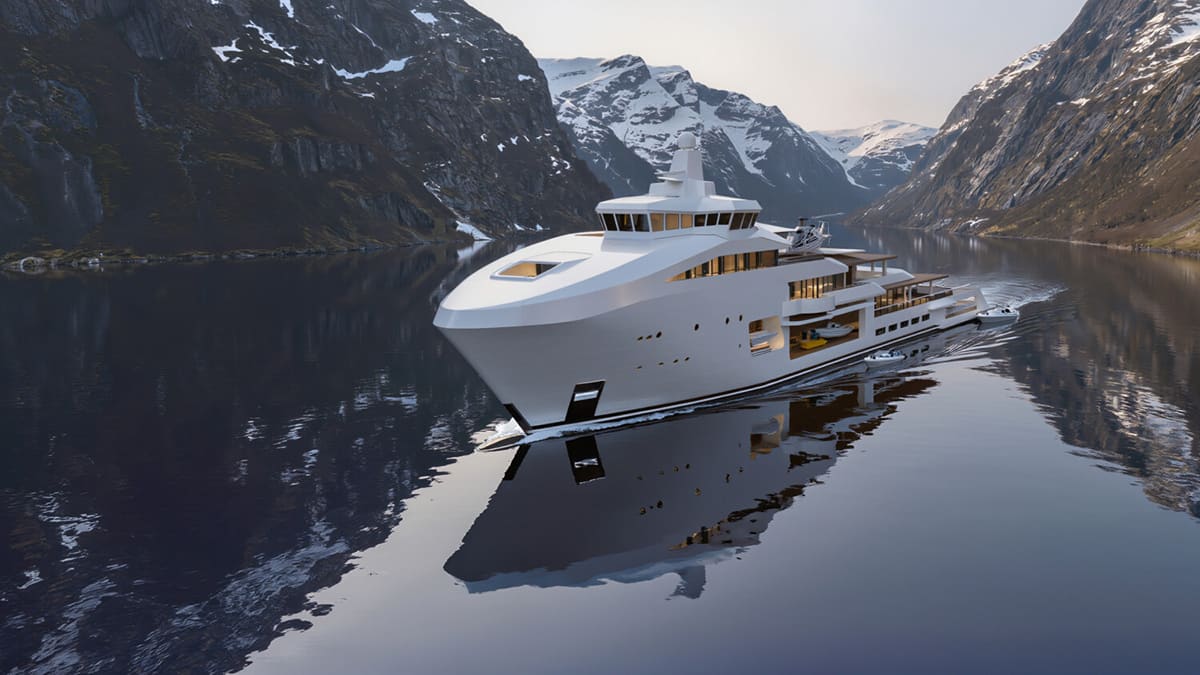
The first design retained the 289-foot length of the original PSVs. Pastrovich reconfigured the interior to accommodate up to 30 guests across two owner's apartments, VIP suites, and additional cabins. The exterior, deliberately utilitarian, was left largely intact. This was not an exercise in cosmetic camouflage. The rugged profile, the industrial lines, these were retained as part of the vessel's identity, a visual honesty that signaled capability over decoration.
Scaling Up for Charter
The initial concept led to two larger successors, both measuring 328 feet. These were designed explicitly for charter operations, conceived as boutique expedition ships that could carry guests to Antarctica, Patagonia, Greenland, and the Arctic, destinations where infrastructure is minimal and weather unpredictable. One configuration accommodates 116 passengers; the other holds 64, prioritizing space and comfort per guest.
For the higher-capacity version, Pastrovich collaborated with Meccano Engineering to adapt the offshore platform for passenger use, a process that required rethinking safety protocols, circulation, and onboard amenities. A separate partnership with Wärtsilä explored a new-build variant, applying the same expedition philosophy to a vessel designed from the keel up rather than retrofitted.
The appeal of these conversions lies in their structural foundation. North Sea supply vessels are built with redundancy, multiple backup systems that ensure operation even when primary equipment fails. They carry fuel for extended passages, possess stabilization suited to rough seas, and require minimal external support. These are not qualities easily replicated in vessels designed primarily for sheltered cruising.
A Fusion of Engineering and Hospitality
Pastrovich describes the project as a fusion of engineering, architecture, hospitality, and operations. The objective, according to the studio, is not superficial refit but coherent integration. The challenge is to preserve the robustness that defines these vessels while introducing the finishes and spatial planning expected in superyacht interiors.
The interiors of the 328-foot concepts reflect this balance. Guest areas are designed to superyacht standards, with attention to materials, lighting, and acoustic comfort, but the layout acknowledges the vessel's origins. Circulation follows logical, efficient paths. Storage is generous. Windows are positioned to frame the landscapes these ships are built to reach rather than to mimic the floor-to-ceiling glass walls common in Mediterranean yachts.
The aft decks, often the most dramatic spaces on expedition vessels, are configured for tender operations and water-level access, essential when anchoring off remote coastlines where no marina exists. Helicopter pads, observation lounges, and outdoor dining areas are integrated without compromising the vessel's working functionality.
Why Now
None of Pastrovich's three concepts have yet entered construction, but the logic behind them has only grown more relevant. The oil market remains volatile, and the offshore supply sector continues to grapple with overcapacity. At the same time, demand for expedition travel has intensified. Travelers increasingly seek access to environments that conventional cruise ships cannot reach, places where ice, shallow drafts, and distance from ports require vessels with genuine offshore capability.
The conversion model addresses both conditions. It offers shipowners a path to repurpose assets that might otherwise be scrapped. It provides the expedition market with vessels that do not require years of new construction. And it introduces a category of travel that sits between private superyacht and large expedition cruise ship, offering the intimacy of the former with the infrastructure of the latter.
The Aesthetic of Function
There is an aesthetic argument embedded in Pastrovich's approach, one that resonates with a broader shift in luxury travel. The vessels do not attempt to disguise their origins. The industrial silhouette, the exposed functionality, these become part of the design language rather than elements to be concealed. In an era when luxury increasingly values authenticity and narrative, a ship that carries the marks of its working life offers a different kind of appeal than one designed solely for leisure.
This is not nostalgia. It is a recognition that certain forms of beauty emerge from purpose, that a vessel built to endure the North Sea possesses a kind of integrity that cannot be replicated through styling alone. The challenge for designers like Pastrovich is to honor that integrity while creating spaces where guests feel invited rather than tolerated, where the vessel's history enriches the experience rather than constrains it.
What Lies Ahead
As the maritime industry continues to reckon with surplus capacity and shifting energy markets, the idea of adaptive reuse will likely gain traction. Pastrovich's work suggests that conversion is not merely a fallback but a legitimate design strategy, one that can yield vessels with distinct character and proven seaworthiness.
The question is whether owners and charterers will embrace the aesthetic and operational trade-offs that come with these conversions. The ships will never be as sleek as purpose-built superyachts. They will carry the visual weight of their industrial past. But for those seeking vessels capable of reaching the planet's most isolated waters, vessels that can operate independently for weeks at a time, the trade-offs may be precisely the point.
Credit: Pastrovich Studio
Spot something wrong? Email editors@globalchicvoyage.com. We log every correction publicly.
RELATED
SEE ALL →
7 Aug 2026 / 5 min

27 Jul 2026 / 5 min

29 Jun 2026 / 5 min
23 Jul 2026 / 5 min