
The Valley That Remembers
Avana Retreat Mai Chau
CS
17 Mar 2026 · 5 MIN READ · UPDATED 17 AUG 2026
Mai Chau, Responsible Travel, And One Retreat That Chooses The Harder Path
There are places in the world that ask nothing of you except that you arrive with some portion of yourself still unscheduled. Mai Chau, in the limestone highlands of northern Vietnam, is one of them. Avana Retreat, hidden in old-growth forest above the valley floor, has built an entire philosophy around that proposition.
It begins before you arrive. The road from Hanoi enters the mountains quietly, as mountain roads do, and the landscape changes in the way that landscapes change when they have been spared: slowly, then all at once. Rice paddies replace the highway’s commerce. Limestone peaks rise without announcement. The villages grow smaller and further apart. By the time the valley of Mai Chau opens below you, terraced in luminous green, ringed in forest, marked here and there by the stilted houses of the Thai people, the city has become something you are no longer thinking about.
This is the northwest highlands of Vietnam, and it has been holding its breath against modernity for a long time. The farmers still work with water buffalo in the lower paddies. The women of the H’Mong villages still weave indigo cloth by hand, a process that begins with planting, moves through fermentation, and ends in a blue that has no commercial equivalent. The valley’s Sunday markets retain the character of genuine exchange rather than tourist performance. These are not curated remnants of a vanishing way of life. They are, simply, a way of life that has not yet been required to vanish.
Into this geography, in 2020, a small team of Vietnamese founders introduced a resort that would spend its first years resisting nearly every instinct of the hospitality industry. They capped their room count at thirty-six and stated publicly that the number would not increase. They built using traditional techniques sourced from local craftsmen. They hired from the three ethnic communities nearest to the estate — Thai, H’Mong, and Muong — and they planted trees where development had thinned the canopy. The result, today known as Avana Retreat, is among the most considered acts of hospitality in Southeast Asia.
Mai Chau: A Portrait of the Northwest
To understand Avana Retreat, one must first understand the valley it inhabits. Mai Chau lies 140 kilometers southwest of Hanoi in Hoa Binh Province, a region whose name translates literally as “Peace”. It sits at the convergence of three distinct highland cultures: the Thai, whose stilt houses and rice wine and intricate textile traditions have shaped the valley for centuries; the Muong, whose ceremonial music and bronze-drum heritage run deeper still; and the H’Mong, who arrived later and settled the higher ground, bringing with them a mastery of beeswax-resist dyeing and embroidered garments that carry in their patterns an entire compressed history.
The landscape is structured by water. Every terrace, every paddy, every village path follows the logic of irrigation — the careful management of the streams that descend from the forested ridgelines into the valley floor. Because the climate grants two full rice harvests each year, the terraces are almost never bare; they cycle from the brilliant acid green of new shoots to the gold of harvest to the still, mirror-surfaced geometry of a flooded field waiting to be planted again. It is an agricultural calendar that doubles as an aesthetic one, and the quality of light in Mai Chau changes accordingly — sharp and celebratory in harvest months, soft and retrospective in the planting season, and in winter, when clouds descend into the valley and linger for days, something close to sublime.
Unlike Sapa, the more visited highland region to the north, Mai Chau has not yet surrendered its proportions to mass tourism. The market towns remain markets. The footpaths remain footpaths. You can hire a bicycle in the morning and spend four hours on valley roads without encountering another tourist, stopping when the sound of a loom draws you toward an open doorway, accepting a glass of rice wine that was brewed in the house you are standing in. This is not a performance arranged for visitors. It is simply a place going about its life, at whatever pace a place chooses.

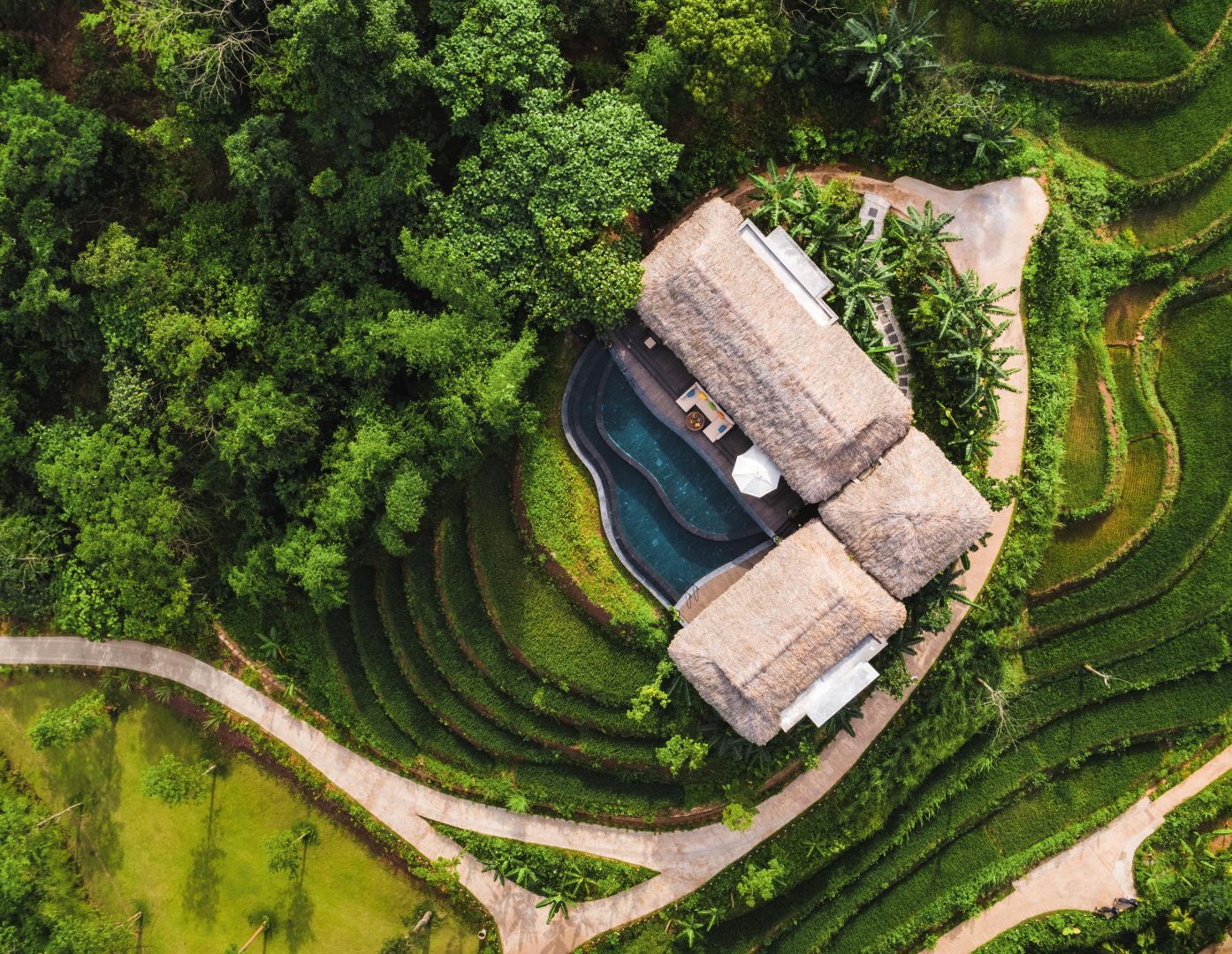
An aerial view of the retreat set gently between terraced rice fields and forest, where water, architecture, and landscape are composed as a single, continuous system
The Harder Path: A Retreat built on Restraint
The founders of Avana Retreat arrived at this 15-hectare plot of old-growth forest with no development plan. What they had, instead, was a conviction: that the natural beauty and living culture of this valley were worth more than the revenue generated by compromising them. That conviction, unusual enough in the abstract, became genuinely radical in its application.
The thirty-six villas that now occupy the mountainside were built using construction techniques passed on from local craftsmen whose methods predate any architectural school. The pitched thatched rooflines, the rattan lampshades, the hand-worked timber frames — none of this is imported aesthetic. It is the visual language of the communities living on the other side of the treeline, applied with care to buildings designed to recede rather than announce themselves. Electric buggies navigate the estate’s narrow paths rather than roads, and those paths were laid around the old trees rather than through them. The organic kitchen garden and free-range chicken farm were not conceived as marketing assets. They were conceived as a way of feeding guests food that had a coherent story.
The staffing model is perhaps the most consequential decision the founders made. The vast majority of Avana’s workforce comes from the Thai, H’Mong, and Muong villages that surround the property. This is not incidental. It means that the resort’s economic activity flows directly into the communities whose cultural heritage it presents to guests. The spa therapists, the kitchen team, the guides, the housekeeping staff — they are the children and grandchildren of the farmers in the paddies below. When a guest learns, over dinner, that the lemongrass in their soup came from a garden tended by the same family that wove the textile on their wall, the connection is not manufactured. It is true.

A hillside villa set into layered rice terraces, thatched roofs and tiered infinity pools follow the contours of the land rather than reshaping it
Thirty-six Villas, No More
The number is not incidental. Thirty-six villas, the founders decided, was the carrying capacity of this landscape — the maximum number of guests that could be present without the silence becoming something else. That ceiling has held, and the statement that it will not be raised is, in the current hospitality industry, something close to a political act.
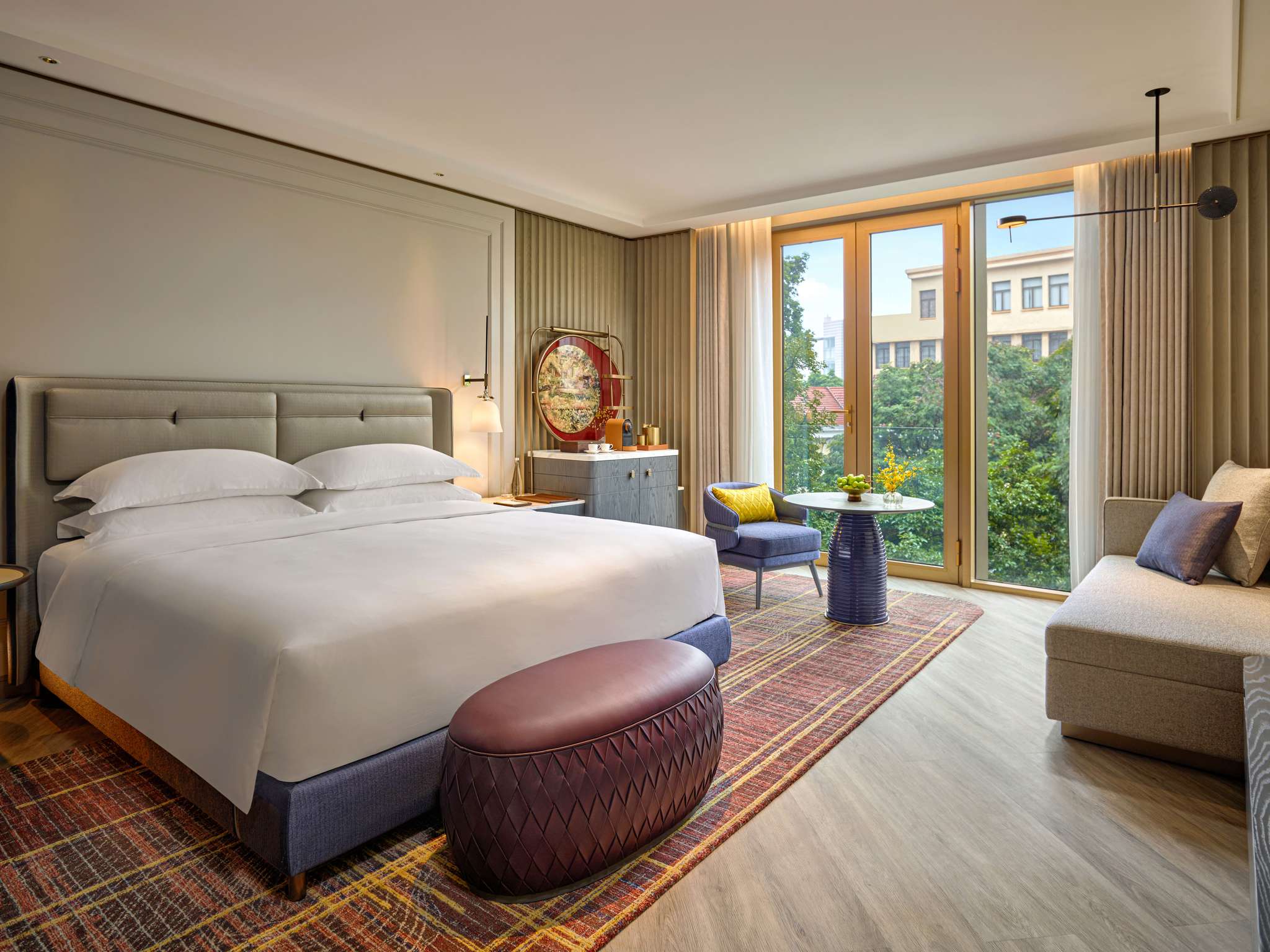
The villas are arranged in two loose corridors along the mountainside, each with a private balcony oriented toward the valley. They are classified into four categories, ascending the hillside as they ascend in scale: the Lantana Bungalow, the Bauhinia Suite, the Ferns Grand Mountain Suite, and at the summit, the Senna Hilltop Pool Villas in one- and two-bedroom configurations. The Mountain Suite is airy and considered — a king bed, a deep sofa, floor-to-ceiling windows that open the room to the forest without air conditioning’s mediating hum, if the season permits. The Senna Pool Villa, perched atop a stack of terraced fields, comes with a private two-tier infinity pool fed from the estate’s natural waterfall and panoramic views that extend, on a clear morning, to the far ridgeline.
The interiors do not compete with the landscape. They participate in it. Locally woven textiles, bamboo ceilings, carved timber joinery — the rooms read as a respectful continuation of the architecture visible in the valley’s stilt villages, refined to the degree required by comfort without crossing into the territory of the generic luxury hotel room. There is no television in the room by default. There is an iPad, which serves as the in-room compendium: menus, activity bookings, the option to arrange a private dinner at the waterfall. The absence of a screen facing the bed is, like so many things at Avana, a small decision with considered implications.

A villa’s pool terrace suspended above the valley, framing expansive views of Mai Chau's mountain ridges

Textured interiors - indigo-dyed textiles, carved wood, and bamboo ceilings - echo the material language of nearby stilt houses

Floor-to-ceiling openings dissolve the boundary between room and forest
The Cloud Pool
The Cloud Pool is, by any reasonable measure, a feat of landscape architecture. Built to mirror the sinuous terracing of the paddy fields below, it unfolds across three descending tiers on the hilltop, oriented toward the full sweep of the Mai Chau Valley. Water is drawn from the estate’s natural waterfall, filtered, and heated year-round. The lower deck extends fifty meters for those inclined toward athletic laps. The upper tiers are for something else entirely: the particular form of suspension that occurs when you are floating in warm water above a valley of green fields and the horizon holds nothing but ridge and cloud.
In winter, the Cloud Pool becomes something more unusual still. As cold air descends from the highlands, the valley fills with cloud from below — a phenomenon that turns the pool, on certain mornings, into an island above a white sea. Guests have described sitting at the edge in the early hours, watching light move through cloud, and losing forty minutes without any awareness of having done so. The Cloud Pool Bar operates alongside, serving Vietnamese coffee, seasonal cocktails, and the resort’s afternoon snacks. It is one of the more unhurried places in Asia.

The Cloud Pool’s terraced edges mirror the valley below, each level catching a different reflection of sky, water, and field
Orchid Spa: A Forest Wellness Sanctuary
The Orchid Spa is not, in any architectural sense, a building. It is a gathering of thatched treatment pavilions connected by a long wooden bridge that winds through old-growth forest above a stream, bending around tree trunks, following the water’s logic rather than imposing its own. The approach takes five minutes on foot, and those five minutes are part of the treatment: the gradual withdrawal of ambient noise, the replacement of ambient noise by birdsong, the adjustment of breathing that occurs when the air is cool and carries the scent of running water.
The pavilions themselves are arranged around a koi pond. Treatments draw on traditional Vietnamese plant medicine — warm bamboo, herbal compress, and botanical body rituals whose ingredients are sourced from the surrounding forest and the kitchen garden. The spa menu is not long. It is precise. There is no background music: the stream provides that, as do the birds and the occasional distant rush of Pung Waterfall. This is the spa that exists at the opposite end of the spectrum from the hotel wellness center with its aromatherapy diffusers and branded robes. It is, instead, a genuinely wild place, made habitable.

Thatched treatment rooms gathered around a still koi pond, where the sound of water replaces any need for music

A herbal compress treatment in an open-air pavilion
Table, Terrace, and Waterfall
The Green Chili Restaurant sits against the rice terraces, its thatched roof and open-sided walls making the boundary between indoors and outdoors largely ceremonial. Chef Luong Bao Nam leads a kitchen whose supply chain is, by the standards of the industry, unusually short: the organic garden produces herbs and vegetables, the chicken farm provides eggs, and the surrounding valley’s farmers supply seasonal produce, river fish, and livestock that appears on the menu under the category of provenance rather than as an afterthought of sourcing. The chef also forages — a practice that is, in highland Vietnamese cooking, simply called knowing your landscape.
The menu navigates between Vietnamese regional cooking and more accessible Western preparations without anxiety about the distinction. The signature pho — its broth built over eight hours with ginger, charred onion, star anise, and slow-rendered beef — is the benchmark against which all subsequent pho will be measured. The Local Set, built around a single valley protein prepared across multiple small dishes, changes by availability and communicates, dish by dish, what it means to cook in a place rather than merely at it.
For private dining, the estate offers what it calls the Waterfall Dinner: a table set beside Pung Waterfall at dusk, candlelit, the sound of falling water serving as the only background. Couples have become engaged at this table. One couple, Sebastien and Laura, returned to this same waterfall the following year to marry. There is nothing stage-managed about the sentiment this provokes. The waterfall was there before the resort. It will be there after. The candles simply make explicit something the place has always contained.

Ingredients gathered at peak freshness, inviting a meal defined by balance, contrast, and clarity of flavor

A table set beside a cascading waterfall, where woven textiles, soft daylight, and the steady rhythm of water shape an unhurried midday meal
Into the Valley: Experiences Worth the Journey
The resort’s activity program is anchored in the valley it inhabits. The full-day village and jungle trek leads through old-growth forest to communities where the guide — invariably a local — knows the families whose houses you pass, can name the plants whose leaves you brush, and understands the difference between showing a place to visitors and introducing visitors to a place. The distinction matters, and Avana’s guides understand it.
Morning yoga takes place at the H’Mong Cottage, a small hilltop pavilion inspired by the seasonal shelters that H’Mong farmers build near their rice terraces during harvest. Free weekly classes are open to all guests. The Jeep tours navigate the back roads of the valley at first light, crossing small rivers and passing through hamlets where life arranges itself around the agricultural calendar in ways that have not fundamentally changed in living memory. The cooking class begins with a market or garden visit in the company of the chef and produces a lunch that guests eat themselves — an experience of food that begins with soil and ends with understanding.
For those whose preference is stillness, the Hidden Spring Lagoon — a natural swimming pool in the forest, bookable for private use — offers what the pool’s name suggests: a place to be alone with cold water, old trees, and the quality of light that filters through a canopy at midday. The Stilt House Museum, a thirty-minute guided tour of artefacts from the three ethnic communities, is understated and informative in the manner of things that do not need to perform their own importance. It is one of the better places on the property to understand where you actually are.

Morning practice at the H’Mong Cottage, where movement follows the quiet rhythm of water and filtered light

A hands-on Thai weaving experience offers guests a chance to work alongside a local artisan, learning to guide dyed threads across the loom
Responsible Travel: What It Actually Requires
The term sustainable tourism has been stretched to cover a wide range of behavior, including, at its most attenuated, placing a recycling bin in a hotel bathroom and printing the Wi-Fi password on recycled paper. Avana Retreat operates at a different register. Its sustainability is structural, not decorative, and it comes at a cost that the founders have consistently chosen to absorb.
The decision to cap rooms at thirty-six and to state that the cap is permanent is a constraint that most investors would not accept. It limits revenue. It limits growth. It is, from the perspective of conventional hospitality development, an obvious mistake. From the perspective of the landscape it protects, it is the only rational decision, and it reflects an understanding of carrying capacity that goes beyond the language of sustainability into the logic of stewardship.
The employment model is equally deliberate. When the majority of a resort’s workforce comes from the surrounding indigenous communities, the economic argument for preserving those communities’ culture, land, and traditional practices becomes concrete rather than abstract. The weaver in the nearby village whose textile hangs in villa No. 12 is not a cultural exhibit. She is a colleague’s mother. The farmer whose ducks appear on the menu is not a local color note. He is part of the supply chain. These connections are the material substance of responsible tourism — not its symbol.
The 10,000 trees planted on the estate since opening will, in their maturity, be appreciated by guests who have not yet been born. The organic garden reduces dependence on supply chains whose environmental costs are rarely counted. The ban on combustion engines on the property paths is minor in isolation; cumulatively, across thousands of guest stays, it is not. None of these measures, individually, constitutes a solution to the tensions between tourism and ecology. Collectively, they constitute a serious attempt to navigate those tensions with honesty.
Considerations: Getting There, When To Go
Avana Retreat is 185 kilometers from Hanoi’s Noi Bai International Airport and 28 kilometers from Mai Chau town proper — a journey of three and a half to four hours by private car. The resort arranges transfers. The road requires no extraordinary driving skill, but is not well suited to rental cars for visitors unfamiliar with northern Vietnamese mountain driving. The approach through the valley, and the final few kilometers on unpaved estate paths, is part of the arrival experience rather than an obstacle to it.
The dry season, from November through April, offers the most reliable conditions. November through January brings plum blossom; March and April, bauhinia. Winter produces the valley fog that makes the Cloud Pool extraordinary. The rainy season — May through October — brings heavier cloud, afternoon showers, and the vivid green for which Mai Chau’s terraces are famous in photography. Both seasons are worth experiencing; they are simply different experiences. Two nights is the minimum for the property to reveal itself. Three nights is the honest answer to how long one ought to stay.
A Final Note
There is a word embedded in the resort’s name whose meaning repays a moment’s attention. Avana: a beautiful wildflower. Not a cultivated flower, not a greenhouse species, not something that can be reproduced at scale or transplanted to another location. A wildflower is what grows where the conditions are right, and nowhere else. It cannot be franchised. It cannot be built twice. It does not persist without the specific soil, the specific altitude, the specific community of living things that surround it.
This is a useful framework for thinking about what Avana Retreat represents. It is not a product that could be exported to another valley and still be itself. It is inseparable from the rice terraces below it, the forest it was built within, the three ethnic communities whose labor and knowledge animate it, and the founders’ decision to accept the economic constraints that protection requires. Remove any of those elements and something else results.
What this means, for the traveler, is that the journey to Mai Chau is not simply a journey to a resort. It is a journey to a specific argument: that beauty is worth protecting, that indigenous culture is worth sustaining, and that the kind of silence you find in an old-growth forest on a mountain above a working rice valley is not a luxury amenity but a condition of the world that, once lost, is not recoverable. Avana Retreat is making that argument with its existence, every day. It is worth going to hear it made in person.
PHOTO CREDIT: Avana Retreat
Spot something wrong? Email editors@globalchicvoyage.com. We log every correction publicly.
RELATED
SEE ALL →
25 Apr 2026 / 5 min
5 Mar 2026 / 5 min
13 Feb 2026 / 5 min
16 Apr 2026 / 5 min