
W Sardinia Rewrites the Island Hideaway in White Arches and Folklore
At Poltu Quatu - "hidden port" - Marriott's latest venture trades neon party energy for a softer alchemy: stone, myth, and the ghosts of 1960s glamour, all wrapped in LeSuiss arches.
SI
23 Jun 2026 · 5 MIN READ · UPDATED 17 AUG 2026
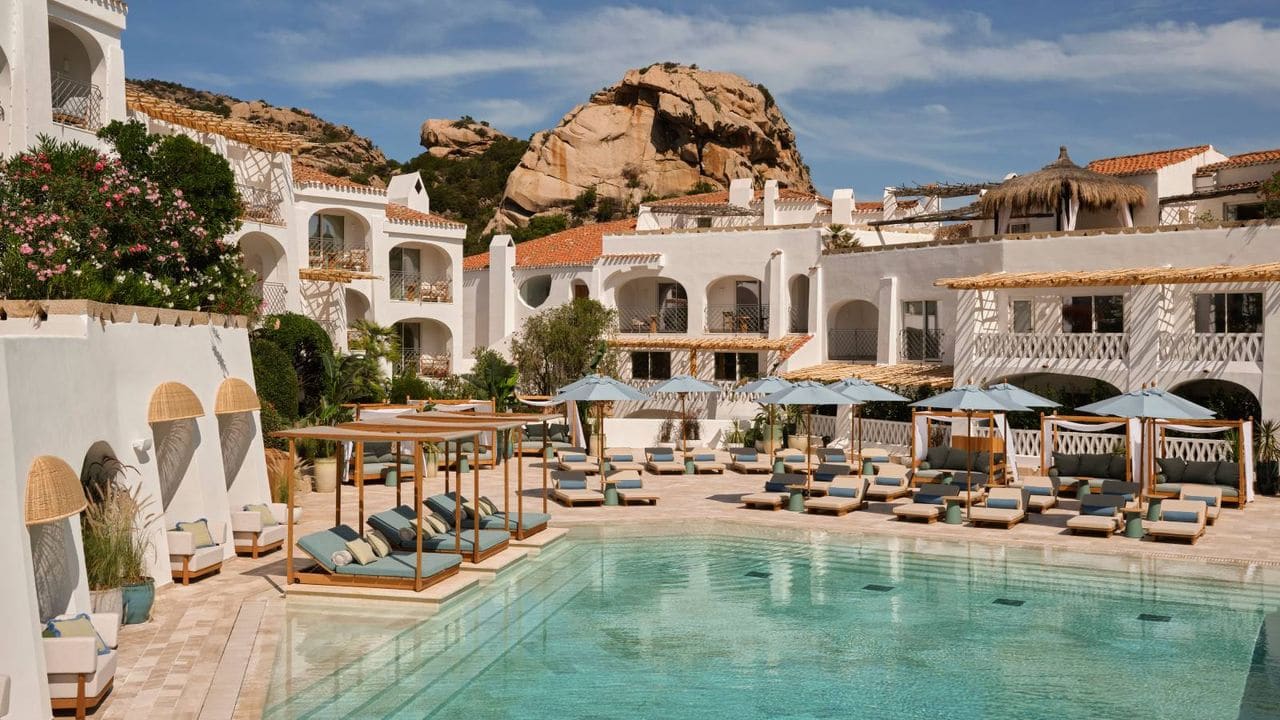
The first thing you notice, sailing toward Poltu Quatu, is that the village withholds itself. Mountains lean in close, and the port barely reveals its hand until you are almost upon it. The name translates to "hidden port," and that instinct for concealment - some old Mediterranean habit of keeping the good things out of sight - carries all the way through to the lobby of W Sardinia, where the space compresses around you before it opens, like a breath held and then released.
At Global Chic Voyage, we have watched W Hotels pivot over the years, from glossy nightclub energy to something more textured, more willing to sit still. This property, which opened this year within the bones of a resort originally designed by Jean-Claude LeSuiss in the early 2000s, signals a quieter chapter. The arches are still irregular - occhio de bue, eye of the bull, a construction headache that reads as visual poetry - and the facades still gleam white under the Sardinian sun. But the mood has shifted. There is less noise here, more myth.
A Village That Holds Its Secrets
Poltu Quatu is small enough to walk in an hour. A handful of boutique shops, a few restaurants, the kind of marina where yachts bob silently at anchor. Fifteen minutes by taxi and you reach San Pantaleo, a bohemian scatter of art galleries and Thursday street markets. We recommend the salted pistachio gelato at Il Buon Gelato, not because it is revolutionary but because it tastes like the place it comes from: mineral, slightly floral, grounded.
The sculptor Nicola Filia, whose work greets you outside the hotel entrance, keeps a gallery in San Pantaleo. His aesthetic - rough stone, organic forms, a kind of ancient minimalism - echoes the island's own Nuragic past, the Bronze Age civilization that left behind stone towers and cryptic artifacts. That thread of deep history runs through the island like an underground river, surfacing in unexpected places: in the shape of a vase, the pattern of a tapestry, the way a doorway frames the sky.
Further afield, Surrau Winery offers an afternoon of Vermentino and Cannonau against rolling vineyards. The winery itself is worth the visit for its architecture alone: wooden ceilings that feel almost Scandinavian, a long underground tunnel lined with bottles. The contrast between that northern austerity and the hot, scrubby landscape outside is part of Sardinia's charm - it borrows from everywhere and belongs only to itself.
Meyer and Davis Read the Room
Will Meyer and Gray Davis, the New York design duo behind the interiors, inherited LeSuiss's architecture and chose not to fight it. The pool stayed. The floors stayed. The arches, those maddening, beautiful arches, stayed. What they added was a narrative layer, a way of reading the space through the island's own stories.
The Janas - fairy guardians of fishermen, said to live in caves and ancient tombs - became a conceptual anchor. According to Marriott, Meyer and Davis wove this folklore into the design through materials and mood rather than literal illustration. The lobby mural in the W Lounge references these protective spirits, but subtly, as if the Janas themselves preferred to stay half-hidden.
Every interior detail was sourced locally. Luca Scassellati hand-sculpted the large art feature behind the lobby deck. Walter Usai contributed ceramic vases that feel both ancient and contemporary. Fabrizio Sanna's tapestries hang like soft geological strata. The woven carpet mimics the movement of water, a nod to the Tyrrhenian Sea a few hundred meters away. The effect is immersive without being heavy-handed - a trick that requires discipline.
Meyer described the area as "kind of mystical," and Davis noted the importance of narrative in shaping the guest experience. That storytelling impulse is evident in the way the spaces unfold. The lobby feels compressed, almost cave-like, before you step out to the Wet Deck and the horizon suddenly opens. It is a choreographed reveal, the kind of spatial sequence that good hospitality design understands: arrival, compression, release, discovery.
Rooms That Feel Like Grottoes
The hotel offers one hundred and fifty-seven rooms and suites, each one a small study in material layering. Stone cabinets with veining so pronounced they read as abstract art. Makeup vanities chunky enough to feel sculptural. Mirrors that overlap to suggest ripples on water. The suites lean into the grotto metaphor - low ceilings, textured walls, a sense of enclosure that somehow feels luxurious rather than claustrophobic.
The premier rooms come with private balconies overlooking the pool, a vantage point that lets you watch the slow ballet of poolside life without participating. The deluxe suites are more expansive: standalone tubs, separate lounging areas, vanities large enough to double as altars to self-care. In both categories, the palette is muted - sand, stone, seafoam - and the effect is soporific in the best sense. You exhale as soon as the door closes.
What strikes us, having spent time in properties across the Mediterranean this season, is how these rooms resist the current trend toward maximalism. There is restraint here, a willingness to let materials speak without amplification. It is a choice that aligns with the island's own aesthetic - Sardinia has never shouted.
Dining Between the Old Gods and the New
Tanit, the hotel's main restaurant, takes its name from the ancient goddess of abundance, a Phoenician deity who found her way to Sardinia centuries ago. The restaurant perches above the marina, and at breakfast the view competes with the food for your attention. The Dolce Room, overseen by Italian chef Fabrizio Fiorani, is a small theater of pastry: fruit tarts filled with custard, sfogliatelle that shatter at the touch, cakes that look almost too considered to eat.
Dinner skews lighter, centered on whatever the boats brought in that morning. We tried the sea bass - simply prepared, with garlic potatoes and roasted vegetables - and a dessert of frozen fruits stuffed with sorbet that tasted like summer distilled. The cocktail menu does not reinvent the wheel, but the pours are generous, almost aggressively so. Pace yourself.
Outside the hotel, the village offers Il Marchese, where you can sit outside and watch the sky turn shades of apricot and rose. The fried courgette flowers arrive impossibly light, the Matriciana pasta is textbook Roman - eighteen-month-aged pecorino romano, traditional pork cheek, nothing extraneous. It is the kind of meal that reminds you why Italian cooking endures: it knows when to stop.
Where the Island Exhales
The pool is the heart of the property, but the real sanctuary is tucked below: a sauna and steam room carved into the hillside, cave-like and dim. The architecture here mirrors the island's own topography - Sardinia is full of grottoes, natural and man-made, spaces where the boundary between inside and outside blurs.
For those who unwind through movement, the fitness center is stocked with Technogym equipment, and the hotel offers sunrise yoga sessions and guided power walks around the marina. We prefer the pool at dusk, when the light goes golden and the day's heat finally softens, but there is no wrong way to be still here.
A Softer Frequency
W Sardinia marks a deliberate departure from the brand's louder iterations. This is not the W of rooftop parties and DJ sets. It is quieter, more textured, more willing to let the place itself set the tone. Meyer and Davis have created something that feels both contemporary and ancient, a space where folklore and mid-century glamour coexist without friction.
The island has always been good at this - holding multiple stories at once, layering Greek topography with Spanish flora and Italian culture into something irreducible. The hotel follows suit. It is a retreat in the truest sense, a place that asks you to step out of time for a few days and let the rhythm slow. Sardinia has been doing this since the 1960s, when the jet set first discovered its hidden coves and white-sand beaches. W Sardinia simply translates that legacy into a language that feels relevant now: local craft, ecological mindfulness, a design vocabulary that privileges story over spectacle.
We left Poltu Quatu the way we arrived - by boat, the village receding into the mountains as if it had never been there at all. That sense of impermanence, of a place that exists slightly outside the ordinary flow of things, is what makes the experience linger. W Sardinia has learned to hold its secrets the way the island does: lightly, generously, and with just enough mystery to make you want to return.
Spot something wrong? Email editors@globalchicvoyage.com. We log every correction publicly.
RELATED
SEE ALL →
20 May 2026 / 5 min
16 Apr 2026 / 5 min
31 Mar 2026 / 5 min
26 Mar 2026 / 5 min