
Where the Desert Meets the Cosmos: Sleeping Under Dark Skies Near Bryce Canyon
A new constellation of transparent domes brings stargazing into the architecture itself, trading hotel walls for Utah's vast night canvas.
ML
8 Aug 2026 · 5 MIN READ · UPDATED 17 AUG 2026
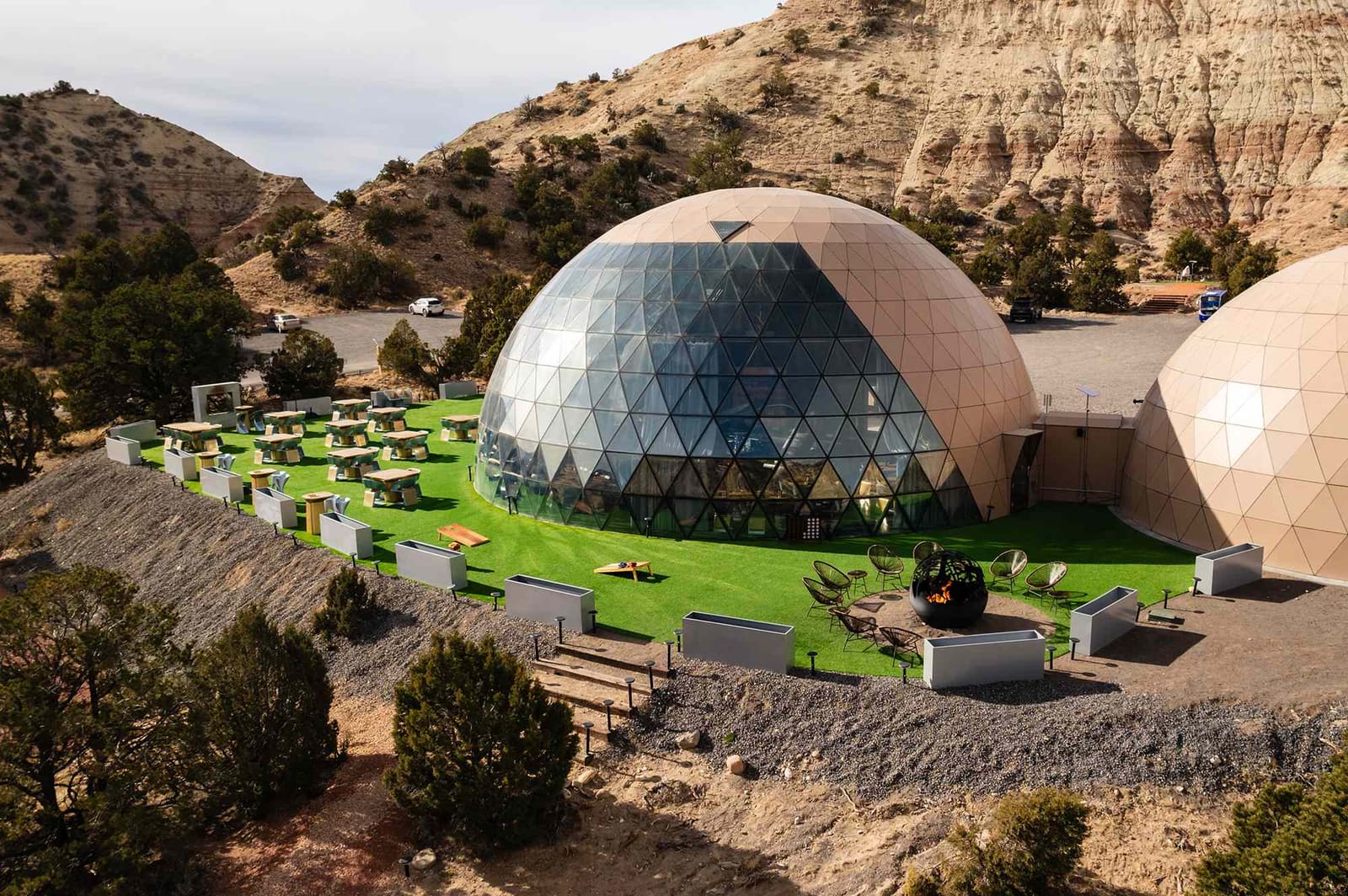
A Room With No Ceiling
There is a particular stillness that arrives in the high desert after sunset, when the last amber glow fades behind the hoodoos and the temperature drops twenty degrees in an hour. It is in this threshold moment that Clear Sky Resorts makes its argument: that the best view in southern Utah should not require stepping outside.
The property's geodesic sky domes, positioned within minutes of Bryce Canyon National Park, replace conventional hotel walls with transparent panels that frame the night sky as architecture. At Global Chic Voyage, we've watched glamping evolve from safari-tent novelty into a legitimate design category, but few properties commit so fully to collapsing the boundary between shelter and landscape. Here, the ceiling is optional. The Milky Way becomes wallpaper.
This is not metaphor. The region holds International Dark Sky certification, a designation that recognizes areas where artificial light pollution remains negligible enough for the human eye to perceive celestial structure unaided. In practical terms, it means lying in bed and watching satellites track across Cassiopeia, or waking at three in the morning to find Orion suspended directly overhead, so clear you can distinguish the nebula's faint glow without optics.
The Geometry of Immersion
The domes themselves borrow from Buckminster Fuller's mid-century fascination with tensile strength and minimal material. Their frames are polygonal skeletons, paneled in transparent acrylic that resists the desert's temperature extremes while maintaining optical clarity. Inside, the furnishings walk a careful line between comfort and restraint: platform beds oriented toward the zenith, climate control discreet enough not to hum through the silence, blackout curtains for those rare mornings when sleep matters more than sunrise.
What distinguishes this approach from earlier glamping experiments is the refusal to apologize for luxury. There is no performance of roughing it, no kerosene lamps or composting toilets presented as virtue. Instead, Clear Sky Resorts treats the desert as a setting worthy of considered design, where the goal is not to survive the landscape but to inhabit it without intrusion. The domes are climate-controlled. The linens are Egyptian cotton. The experience is immersive precisely because the infrastructure does not announce itself.
The Architecture of Darkness
We tend to think of architecture as the art of enclosure, but the sky domes function in reverse: they frame absence, curating what is not there. No light pollution. No visual clutter. No competing focal points. The design is subtractive, removing everything that might distract from the primary experience of lying beneath a sky so dense with stars that the constellations become difficult to parse.
This is rarer than it should be. According to research on light pollution, more than eighty percent of the global population now lives under skies where the Milky Way is invisible. For urban travelers, the experience of true darkness has become as exotic as any foreign destination. Clear Sky Resorts capitalizes on this scarcity, offering not just a bed in the desert but access to a vanishing resource: the night sky as our ancestors knew it, before Edison.
The location near Bryce Canyon is strategic. The park's famous amphitheaters of red rock draw two million visitors annually, most of whom arrive for the geology and leave before dark. The sky domes offer a complementary experience, one that begins when the day-trippers depart and the desert reclaims its quiet. It is a model we've seen repeated across the American West, where the same remoteness that once signaled hardship now commands premium rates.
The Performance of Stillness
There is a question worth asking: whether transparency alone constitutes connection, or whether the domes simply offer a more scenic form of separation. After all, you are still inside, still climate-controlled, still insulated from the desert's less photogenic realities - the scorpions, the cold, the wind that scours the plateau at dawn. The dome is a frame, and frames are always acts of selection.
But perhaps that is the point. Luxury travel has always been about curated access, about experiencing the sublime without the suffering. The sky domes do not pretend to dissolve the distance between guest and environment; they simply make that distance transparent, literal. You are not camping. You are not even glamping, in the old canvas-tent sense. You are occupying a viewing platform, a piece of infrastructure designed to hold you still long enough to notice what the desert has been doing all along.
And in a culture that increasingly equates travel with motion, with accumulation of sights and stamps and experiences, there is something almost radical about a property whose primary amenity is the opportunity to lie down and look up. No guided tour. No interpretation. Just the sky, rotating slowly overhead, performing the same choreography it has executed for millennia, now visible again because someone had the sense to turn off the lights.
What the Desert Teaches
We return to that threshold hour, the moment after sunset when the dome's transparency shifts from novelty to necessity. The desert does not offer its secrets to those in a hurry. It requires patience, acclimatization, a willingness to let the eye adjust to darkness and discover what appears only in the absence of glare.
Clear Sky Resorts has built its offering around this principle. The domes are not destinations in themselves but instruments, tools for paying attention. They succeed not because they are futuristic or Instagram-ready - though they are both - but because they remove the barriers, physical and perceptual, that prevent most travelers from experiencing the night sky as anything more than backdrop.
In this, they join a small but growing category of properties that treat natural phenomena as the primary draw, designing around eclipses or migrations or, in this case, the simple fact of darkness. It is a model that acknowledges what luxury increasingly means to a generation raised on screens: not more stimulation, but better stillness. Not escape from the world, but a clearer view of the one we have been missing.
Credit: Clear Sky Resorts
Spot something wrong? Email editors@globalchicvoyage.com. We log every correction publicly.
RELATED
SEE ALL →
9 Jul 2026 / 5 min
8 Aug 2026 / 5 min
8 Aug 2026 / 5 min
7 Aug 2026 / 5 min