
Where the Island's Best Tables Happen to Be in Resorts
From cliffside fire-cooked feasts to jungle-canopy rendang, Bali's hotel restaurants have quietly become destinations in their own right.
SI
7 Aug 2026 · 5 MIN READ · UPDATED 17 AUG 2026
The Myth of the Hotel Restaurant
There is a particular hesitation that comes with booking a table at a hotel restaurant. We've all been there: overlit buffets, menus that try too hard, prices that feel divorced from the plate in front of you. For years, the assumption held that stepping outside the resort gates was the only way to find a meal worth remembering.
But something has shifted across Bali's southern coasts and interior valleys. A handful of hotel kitchens have stopped playing it safe. They've hired chefs who understand the island's produce, built dining rooms that frame the landscape rather than block it, and written menus that reflect both place and ambition. At Global Chic Voyage, we've watched these restaurants become destinations in themselves, drawing diners who have no intention of checking in but every intention of staying for dessert.
What follows is not a list of where to eat when you're stuck at your resort. It's a guide to the tables we'd cross the island to reach, even if we had to leave our own hotel to get there.
Fire and Cliff in Uluwatu
The southern Bukit Peninsula has always been about drama: limestone cliffs, surging swells, sunsets that stop conversation mid-sentence. Two restaurants here have learned to match that energy without shouting.
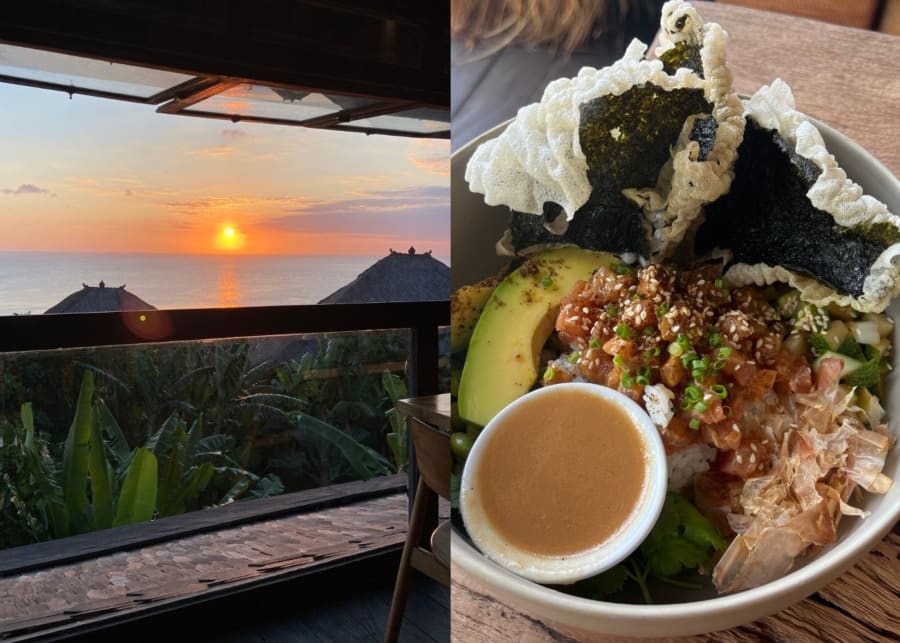
Perched above the surf breaks, one cliffside pavilion built from reclaimed teak serves food that reflects the surfer ethos, nourishing without being precious. Baja-style fish tacos arrive crispy and bright, skillet-roasted chicken comes bronzed and herb-flecked, and frittatas cater to the plant-forward crowd without apology. The real draw, though, is the evening ritual: cocktails by the pool as the horizon turns gold, then dinner at long communal tables where strangers become temporary friends. Friday sunset parties pack the space, so those seeking quieter contemplation should arrive earlier in the week.
Higher up the coast, another clifftop venue takes a more primal approach. Here, everything tastes of smoke and fire. The kitchen celebrates open-flame cooking, turning local produce into shareable plates that demand a crowd. Folded flatbreads still warm from the hearth, hummus that hasn't had time to cool, Wagyu yakitori skewers glazed and charred, whole fish that arrive looking like they've been pulled straight from the coals. Dessert is theatre: whipped chocolate mousse served inside a split cacao pod, rich enough to justify the flourish. The cocktail program alone justifies the drive south; whimsical, carefully balanced, and designed to be sipped slowly as the Indian Ocean darkens below.
The Jimbaran Equation
Jimbaran Bay has long been synonymous with beachfront seafood, but one address has refined the formula without losing the soul. The name translates to "beautiful" in Sanskrit, and the setting delivers on that promise: an infinity pool that melts into the bay, fire pits that flicker to life at dusk, and a menu that balances barbecue ease with five-star precision.
By day, it functions as a relaxed beach club where families spread out under umbrellas. By night, the space transforms. Coffee wood-smoked Wagyu short ribs emerge tender and fragrant, fusion plates layer techniques from across Asia, and the wine list runs deep. The Sunday brunch has become something of a ritual, centered on fresh seafood platters and chilled rosé, a combination that feels both indulgent and entirely appropriate for a morning spent barefoot in the sand.
Nusa Dua's Quiet Standard
One beach-facing dining room in Nusa Dua helped set the tone for Bali's fine dining ambitions more than a decade ago, and it has refused to coast on that legacy. The kitchen draws from pan-Asian traditions, filtered through Balinese ingredients and a respect for seasonality. Coral trout carpaccio is delicate and precise, Wagyu beef is handled with the reverence it deserves, and a seafood linguine has earned a loyal following among repeat guests.
The wine program has won recognition from Wine Spectator for fourteen consecutive years, a quiet testament to the care taken with every part of the experience. For those inclined toward structure, degustation menus are available at both lunch and dinner, though the à la carte offerings are strong enough to build your own progression. The Sunday brunch here begins with cocktails in a bright, minimalist bar before moving to the main dining room, where the beach provides a calming backdrop to courses that arrive with unhurried confidence.
Seminyak's Two Faces
Seminyak has always been Bali's most self-aware neighborhood, and two hotel restaurants here reflect that duality: one looking outward to the ocean, the other turning inward toward ideas.
The first is a love letter to the sea. Japanese technique meets Balinese salt harvested from Kusamba in the east, and the result is a seafood-focused menu that feels both refined and approachable. Hamachi crudo is clean and bright, dumplings are plump with seafood, and whole barramundi arrives encased in salt crust, dramatic and perfectly moist. The cocktail program follows a zero-waste philosophy, turning what other kitchens discard into garnishes, syrups, and infusions. Sunset here is a daily ritual, and the Sunday brunch has become one of the island's most reliable, pairing fresh catches with Japanese inflections.
The second restaurant occupies a geodesic dome inspired by a futurist architect who championed sustainability long before it became fashionable. The space functions as café, wine bar, and dinner destination, with a menu that shifts regularly to reflect what's available locally. Beef and oyster tartare, fish terrine, cuttlefish noodles, local cold cuts: the kitchen intervenes minimally, letting ingredients speak for themselves. The natural wine list is curated by a sommelier who treats each bottle as a conversation starter, and the space itself hosts events that blur the line between dining and cultural exchange. It's a place for those who want their meal to come with a side of ideas.
Ubud's Canopy Table
High above the Ayung River valley, a terrace restaurant at a renowned resort has perfected the balance between spectacle and substance. The view alone, treetops stretching toward distant ridges, the river a constant murmur below, would be enough to draw diners. But the kitchen, led by a chef who grew up with these flavors, has elevated traditional Indonesian cuisine without erasing its roots.
Beef rendang here is slow-cooked using sous vide before being finished with traditional herbs and spices, resulting in a texture that borders on creamy. Grilled chicken breast in opor ayam, a coconut and candlenut broth, arrives with cassava mash that feels both familiar and unexpected. The menu is an exercise in honoring heritage while embracing contemporary technique, and the service carries the polish expected from a property of this caliber. For larger groups, a family-style set menu spans regional dishes from across the archipelago, a way to experience breadth without sacrificing depth.
Pererenan's Heritage Project
In the rapidly developing stretch of Pererenan, one restaurant anchors a newer resort with a mission that feels both timely and timeless: to celebrate Indonesian heritage cuisine without diluting it for foreign palates. The kitchen doesn't shy away from heat, spice, or bold flavors. Each dish traces a thread through the archipelago's culinary history, crafted with ingredients sourced as locally as possible.
The space itself is open to the street, an invitation rather than a retreat, and the menu rewards curiosity. This is food that asks diners to meet it halfway, to appreciate complexity and tradition in equal measure. It's a reminder that hotel restaurants, at their best, can be more than a convenience. They can be a lens through which to understand the place you're visiting, a table where location and ambition converge.
What We Return For
The hotel restaurants that earn repeat visits are the ones that have stopped apologizing for being inside a resort. They've embraced their location, their resources, and their ability to offer something that standalone venues cannot: a sense of arrival without the need to leave.
Across Bali, these kitchens have found their voice. They've hired chefs who care, built dining rooms that respect their surroundings, and written menus that balance ambition with approachability. The result is a dining landscape where the question is no longer whether to eat at your hotel, but which hotel restaurant is worth planning your evening around.
Credit: Honeycombers
Spot something wrong? Email editors@globalchicvoyage.com. We log every correction publicly.
RELATED
SEE ALL →
30 Jul 2026 / 5 min
29 Jul 2026 / 5 min

27 Jul 2026 / 5 min
30 Jun 2026 / 5 min