
Where the Pacific Meets Permanence: A Season Among Big Sur's Hidden Stays
From redwood hollows to clifftop sanctuaries, the coastal stretch between Carmel and San Simeon continues to rewrite the vocabulary of American retreat.
SI
7 Jul 2026 · 5 MIN READ · UPDATED 17 AUG 2026
The Ritual of Arrival
There is a particular moment on Highway 1, just south of Carmel, when the road stops being merely functional and becomes ceremonial. The asphalt begins its serpentine climb into the Santa Lucia Mountains, and the Pacific unfolds below in impossible cobalt. Coastal redwoods punctuate the ridgeline. Waterfalls appear and vanish. You have entered Big Sur not as a destination but as a state of mind.
At Global Chic Voyage, we've watched this stretch of California coast resist the homogenizing forces that have flattened so much of American travel. Big Sur draws visitor numbers that rival Yosemite, yet it has cultivated something the national park cannot: a lodging culture that feels less like hospitality and more like temporary citizenship in a very particular republic of solitude.
The properties we return to year after year share an ethos rooted in the region's literary past. Kerouac, Nin, Thompson, and Miller didn't simply visit Big Sur; they used it as raw material for transformation. The best hotels here understand that inheritance. They offer not amenities but conditions: for contemplation, for disconnection, for the kind of boredom that precedes insight.
Clifftop Architectures
Perched on oceanfront precipices south of the village, one resort has made its reputation by treating luxury as an exercise in restraint. Its 40 accommodations, no two identical, range from cantilevered treehouses to glass-walled pavilions that seem to hover above the void. Living roofs planted with native wildflowers blur the boundary between structure and landscape. Materials are local, sustainable, chosen for how they weather rather than how they gleam.
The signature gesture here is the cliffside infinity pool, heated to body temperature, where the horizon line between water and ocean dissolves entirely. Guests describe the sensation as floating in negative space. Architecture critics have praised the property's commitment to site-specific design; it has appeared on multiple hospitality awards lists and earned recognition for both environmental stewardship and culinary ambition.
Dining unfolds as a prix fixe progression at the resort's glass-pavilion restaurant, where the kitchen works almost exclusively with producers within a fifty-mile radius. The menu changes with the seasons, but the view, framed by floor-to-ceiling windows, remains the central course: an unobstructed expanse of Pacific that on clear days seems to curve with the planet.
Daily programming includes guided nature walks, morning yoga on ocean-view decks, and access to a spa that has built its treatments around indigenous botanicals and thermal soaking. The complimentary minibar is stocked not with candy bars but with organic provisions. There is no pretense of roughing it here, only a conviction that luxury can be measured in silence as much as in thread count.
Midcentury Interlude
In Big Sur Village proper, where Highway 1 briefly flattens and the redwoods press close, a reimagined motor court offers a different proposition. Originally built in 1957, the property was rescued from decline by owners who understood that midcentury design and coastal forest are natural allies.
The accommodations split into two typologies. On one side of the highway, compact rooms feature gas fireplaces, plush bedding, and interiors that balance rustic materiality with clean-lined restraint. Across the road, freestanding cabins nestle among the trees along the Big Sur River, each with an outdoor clawfoot tub and a firepit for evening gatherings.
What distinguishes the property is its embrace of sociability. A communal firepit comes stocked with s'mores kits and half-bottles of local Pinot. Strong Wi-Fi, a rarity in Big Sur, is offered without apology. The dirt path connecting the cabins doubles as a loop trail through old-growth redwoods, terminating at swimming holes furnished with Adirondack chairs.
The on-site restaurant occupies an airy, light-filled space and serves an all-day menu of elevated comfort food: grass-fed burgers, kale Caesar salads, housemade pastries. Each morning, complimentary coffee and donuts appear in the lobby, a gesture that feels less like hospitality theater and more like genuine neighborliness.
The All-Inclusive Argument
Farther south, where the coastline steepens and the fog lingers into late morning, an upscale retreat has built its model around a single insight: that true relaxation requires the elimination of transactional friction. The property operates as an all-inclusive, folding meals, activities, and gratuities into a single rate.
Fifty-nine suites are scattered across a hillside thick with oaks, ferns, and redwoods. Interiors favor natural materials, wood-burning fireplaces, and deep soaking tubs. Each suite is provisioned with binoculars and walking sticks; the property is laced with private trails that connect ridge to riverbank to bluff.
Dining takes place at an ocean-view restaurant where the kitchen composes plates with the precision of a Kyoto kaiseki chef, though the ingredients are resolutely Californian. The deck extends over the hillside, offering sightlines that stretch to the horizon.
What sets the property apart is its programming. Daily activities range from yoga sessions set to vinyl records to wine-fueled macrame workshops. There are guided hikes, foraging walks, and evening storytelling circles around firepits. A Japanese-style bathhouse offers open-air soaking pools fed by natural springs. Personal shuttles ferry guests across the property's acreage, though most prefer to walk.
The philosophy here is abundance without overwhelm. Guests are free to participate or to disappear entirely into hammocks strung between redwoods, into the bathhouse steam, into the kind of idleness that modern life has rendered nearly extinct.
Storybook Seclusion
In a narrow redwood canyon near the village, a 1930s inn survives as an artifact of a different hospitality era. Built largely by hand by a Norwegian immigrant, the property comprises twenty rooms, no two alike, furnished with woodstoves, antique furniture, and varying degrees of modern convenience.
This is not a place for those who require soundproofing or cellular connectivity. The inn's single-wall construction means you will hear your neighbors. There is no Wi-Fi. Cell service is nonexistent. These are not oversights but features, designed to foster the kind of hushed, unplugged atmosphere that has become Big Sur's rarest commodity.
Select rooms include outdoor soaking tubs, private decks, and wood-burning fireplaces. The restaurant, candlelit and filled with Norwegian antiques, serves a menu of comforting classics: herb-roasted chicken, buttermilk pancakes, housemade soups. At the rear of the property, a fern-filled ravine conceals a small waterfall and a scattering of Buddha statues, remnants of the property's bohemian lineage.
The inn sits within walking distance of McWay Falls and the Henry Miller Memorial Library, a combination bookshop and music venue that continues to serve as Big Sur's cultural hearth. To stay here is to accept Big Sur on its own terms: beauty in exchange for inconvenience, solitude as a form of luxury.
Within the State Park
One property occupies a unique position, located entirely within Pfeiffer Big Sur State Park. The accommodations, recently renovated, are grouped in clusters around a seasonal swimming pool and feel more like duplex apartments than traditional hotel rooms. Request one with a fireplace; the differential in atmosphere is significant.
The real asset here is location. Guests receive complimentary day passes to the park, which encompasses miles of redwood trails, the sixty-foot Pfeiffer Falls, and crystal-clear swimming holes along the Big Sur River Gorge. An all-day restaurant serves outdoor diners beneath the canopy, and a camp store stocks both provisions and regional gifts.
Families gravitate to this property for its balance of comfort and immersion. Children can spend the day exploring trails and floating in the river, then return to rooms equipped with modern bathrooms and reliable heating. A campfire center offers seasonal programming, ranger talks, and evening storytelling.
The Yurt Proposition
On Big Sur's remote southern coastline, where development thins and the landscape reasserts its dominance, one resort has staked its identity on architectural experimentation. The property offers a range of hillside dwellings, all perched high above the Pacific: upscale yurts with plush bedding and gas fireplaces, a sleek 3D-printed tiny home with an ocean-view deck and soaking tub, and two architecturally striking tent structures with glass walls and expansive, firepit-equipped terraces.
The yurts, while atmospheric, lack private bathrooms; guests seeking full amenity should opt for the tiny home or tent dwellings. Dining is treated as theatre. The main restaurant operates on a prix fixe model, with wood-fired dishes sourced from the property's organic garden. A separate sushi bar offers an eighteen-course omakase experience, a surprising and ambitious gesture this far from urban supply chains.
Mornings include complimentary breakfast, housemade granola, and frittatas served family-style. A blufftop hot tub, morning yoga sessions, and nearby trails to Sand Dollar Beach and Salmon Creek Falls round out the experience. The property is entirely off-grid, powered by solar and propane, a technical achievement rendered invisible by thoughtful design.
Riverfront Simplicity
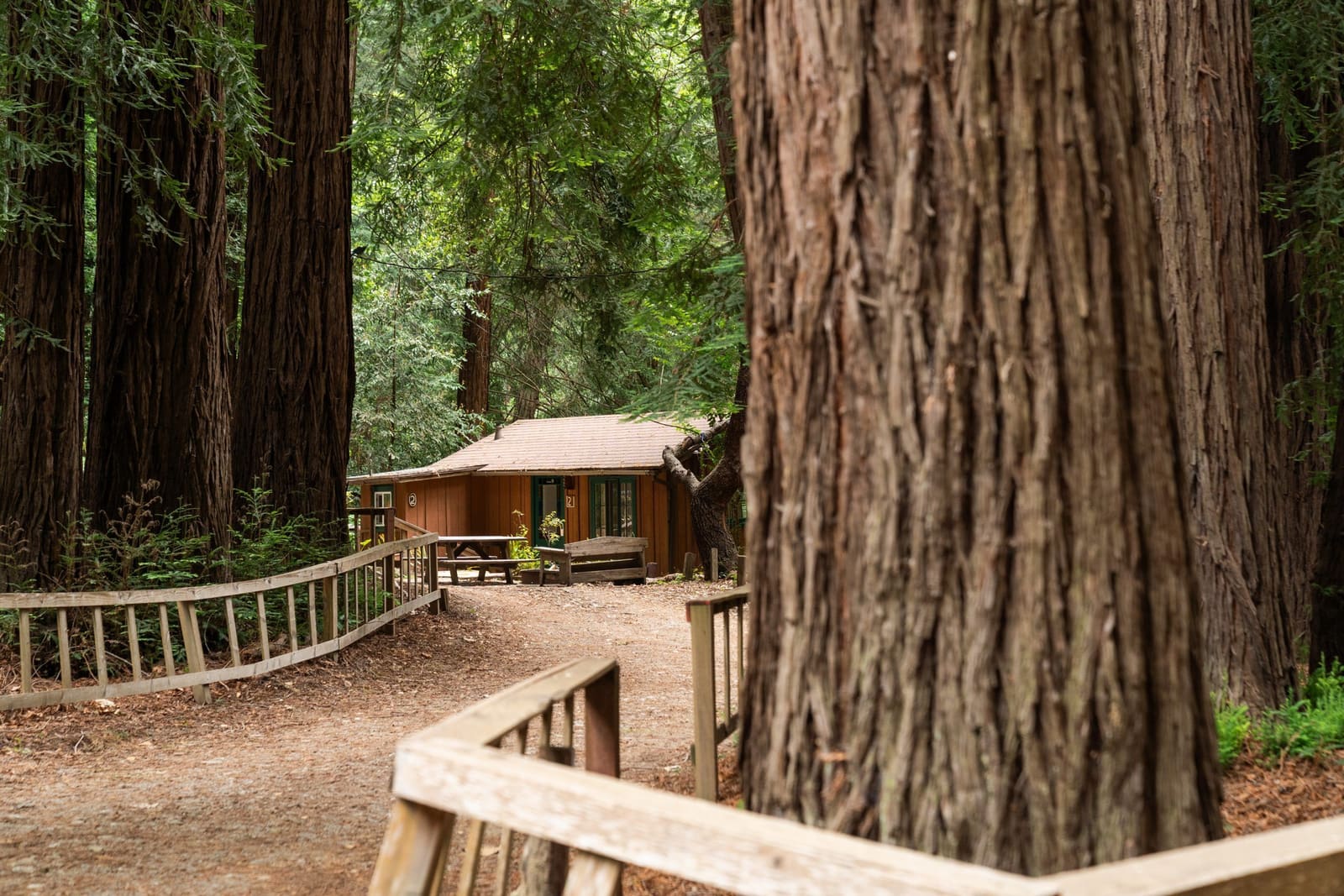
For travelers seeking the textures of camping without the logistics, a riverfront property offers twenty wood-paneled cabins warmed by potbelly stoves or fireplaces. Interiors are outfitted with organic linens and locally made body products derived from Big Sur botanicals. A French press and freshly ground coffee from a Monterey roaster are standard provisions.
The A-frame cabins, when available, include full kitchens and private decks. In warm months, guests can borrow inner tubes from the camp store and float lazily down the sun-dappled Big Sur River, a pastime that has remained unchanged for decades. The property also operates as a campground, lending it a sociable, communal atmosphere that some of the more secluded resorts lack.
The First Impression
Entering Big Sur Village from the north, one motel-style property serves as the gateway. Rooms are snug and recently updated, but the real draw is the indoor-outdoor restaurant positioned along the banks of the Big Sur River. Adirondack chairs are scattered in the shallow waters, and on warm afternoons, the scene resembles a Hockney painting: sun, wine, rippling water, bare feet.
An adjacent convenience store and deli make the property a practical base for road-trippers. It lacks the architectural ambition of its neighbors, but it understands its role: comfortable lodging for travelers who plan to spend their days elsewhere, on trails and beaches and clifftop overlooks.
What We Return For
We return to Big Sur not because it offers novelty but because it refuses it. The landscape has remained essentially unchanged since the highway was completed in 1937. The hotels, even the newer ones, seem to understand that their task is not to compete with the surroundings but to frame them, to provide just enough structure that solitude becomes bearable.
In an era when most luxury travel markets itself through accumulation, more pools, more restaurants, more programming, Big Sur's best properties practice subtraction. They remove cell service, transaction anxiety, the tyranny of choice. What remains is what the bohemian writers came for: space to think, permission to disappear, and the company of a coastline that has outlasted every attempt to tame it.
Photo: Ripplewood
Spot something wrong? Email editors@globalchicvoyage.com. We log every correction publicly.
RELATED
SEE ALL →
27 Jul 2026 / 5 min
8 Jul 2026 / 5 min
7 Jul 2026 / 5 min
2 Jul 2026 / 5 min