
A Canadian Yard Offers a Blank Canvas on a 110-Foot Catamaran
Crescent Custom Yachts is building a multihull on spec, allowing buyers to shape the interior as construction unfolds across the aluminum hulls.
MA
29 Jul 2026 · 5 MIN READ · UPDATED 17 AUG 2026
A Proposition in Aluminum and Opportunity
There is something quietly radical about a shipyard that begins building before a buyer has signed. Crescent Custom Yachts, based in Canada, has launched construction of its first CCY110 catamaran on speculation, a move that signals both confidence and a particular understanding of how yacht ownership has changed. The vessel is already taking shape in aluminum, its twin hulls rising in a facility where the usual protocol - owner first, design second, construction third - has been deliberately reordered.
At Global Chic Voyage, we have watched the catamaran market evolve from a niche preference among charter operators to a serious consideration for private owners who prize volume, efficiency, and access to shallow anchorages. The CCY110 arrives at a moment when multihulls are no longer the outlier in a harbor dominated by monohulls, but a defensible choice for those who prioritize livable space and operational economy over the singular silhouette of a traditional superyacht.
Volume Without the Draft
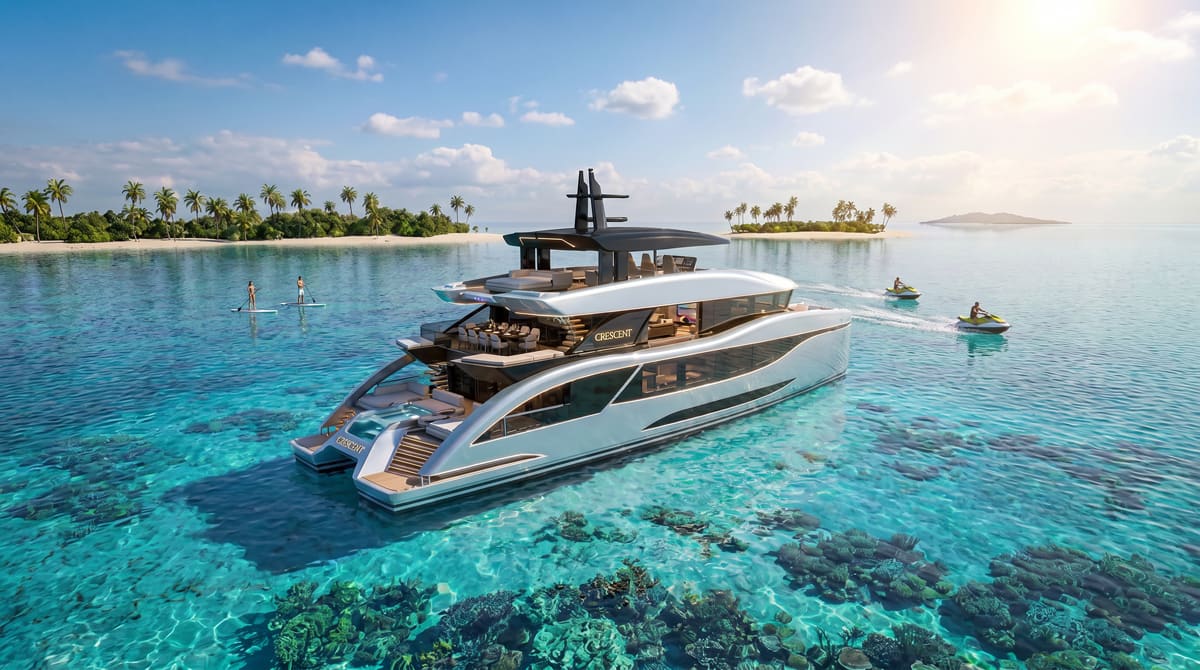
The CCY110, designed by American naval architect Joe Lazzara and engineered by Gregory C. Marshall, delivers more than 400 gross tons of interior volume across a platform that spans just over 110 feet. That translates to approximately 7,100 square feet of living and deck space, a figure that, according to Crescent, rivals what one might find on a 150-foot monohull. The comparison is not entirely rhetorical. The width afforded by a catamaran's twin-hull configuration allows for full-beam staterooms, expansive saloons, and outdoor areas that do not require the compromise typical of a narrower vessel.
The layout currently includes six staterooms, among them a primary suite that stretches the full beam. Yet the term "currently" is operative here. Because the yacht is being built on spec, prospective owners can alter the interior arrangement, select finishes, and adjust technical specifications as construction progresses. It is a model borrowed more from residential real estate than traditional yacht building, where customization usually demands a two- or three-year lead time.
The aluminum hulls also contribute to a shallow draft, a feature that extends the vessel's cruising range into waters often restricted to smaller craft. The Bahamas, the Florida Keys, and other archipelagos defined by sandbars and coral reefs become accessible in a way they are not for many yachts of comparable length. Stability is another dividend. The wide stance of a catamaran reduces roll, a quality that matters not only in open water but also at anchor, where a monohull might sway through the night.
A Beach Club That Functions as a Second Saloon
One of the CCY110's defining spaces is a 1,500-square-foot beach club, a term that has become standard in superyacht parlance but is executed here with unusual generosity. The area incorporates an open-air chef's kitchen, a plunge pool, a wellness room, and multiple lounge zones, all configured to transition seamlessly between indoor and outdoor use. Stairs descend directly to the waterline, a detail that transforms the space from a place to pass through into a destination within the yacht itself.
We have seen beach clubs treated as afterthoughts on smaller vessels, carved from leftover volume near the stern. Here, the scale and amenities suggest a different intention. The space is designed to function as a second saloon, one that privileges connection to the water over climate control and enclosure. It is a shift in how social space is conceived on a yacht, reflecting a broader trend among owners who spend more time at anchor than underway and who value the quality of that stationary experience as much as the passage itself.
Engineering for Efficiency and Simplicity
Marshall's engineering brief for the CCY110 emphasized structural efficiency and reduced complexity, goals that align with a growing segment of buyers who are wary of the maintenance burden that often accompanies custom superyachts. Lightweight aluminum construction, simplified systems, and a focus on long-term operating economy are not the romantic talking points of yacht marketing, but they are increasingly the practical considerations that determine whether a vessel remains in active use or becomes a financial liability tied to a dock.
The catamaran's twin-engine configuration also contributes to fuel efficiency, a benefit that compounds over thousands of nautical miles. While the CCY110 is not marketed as an eco-yacht, the reduced fuel consumption relative to a monohull of similar volume is a quiet nod to the operational realities that owners face once the novelty of delivery day has passed.
The Currency Advantage and the Spec Gamble
Crescent has pointed to the current exchange rate between the U.S. and Canadian dollars as an additional incentive for American buyers. With one U.S. dollar purchasing approximately 1.41 Canadian dollars, the effective cost of building in Canada is reduced by a meaningful margin. It is a factor that fluctuates with macroeconomic conditions, but at present, it works in favor of buyers willing to commit to a project that is already underway.
The decision to build on spec is not without risk for the yard. It requires capital, confidence in the design, and a belief that the market will respond to a vessel that exists in partial form rather than as a rendering on a screen. For buyers, however, the model offers an accelerated delivery timeline. Rather than waiting years for construction to begin after contracts are signed, an owner can step into a project that is already moving, shaping it as it progresses but benefiting from the momentum of a hull that is already being welded and faired.
A Shift in How Yachts Are Used
Lazzara has noted that the way owners use their yachts continues to evolve, a statement that feels less like marketing and more like an observation drawn from years of watching how vessels are actually lived on. The CCY110 is designed around social spaces that accommodate family and friends, a departure from the more formal, compartmentalized layouts that once dominated yacht interiors. The emphasis is on gathering, on spaces that invite people to linger rather than pass through.
This is not a new idea, but it is one that has gained traction as yacht ownership has become less about the vessel as status object and more about the vessel as a platform for experience. The CCY110, with its beach club, its volume, and its shallow-water capability, is calibrated for owners who prioritize where they can go and what they can do once they arrive over the optics of the yacht itself.
What Comes Next
Crescent has indicated that construction updates will be shared through its website, and the yard plans to present the CCY110 at the Fort Lauderdale International Boat Show in October. The project is still in its early stages, with hull and deck construction underway, but the outline of the vessel is already legible. It is a catamaran that borrows the volume and amenity set of a much larger yacht, built by a yard willing to begin before a buyer has committed, and designed for a market that values efficiency, access, and the quality of time spent at anchor as much as the spectacle of arrival.
For those considering a multihull, the CCY110 represents an opportunity to acquire a vessel that is already taking shape, with the flexibility to influence its final form. It is a model that may well redefine how spec builds are approached in the yacht market, particularly for buyers who are ready to move quickly and willing to work within a framework that is already in motion.
Credit: Joe Lazzara / Crescent Custom Yachts
Spot something wrong? Email editors@globalchicvoyage.com. We log every correction publicly.
RELATED
SEE ALL →
31 Jul 2026 / 5 min
25 Jul 2026 / 5 min
23 Jul 2026 / 5 min
14 Jul 2026 / 5 min