
A New River Vessel Blurs the Line Between Cruise Ship and Private Yacht
With expansive suites, multiple lounges, and a design language borrowed from the megayacht world, Connect redefines what a riverboat can be.
SI
31 Jul 2026 · 5 MIN READ · UPDATED 17 AUG 2026
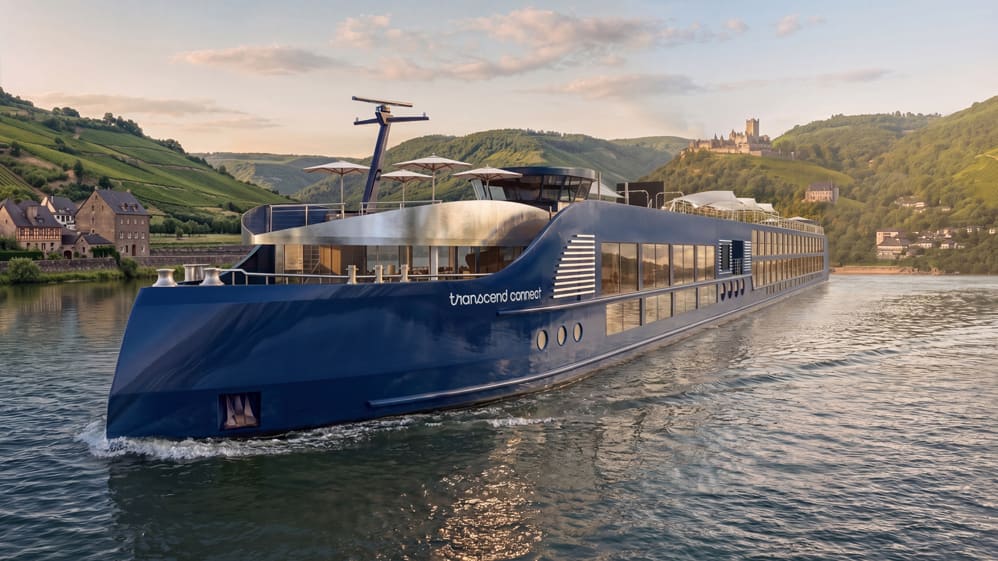
A Different Kind of River Journey
There's a moment, late afternoon on the Danube, when the light slants low across the water and you realize the vessel you're standing on feels nothing like the compact river ships that have plied these routes for decades. The proportions are wider. The ceilings higher. The glass walls stretch from floor to ceiling without interruption, framing the riverbanks as though they were gallery canvases hung for your private viewing.
At Global Chic Voyage, we've watched the river cruise sector evolve over the past few years, but the 443-foot Connect represents something closer to a philosophical shift than an incremental upgrade. Expected to launch later this year, the ship reads less like a scaled-down cruise liner and more like a floating residence designed by someone who spends their winters aboard superyachts in the Caribbean.
The Swedish design studio Tillberg Design of Sweden has conceived Connect as a vessel that borrows its spatial logic from the world of private yachts rather than from the utilitarian traditions of river navigation. The result is a ship that challenges the assumptions we've long held about what a riverboat should look and feel like.
Suites That Rethink the River Cabin
Traditional river cruise cabins are compact by necessity, their dimensions dictated by the narrow confines of European waterways and the engineering realities of shallow-draft vessels. Connect's suites, by contrast, feel as though they've been lifted wholesale from a different category of travel.
The accommodations feature separate living rooms, a design choice almost unheard of in the river cruise world. Floor-to-ceiling windows can be configured with transparent or privacy glass, allowing guests to control their relationship with the passing landscape. The interiors favor clean lines, pale wood, and a restrained material palette that reads as contemporary without tipping into coldness.
What strikes us most is the sense of horizontal space. River ships traditionally maximize vertical real estate, stacking decks to increase capacity within tight length and beam restrictions. Connect appears to have prioritized width and openness instead, creating suites where you can move freely without the constant awareness of being aboard a ship designed for narrow canals.
Public Spaces That Invite Lingering
The vessel's public areas reflect a similar design ethos. The main lounge incorporates a dance floor and piano, elements that signal a return to a more formal, evening-focused style of river travel. The aft lounge, with its floor-to-ceiling glazing and low seating, feels like the observation deck of a modern art museum, a place designed for watching the world drift past rather than for scheduled activities or group programming.
A space called the Forum functions as a flexible social hub, with tables that can be reconfigured for dining, working, or casual conversation. The restaurant includes a chef's table, a detail that suggests a culinary program with ambitions beyond the buffet model that has long dominated river cruising.
These are not spaces designed for mass-market efficiency. They are rooms that assume their occupants will want to spend time in them, that the quality of light and the comfort of the furniture and the sightlines to the water matter as much as the itinerary itself.
The Megayacht Influence
The design language throughout Connect owes more to the superyacht industry than to traditional cruise architecture. There's an emphasis on natural materials, on sightlines that extend uninterrupted through multiple rooms, on furniture that looks residential rather than institutional.
This crossover is not entirely new. We've seen yacht designers move into the cruise space before, bringing with them an aesthetic vocabulary developed for private vessels with guest lists measured in single digits rather than hundreds. But the application of that vocabulary to a river ship, with all its unique engineering constraints, represents a more challenging translation.
River vessels must contend with low bridges, shallow channels, and locks that impose strict dimensional limits. They cannot simply scale up the way ocean-going ships can. Connect's designers appear to have worked within those constraints while refusing to accept the aesthetic compromises that usually accompany them.
What This Signals for River Travel
The broader implication of a vessel like Connect is that river cruising, long positioned as a more intimate alternative to ocean cruising, may be entering a phase where intimacy is no longer its primary selling point. Instead, the emphasis shifts to design quality, spatial generosity, and a level of material refinement that aligns more closely with the expectations of travelers accustomed to private aviation and boutique hotels.
This is not a democratizing trend. A ship like Connect will almost certainly command premium pricing, appealing to a narrower audience than the established river cruise lines that fill their vessels with retirees on bucket-list European itineraries. But it does suggest that the river cruise market is differentiating, creating tiers of experience that mirror the broader luxury travel landscape.
For destinations along Europe's rivers, this evolution presents both opportunity and challenge. A more design-conscious, higher-spending clientele may demand different experiences ashore, favoring private access and bespoke programming over group tours and included excursions. The infrastructure of river tourism, from docking facilities to local guides, will need to adapt.
A Vessel Built for a New Traveler
Connect arrives at a moment when the profile of the luxury traveler has shifted. Younger affluent guests, particularly those from Asia and the Middle East, approach river cruising without the nostalgic associations that have long shaped the product. They do not necessarily want a floating hotel that happens to move; they want a vessel that feels like an extension of the design-forward, experience-rich environments they inhabit on land.
The ship's interiors reflect this shift. There is no heavy wood paneling, no nautical kitsch, no visual references to a maritime heritage that may hold little resonance for a generation of travelers raised on minimalist Scandinavian design and Japanese spatial philosophy. Instead, the aesthetic is clean, light, and deliberately neutral, a backdrop for the landscapes outside rather than a statement in itself.
This restraint is, in its own way, a luxury. It assumes that the vessel does not need to work hard to justify its existence, that the experience of gliding through the Rhine Valley or the Douro at a leisurely pace, from a suite with a separate living room and floor-to-ceiling glass, is justification enough.
The River as Canvas
What Connect ultimately offers is a different way of seeing Europe's rivers. Not as a mode of transportation between historic cities, though it certainly functions that way, but as a moving frame for a slower, more contemplative form of travel. The design of the ship supports this by making the act of observation comfortable, even luxurious, in a way that traditional river vessels do not.
We will be watching closely as Connect enters service later this year. The vessel represents a test case for whether the river cruise market can sustain a truly high-end product, one that competes not with other river ships but with the world of private yachts and exclusive resorts. If it succeeds, we may see a wave of similar vessels, each pushing further into the territory where river cruising and yachting begin to overlap.
For now, Connect stands as a singular proposition: a river ship that refuses to look or feel like one, designed for travelers who measure luxury not in amenities or service ratios but in the quality of space, light, and the uninterrupted view of the water slipping past.
Credit: Tillberg Design of Sweden
Spot something wrong? Email editors@globalchicvoyage.com. We log every correction publicly.
RELATED
SEE ALL →
29 Jul 2026 / 5 min
25 Jul 2026 / 5 min
23 Jul 2026 / 5 min
14 Jul 2026 / 5 min