
Between Flights and Belonging: Air India's New San Francisco Sanctuary
Plaza Premium Group's latest lounge at SFO reimagines the layover as a space of cultural continuity—where tarmac views meet Indian hospitality in a city built by diaspora.
ML
11 Jun 2026 · 5 MIN READ · UPDATED 17 AUG 2026
A Window Seat on Two Worlds
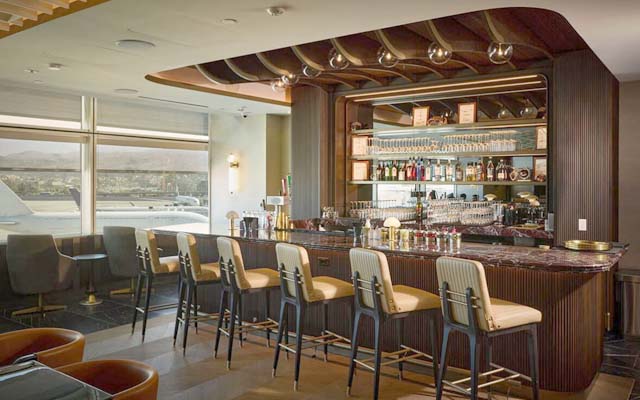
There's a particular quality to light at San Francisco International Airport in the late afternoon—the way it slants across the tarmac, gilding taxiing aircraft in gold, the Pacific visible as a steel-blue line beyond the runways. It's the light of arrival and departure both, of journeys that arc across hemispheres. In Terminal A, near Gate A1, Air India passengers now have a place to sit in that light: The Maharaja Lounge, a recent addition to the airport's international terminal that attempts something more ambitious than mere comfort. It seeks to be a threshold space—neither fully India nor fully America, but a designed pause between the two.
Plaza Premium Group introduced the lounge this month, part of a broader strategy to anchor premium hospitality at key international gateways. The timing is deliberate. San Francisco sits at the eastern edge of the Pacific Rim, a city whose identity has long been shaped by migration flows—Chinese, Filipino, Indian, Vietnamese. For Air India, whose transpacific routes connect the subcontinent to Silicon Valley and beyond, SFO represents more than a hub. It's a city where the Indian diaspora has remade entire neighborhoods, funded startups, and built institutions. A lounge here is not just infrastructure. It's a statement about who belongs in the air and on the ground.
Design as Cultural Bridge
The lounge accommodates up to 80 guests—a capacity that speaks to Air India's ambitions at this gateway rather than its current traffic. Eligibility extends to First and Business Class passengers, Maharaja Club Platinum and Gold members, and select guests through Plaza Premium Group's affiliate network. But numbers alone don't capture what the space attempts.
Inside, the design language is hybrid: Indian-inspired motifs rendered in contemporary materials, a visual grammar that avoids both sterile minimalism and heavy-handed nostalgia. There's a bar, social seating clusters, and tarmac-facing windows that frame departures as spectacle. The dining area serves both Indian and international cuisine, a culinary hedge that reflects the realities of long-haul travel. Passengers arriving from Delhi or Mumbai may crave something familiar before boarding a domestic connection; others, mid-journey, may seek variety.
At Global Chic Voyage, we've watched airport lounges evolve from afterthoughts to strategic brand assets. The best of them—Qantas's First Lounge in Sydney, Cathay Pacific's The Pier in Hong Kong—understand that transit spaces carry emotional weight. They're where exhaustion meets anticipation, where the body is suspended but the mind is already elsewhere. The Maharaja Lounge enters this lineage with a regional specificity: it must serve passengers for whom San Francisco is both destination and waypoint, a place where identity is constantly negotiated.
The Airport Hospitality Calculus
Plaza Premium Group's role here is operational but also symbolic. The company manages a global portfolio of airport lounges and passenger services, a model built on scale and standardization. Yet each lounge must also perform locality—it must feel appropriate to its setting. In San Francisco, that means acknowledging the Bay Area's Indian American community, its tech economy, its self-image as a progressive gateway.
The lounge's location near Gate A1 in the international terminal is strategic. It's positioned for maximum visibility among connecting passengers, many of whom are navigating complex itineraries between South Asia, North America, and onward destinations. The tarmac views are more than aesthetic—they're a reminder of the machinery of global mobility, the infrastructure that makes these journeys routine.
What's notable is what the lounge doesn't attempt: it's not a temple to luxury in the Emirates First Class mold, nor is it a stripped-down efficiency space. It occupies a middle register, premium but not ostentatious, culturally specific but not exclusionary. This is the hospitality calculus of a carrier rebuilding its international reputation, one lounge at a time.
Why It Matters: Infrastructure and Soft Power
Airport lounges are often dismissed as perks for the privileged, and there's truth in that. But they're also nodes in a larger network of soft power. When a national carrier opens a lounge at a foreign airport, it's claiming space—literally and symbolically. It's saying: our passengers are here, our routes matter, our culture travels.
For Air India, the San Francisco lounge arrives at a moment of institutional reinvention. The airline is modernizing its fleet, expanding routes, and attempting to compete with Gulf carriers that have long dominated India-West Coast traffic. A well-designed lounge won't win that battle alone, but it signals intent. It tells premium passengers—especially the Indian diaspora shuttling between continents—that Air India is investing in their experience, not just extracting revenue from it.
San Francisco, meanwhile, continues its evolution as a global gateway. The city's airport serves over 50 million passengers annually, many of them on long-haul international routes. As climate concerns reshape aviation and regulators debate carbon pricing, the future of transpacific travel remains uncertain. But for now, lounges like The Maharaja represent a bet on continuity: that people will keep flying, that premium cabins will remain viable, that airports will still be places where cultures collide and commingle.
Epilogue: The View from Gate A1
Late in the evening, when the fog rolls in from the Pacific and softens the runway lights, the lounge will fill with passengers in transit—some heading home, others departing. They'll sit in those tarmac-facing seats, Indian cuisine on one side of the buffet and international options on the other, and for a moment the binary will dissolve. This is the promise of well-designed transit spaces: not escape, but a kind of suspension, a pause before the next leg.
The Maharaja Lounge won't redefine airport hospitality. But it might, quietly, redefine what Air India means to the passengers who use it—proof that even in the transient architecture of airports, belonging can be designed, one lounge at a time.
Spot something wrong? Email editors@globalchicvoyage.com. We log every correction publicly.
RELATED
SEE ALL →
8 Aug 2026 / 5 min
8 Aug 2026 / 5 min
8 Aug 2026 / 5 min
7 Aug 2026 / 5 min