
Fire, Silk, and the Ghost of a Georgian Townhouse
Inside Miko Mei Fair, where Thai cooking meets Mayfair's most atmospheric dining room yet
SI
13 Jul 2026 · 5 MIN READ · UPDATED 17 AUG 2026
A Townhouse That Forgot Its Manners
There is a particular kind of hush that descends over Mayfair dining rooms after dark: the rustle of linen, the clink of crystal, the studied murmur of conversations that never quite rise above a whisper. Miko Mei Fair, which opened on Curzon Street this summer, has no interest in that hush. Step through its doors and you are met instead with the scent of charred wood, the flicker of candles against glossy timber, and the unmistakable sense that this Georgian townhouse has been handed over to something wilder.
The restaurant is the work of Samyukta Nair, the force behind a string of London establishments that includes Jamavar, Bombay Bustle, and the upstairs sibling, MiMi Mei Fair. Where MiMi leans into Cantonese elegance, Miko veers south and east, anchoring itself in the cooking traditions of Thailand while keeping one foot firmly planted in the architecture of old Mayfair. The result is a space that feels less like a new opening and more like a secret that has been hiding in plain sight, waiting for someone to light the match.
The Architecture of Appetite
At Global Chic Voyage, we have long believed that the best dining rooms are those that understand the grammar of their surroundings without being enslaved by it. Miko Mei Fair achieves this through a series of deliberate inversions. The Georgian bones remain: high ceilings, sash windows, the proportions of a townhouse built when Mayfair was still farmland. But the interiors have been reimagined with a palette that belongs elsewhere entirely.
Teal panelling rises along the walls, interrupted by sections of dark timber that catch and hold the candlelight. Red leather booths line one side of the room, their surfaces worn smooth in a way that suggests age even if the restaurant is only weeks old. Brass accents punctuate the space: handles, light fixtures, the edges of tables. Tropical wallcoverings introduce a note of exoticism without tipping into pastiche, while gold-leaf lotus motifs scattered across surfaces offer a visual echo of the cooking that emerges from the kitchen.
The Peacock Room, tucked behind folding timber screens, seats eight for private gatherings. Hand-painted chinoiserie wallpaper connects it to MiMi Mei Fair upstairs, a reminder that these two restaurants share not just a building but a sensibility: one that treats Asia not as a monolith but as a collection of distinct, intersecting culinary traditions.
Fire as Philosophy
The cooking at Miko Mei Fair is guided by Soonthorn Apaipat, whose work at Koyn Thai has earned attention for its command of robata-style grilling. Here, that technique becomes the organising principle around which the menu revolves. Fire is not simply a method but a lens through which the regional diversity of Thai cooking is refracted.
The menu moves across geographies. There is the heat of Isaan, the northeastern region where chilli and fermented fish dominate. There is the coconut richness of the South, where curries take on a depth that borders on the medicinal. And there is the balance of Central Thailand, where sweet, sour, salty, and bitter are held in careful equilibrium. Apaipat does not flatten these differences but uses the grill to draw out what is particular to each.
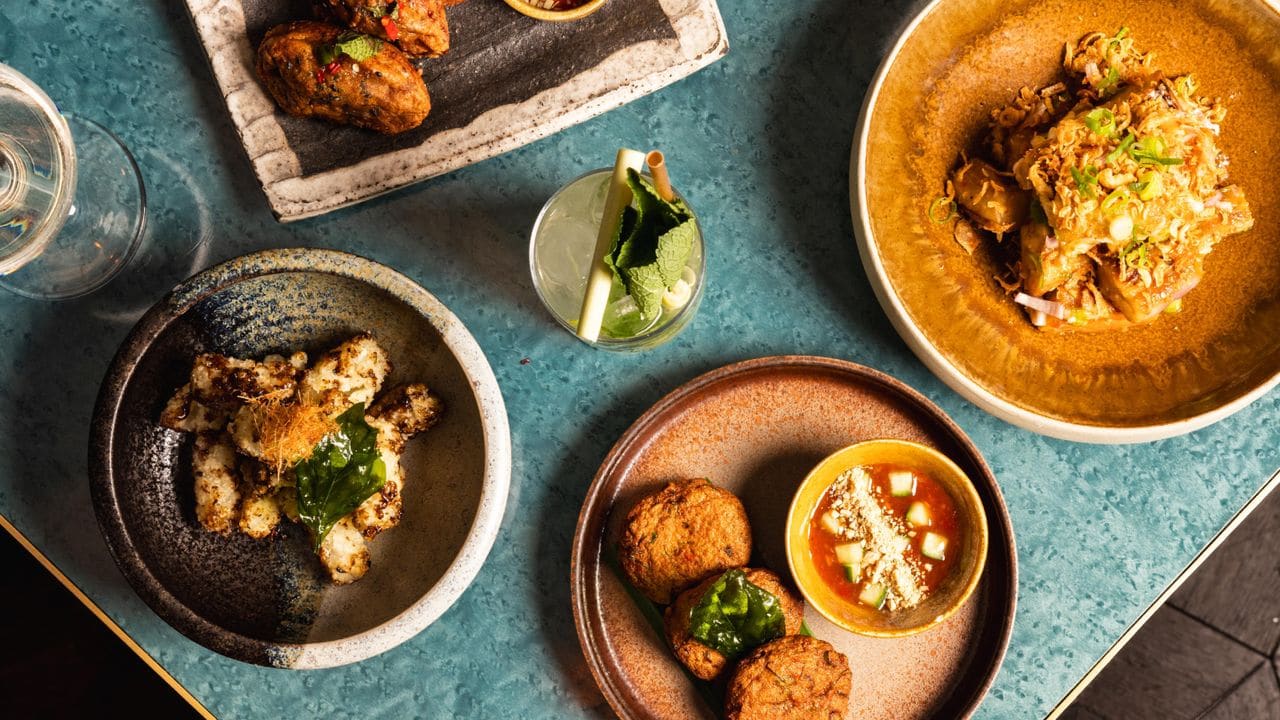
The headline offering is the Apple Wood Fire Peking Duck Penang Curry, a dish that borrows the signature duck from MiMi Mei Fair and reimagines it within one of Thailand's most beloved curry preparations. The duck is cooked over apple wood, which lends a sweetness that plays against the earthiness of the Penang curry paste. It is a dish that announces itself, both in aroma and in ambition, as something that exists between traditions rather than within them.
Elsewhere, the menu offers spring rolls filled with tofu and spring onion, their wrappers blistered and crisp. Prawns arrive with pla ra, the fermented fish sauce that is to Isaan what soy sauce is to Cantonese cooking: a foundation flavour, pungent and irreplaceable. Toasted rice beef tenderloin brings together the smokiness of the grill with the nutty crunch of khao khua, a technique that grinds roasted rice into a powder used to season meat.
The Ritual of the Table
What strikes us most about Miko Mei Fair is the way it understands dining not as a linear progression but as a ritual of accumulation. Dishes are designed to be shared, arriving in waves that build on one another. This is not the sharing of small plates, where each dish is a discrete experience, but something closer to the Thai khantoke tradition, where food is laid out in abundance and the act of eating becomes communal.
The restaurant seats fifty, a size that allows for intimacy without feeling cramped. Service is attentive but not intrusive, guided by an understanding that the pacing of a meal is as important as the food itself. Candles are replenished, water glasses refilled, dishes cleared with a timing that suggests the staff has been here far longer than the restaurant's opening date would suggest.
Drinking in Context
The beverage program at Miko Mei Fair reflects the same attention to regional specificity that defines the food. Sabai Sabai, the signature cocktail, combines Mekong rum with kaffir lime, Thai basil, and soda. It is a drink that tastes of place: the herbaceousness of the basil, the citric sharpness of the lime, the warmth of the rum all working in concert.
For those who prefer not to drink alcohol, the Akoya offers a thoughtful alternative. Cucumber, Thai basil, lychee, lime, and sparkling jasmine tea come together in a drink that is both refreshing and complex, avoiding the trap of being merely sweet. It is a reminder that non-alcoholic beverages need not be afterthoughts but can hold their own as fully realised compositions.
Why Mayfair Needs This
London's dining landscape has, in recent years, seen a proliferation of restaurants that treat regional Asian cuisines with the same seriousness once reserved for European cooking. Miko Mei Fair is part of that shift, but it also represents something more specific: a willingness to let the architecture and the cooking exist in productive tension rather than harmony.
Mayfair has always been a neighbourhood of polish and restraint, a place where dining rooms tend toward the neutral and the understated. Miko Mei Fair pushes against that tendency without rejecting it entirely. The result is a space that feels both of Mayfair and apart from it, a dining room that honours the bones of the building while insisting on its own vocabulary.
At Global Chic Voyage, we have watched as Thai cooking has moved from the margins of London's dining scene to its centre. What restaurants like Miko Mei Fair offer is not simply technical proficiency but a point of view: a belief that fire, balance, and the act of sharing are not just techniques but philosophies, ways of organising the world that extend beyond the plate. In a neighbourhood that can sometimes feel like a museum of its own history, that kind of disruption is not just welcome. It is necessary.
Photo: Miko Mei Fair
Spot something wrong? Email editors@globalchicvoyage.com. We log every correction publicly.
RELATED
SEE ALL →
13 Jul 2026 / 5 min
27 Jul 2026 / 5 min
27 Jul 2026 / 5 min
7 Aug 2026 / 5 min