
Palazzo Donà Giovannelli Opens Its Doors to the Modern Traveler
Inside Venice's newly restored 15th-century palace, where Aline Asmar d'Amman has woven together five centuries of history with a contemporary vision of lagoon luxury.
SI
14 Jul 2026 · 5 MIN READ · UPDATED 17 AUG 2026
Arrival by Water
The only proper way to arrive is from the canal. Your boat cuts through Cannaregio's waterways, past façades that have stood since the medieval era, their stone foundations emerging directly from the lagoon. At the blush-pink exterior of Palazzo Donà Giovannelli, a doorman waits at the water entrance, the threshold between the everyday Venice and something altogether more rarefied. Beyond lies a succession of frescoed ceilings, stucco work that catches the light in unexpected ways, and chandeliers from Murano that have witnessed generations of Venetian life.
At Global Chic Voyage, we've long believed that the most compelling hotels are those that refuse to choose between preservation and reinvention. This palazzo, built in 1436 during the apex of the Venetian Republic's power, has become precisely that kind of place.
A Neighborhood of Real Life
Cannaregio does not appear on postcards with the frequency of San Marco. There is no overwhelming grandeur here, no crush of tourists photographing the same angle of the same bridge. Around one corner, you might find a shop selling costume jewelry to teenagers. Laundry hangs over narrow canals. Venetians actually live in this sestiere, conducting the ordinary business of daily existence.
The Jewish Ghetto, established in 1516, occupies a central place in the neighborhood's identity. The Gothic lines of Madonna dell'Orto church cut against the sky. But when you are staying within a palace of this architectural significance, debates about location become somewhat beside the point. The building itself creates its own context.
The Architect's Vision
The palazzo's journey through time reads like a chronicle of Venetian aristocracy. After its construction in the early 15th century, it passed through the hands of noble families before evolving into one of the city's prominent cultural salons. In the middle of the 19th century, architect Giovanni Battista Meduna reimagined the interiors in neo-Gothic style. The octagonal staircase he introduced remains one of the building's defining features, along with reception rooms that seem to expand beyond their physical dimensions.
Lebanese architect and designer Aline Asmar d'Amman led the most recent transformation, a process that stretched across nearly ten years. The restoration demanded interventions that go far beyond typical hotel renovations. Foundations required drying. A dam was constructed around the façade walls. Individual stones from walls and floors were removed, treated, and reinstalled. Hundreds of artisans specialized in fresco restoration, sculpture, gilding, and woodwork contributed their expertise.
"Beyond a monument to history, I see this as a living story, where the past shapes the future," Asmar d'Amman has said of her approach. "It was important for me to honour the palazzo's history while reimagining it for the present."
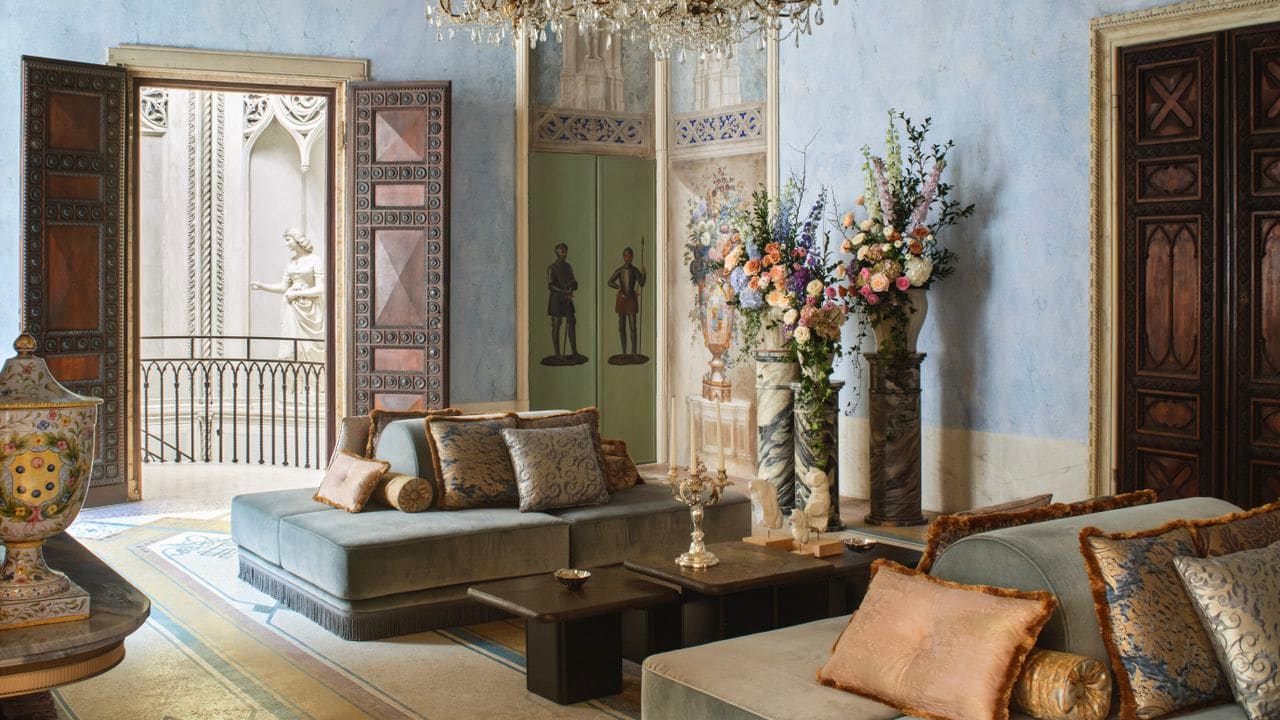
The designer resisted the impulse to create a museum. Original frescoes now share space with mirrored walls. Silk, velvet, and embossed leather meet patinated plaster and carved timber. The old stones of Venice, worn smooth by centuries of footsteps, anchor rooms furnished with pieces that belong firmly to our moment.
The Palette of Lost Colors
Asmar d'Amman's color strategy reveals itself gradually. She studied what she calls Venice's "lost colors," the saturated reds, ochres, blues, and greens that once animated the city's buildings before salt air and centuries of sunlight faded them to softer tones. Rather than attempting to resurrect those original hues, she embraced the entire spectrum of their evolution. Baby tones appear throughout upholstery, curtains, and architectural finishes, creating a chromatic story that feels both historical and distinctly contemporary.
This approach reaches its fullest expression in the public rooms. The Salone Vittoria unfolds in sorbet shades that shift with the quality of light throughout the day. The Sala della Cultura is crowned by a lapis lazuli ceiling that seems to contain all the depth of the lagoon itself. These spaces represent the restoration's most theatrical moments, rooms that understand drama without tipping into spectacle.
Where History Sleeps
The six Signature Suites compete with the public rooms for attention. The largest span 145 square meters and incorporate original details that could not be replicated today at any price. Nineteenth-century frescoes depict mythical winged figures across ceilings. Marble fireplaces occupy entire walls. Tall windows frame views of canals where the morning light arrives in shades of pearl and gold.
"I wanted guests to be touched by the grace of undying youth, while also experiencing a sense of cinematic progression," Asmar d'Amman explains. "It becomes a great discovery, where one moves through layers of history."
The Colori Persi Suite, named for those lost colors, demonstrates how the designer layers different periods of Venetian craft. The Cherubini Suite houses a 1958 Carlo Scarpa chandelier alongside a vintage Murano chess table, creating a dialogue between mid-century modernism and earlier artisanal traditions.
Standard guestrooms take a quieter approach. Finished in coffee tones and pale timber, with fretwork inspired by Ca' d'Oro (another Meduna design along the Grand Canal), they offer elegance without competing with the palazzo's more ornate spaces. Some might find them understated compared to the suites, but there is something to be said for visual respite in a building of such consistent richness.
Tables in the Palace
Two restaurants divide the dining experience. La Casati operates throughout the day, serving Venetian cooking that ranges from cicchetti to marinated beef with artichokes and creamed cod ravioli. The name references Marchesa Luisa Casati, the early 20th-century aristocrat who walked her pet leopard through Piazza San Marco, a detail that captures a certain Venetian embrace of the theatrical.
For more ambitious cooking, there is a restaurant in the restored orangerie led by three-Michelin-starred chef Heinz Beck, who applies his ingredient-focused approach to produce from the lagoon. Before or after dinner, the Wagon Bar provides cocktails in an art deco setting that gestures toward the golden age of rail travel, a subtle nod to the broader brand identity.
"A loving tension reigns between the Orient Express world, marked by the glamour of the 1930s, and a reinterpretation of Venetian living," Asmar d'Amman notes. "It embraces the duality of legacy and reinvention."
Rare Quiet in a Loud City
Perhaps the most significant luxury here is one that cannot be photographed effectively: silence. Venice's tourist center operates at a constant hum of voices, footsteps, and rolling luggage. Within the palazzo's walled garden, that noise recedes. Gardens of this scale are exceedingly rare in Cannaregio. This one has been restored with fountains, antique gates, and pathways lit by lanterns after dark.
The spa continues this philosophy of withdrawal. Drawing from Roman, Venetian, and Ottoman bathing traditions, it creates a lagoon-inspired sanctuary where water remains central to the experience, as it must be in this city.
A Question of Context
We have watched Venice struggle with the weight of its own appeal, the challenge of remaining a living city while serving as a stage set for global tourism. Palazzo Donà Giovannelli does not solve that tension, but it navigates it with unusual grace. The location in Cannaregio should not suggest compromise. Few addresses in Venice offer this combination of scale, architectural significance, and atmosphere.
The romance of the city is not manufactured here. It exists in the stones themselves, in the way light moves across frescoed ceilings, in the particular quality of silence that descends over the garden at twilight. Asmar d'Amman's contemporary interventions are executed with such care that they feel less like additions and more like natural evolutions, the next chapter in a story that has been unfolding for nearly six centuries.
In a city where so many hotels either worship the past or ignore it entirely, this palazzo has found a third way. It lives in both periods at once, honoring what came before while refusing to be trapped by it. That balance, more than any individual design detail, is what makes the experience here feel genuinely Venetian.
Photo: Giulio Ghirardi
Spot something wrong? Email editors@globalchicvoyage.com. We log every correction publicly.
RELATED
SEE ALL →
27 Jul 2026 / 5 min
17 Jul 2026 / 5 min
8 Aug 2026 / 5 min
8 Aug 2026 / 5 min