
Where the Lagoon Still Whispers: Cipriani's Torcello Inn Returns
On a forgotten island an hour from the Grand Canal, a family's first hospitality experiment has been quietly reborn - not modernized, but remembered.
SI
27 Jul 2026 · 5 MIN READ · UPDATED 17 AUG 2026
A Different Kind of Arrival
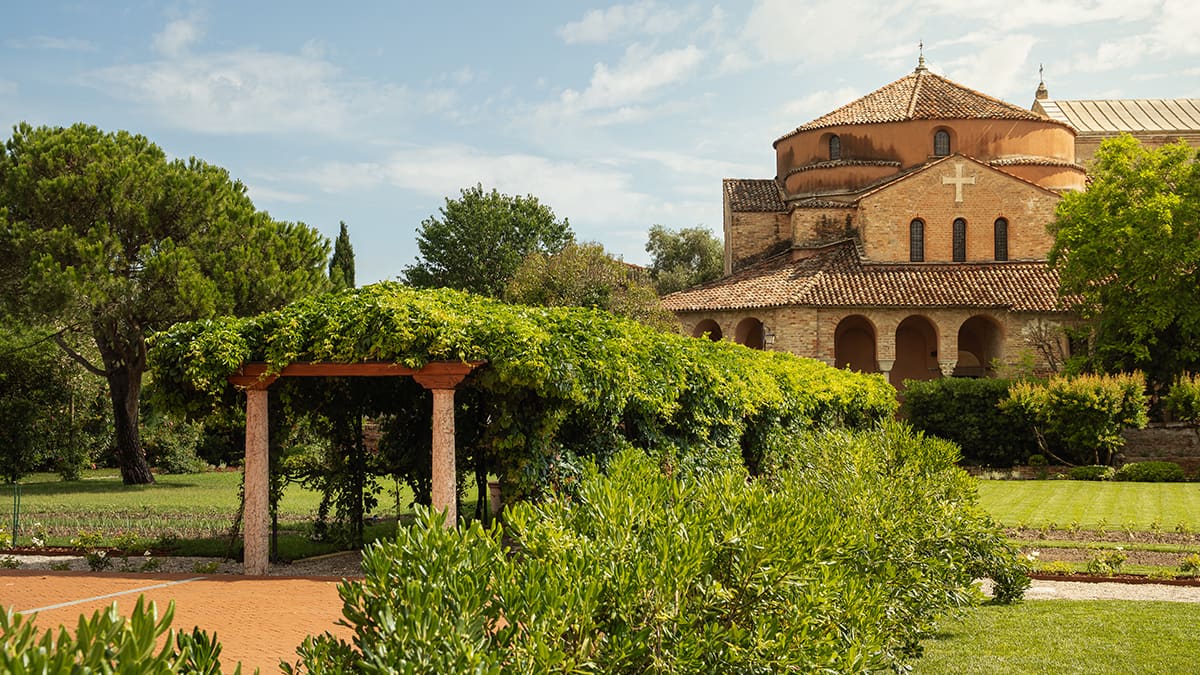
There is a particular quality to the light that falls across Torcello in the late afternoon, when the lagoon turns pewter and the Byzantine domes of Santa Maria Assunta catch the last of the sun. It is the kind of light that makes you forget you are only twenty-five minutes by boat from the crush of Venice, from the queues snaking toward the Rialto and the tour groups bottlenecking the narrow calli. Here, on this sparsely inhabited island, time moves differently. The medieval buildings stand silent. The fields stretch green. And at the edge of it all, past the ancient basilica and the vine-covered pergola, sits a modest structure that has been welcoming travelers for nearly ninety years.
This is Locanda Cipriani, the family's first real foray into hospitality - before the luxury hotel empires, before the global brand, before the white tablecloths became synonymous with a certain kind of elegance. In 1936, Giuseppe Cipriani Sr. acquired a wine shop on this remote island and, after the war, transformed it into an inn. While most visitors flocked to Venice proper, he saw something in Torcello's emptiness: a refuge, a place where privacy was not a luxury but a given. Over the decades, that vision attracted a roster of guests who sought exactly that - monarchs and novelists, musicians and prime ministers. Ernest Hemingway stayed for months, writing Across the River and Into the Trees within these walls. The locanda became legend, not through spectacle, but through discretion.
Now, after a sensitive expansion and restoration led by Fabrizio Cocchi Studio, the inn has reopened with ten rooms instead of six, four of them new suites. At Global Chic Voyage, we've watched countless historic properties struggle with the tension between preservation and reinvention, and the question is always the same: how do you honor what was without embalming it? The answer here, it seems, was to let the island itself lead.
Designing Around Silence
Giuseppe Cipriani, grandson of the founder and current head of the Cipriani Group, framed the project as an act of listening rather than imposition. The goal was not to modernize the locanda but to preserve what he calls "the soul of the place" - something rooted in its history, its setting, and the generations who have passed through. That philosophy is evident in every choice. Historic ceiling beams were painted white to lift the atmosphere without erasing their age. High-gloss wood paneling now lines the walls, paired with handblown glass fixtures from Vetreria Venier in Murano, the island known for its centuries-old glassmaking tradition. The materials are local, the craftsmanship traditional, the effect quietly luxurious.
Each of the ten rooms now includes dedicated living areas and private terraces that open onto the gardens or frame views of the nearby Basilica of Santa Maria Assunta. The scale remains intimate, almost domestic - this is not a place that aspires to grandeur. It aspires, instead, to feel like a private home where you happen to be a guest. The Murano glass fixtures cast a soft, diffused glow in the evenings, and the white beams reflect the changing light of the lagoon throughout the day. In a region where so much design leans on Venetian baroque excess, the restraint here feels radical.
The interiors, Cipriani explains, were conceived to stay in conversation with the landscape. "I wanted the interior to feel connected to the landscape, allowing the lagoon, the gardens, and the changing light to remain the true protagonists." It is a philosophy that recalls the Japanese concept of shakkei, borrowed scenery, where architecture frames nature rather than competing with it. Here, the windows are not just openings but careful edits, selecting which slice of Torcello you wake to.
The Gardens, the Bar, the Table
Beyond the guest rooms, the restoration extended to the shared spaces - the places where conviviality unfolds. A new bar counter has been installed, a gesture that nods to the family's history. It was at Harry's Bar in Venice, after all, that Giuseppe Cipriani Sr. first made his name in 1931, and every Cipriani restaurant since has featured a welcoming bar as its social anchor. Here, the bar is less about mixology theater and more about the simple ritual of arrival, of settling in with an aperitif while the boat that brought you idles at the dock outside.
The restaurant, which serves both Cipriani signatures and classic Venetian dishes, occupies the heart of the locanda. The menu draws from the lagoon - soft-shell crab, risotto with go fish, grilled branzino - and from the island's own vegetable plots, which have been replanted as part of the renovation. Roses and flowering plants now frame the property, and a vine-covered pergola supported by pink marble columns offers shade in the warmer months. The gardens, like the interiors, were not invented but restored, returned to a version of themselves that existed decades ago.
This attention to the edible landscape is more than aesthetic. It reflects a broader shift we've observed across luxury hospitality in Europe, where chefs and hoteliers are reclaiming kitchen gardens not as novelty but as necessity. At Torcello, the vegetables grown on-site become part of the daily menu, a quiet assertion that luxury need not be imported.
The Weight of a Guest List
It is difficult to write about Locanda Cipriani without invoking the names that have passed through - Queen Elizabeth II, Winston Churchill, Nicole Kidman, Elton John. The temptation is to let the guest list do the work, to suggest that celebrity proximity somehow validates a place. But the truth is more subtle. These figures came not because Torcello was famous, but because it was forgotten. They came for the same reason anyone comes: to disappear for a while.
Hemingway's months-long residency is perhaps the most emblematic. He was not here to be seen. He was here to work, to write, to sit in a room where the lagoon light shifted across the walls and the only interruptions were meals. That kind of solitude is increasingly rare, even in places that market themselves as retreats. Torcello offers it not through exclusivity clauses or NDAs, but through geography. The island is simply too far, too quiet, too empty to attract the crowds.
And yet, the locanda is not austere. It is warm, convivial, rooted in the Italian tradition of ospitalità - hospitality as generosity, not transaction. The intimacy of ten rooms means the staff know your name, your preferences, the way you take your coffee. It means dinners can stretch late into the evening without the pressure of turnover. It means the rhythm of your stay is your own.
A Counterpoint to the Grand Canal
Venice in 2026 is, by most accounts, having another moment. A wave of high-profile hotel openings and renovations has reinforced the city's status as a perennial destination, a place where luxury hospitality competes for ever-narrower slivers of waterfront real estate. The Grand Canal is lined with names - Aman, Rosewood, Belmond - each offering their interpretation of Venetian opulence. There is nothing wrong with that. But it is worth asking what gets lost when every stay is orchestrated, every view iconic, every experience curated to within an inch of spontaneity.
Torcello, by contrast, asks you to trade the iconic for the incidental. There are no gondolas here, no Tintorettos, no late-night spritz crawls through packed squares. There is a Byzantine basilica, a handful of medieval buildings, and the slow, steady lap of the lagoon against the shore. The island's population hovers around a dozen permanent residents. You walk the paths alone. You hear birds. You notice the way the wind moves through the reeds.
This is not a critique of Venice proper, which remains one of the most extraordinary cities on earth. It is, rather, an acknowledgment that proximity to greatness can sometimes obscure quieter truths. The Cipriani family understood this nearly a century ago, when they chose to invest in an island most travelers bypassed. They understood it again now, when they chose restoration over reinvention.
The Invitation to Slow Down
There is a line from Giuseppe Cipriani that captures the ethos of the place: "Torcello is a place that invites you to slow down and simply listen." It is a simple statement, almost banal in its directness. But simplicity, in this context, is the point. The locanda does not offer curated wellness programs or branded meditation apps. It offers time, space, and the kind of quiet that makes listening possible - to the lagoon, to the gardens, to yourself.
At Global Chic Voyage, we've found that the most memorable stays are often those that resist the urge to fill every hour, to optimize every moment. They are the places that trust you to find your own rhythm, to discover what it is you came for. Locanda Cipriani, with its ten rooms and its century of discretion, is exactly that. It is not a destination in the conventional sense. It is a departure - from the crowds, from the noise, from the relentless forward momentum of modern travel.
The locanda opens with rates starting around $860 per night, a figure that reflects both the intimacy of the property and the legacy it carries. You are not simply booking a room. You are stepping into a lineage of hospitality that began with a wine shop and a vision, that sheltered a Nobel laureate and countless others who sought refuge in the margins. You are, for a few days at least, part of Torcello's story - a story that has always been told in whispers, not shouts.
Credit: Locanda Cipriani Torcello
Spot something wrong? Email editors@globalchicvoyage.com. We log every correction publicly.
RELATED
SEE ALL →
14 Jul 2026 / 5 min
17 Jul 2026 / 5 min
8 Aug 2026 / 5 min
8 Aug 2026 / 5 min