
Riding Steel Through the Clouds: A Railroad Carved Into Legend
One North American rail route has earned its place among the continent's most arresting journeys, threading through waterfalls and rock face with the quiet grace of a bygone era.
ML
1 Jul 2026 · 5 MIN READ · UPDATED 17 AUG 2026
The Romance of the Rails, Rediscovered
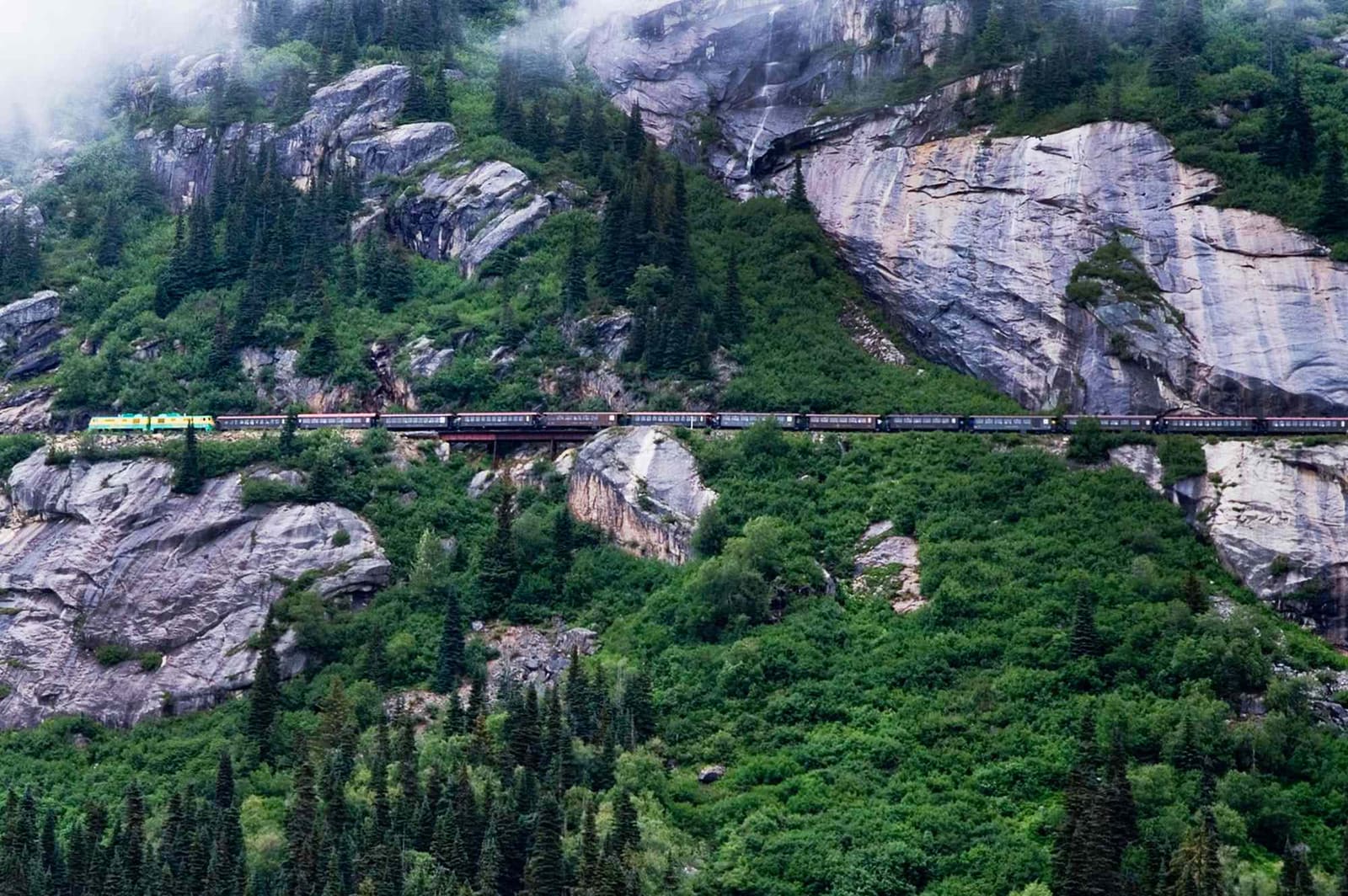
There is a particular stillness that descends when the locomotive rounds a bend and the world opens up before you: a plunge of white water, three hundred feet of cascading force, framed by the window of a moving train. It's the kind of moment that suspends conversation, that makes even the most seasoned traveler set down their book and press closer to the glass. At Global Chic Voyage, we've watched rail travel reclaim its place in the luxury landscape, not as a means of transit but as an immersive passage through terrain that remains inaccessible by road, untouched by the rush of highway culture.
One particular railroad has recently earned distinction as among the most beautiful train rides in North America, a recognition that speaks to both the drama of its geography and the enduring appeal of slow travel through wild places. The route threads through mountain corridors where rock faces rise sheer from the tracks, where waterfalls thunder down cliffsides in vertical rivers, where the forest closes in so tightly that passengers can see the texture of bark and moss as the train slips past.
This is not a journey measured in efficiency. It is measured in the quality of light on granite, in the way mist rises from the valley floor at dawn, in the silence that follows the conductor's announcement as travelers absorb the scale of what they're witnessing.
Geography as Theater
The railroad's claim to beauty rests on topography. The line was engineered through terrain that resisted settlement, that forced surveyors and laborers to carve shelf roads into vertical stone, to bridge gorges where rivers cut deep into the earth. What was once an act of audacious infrastructure has become, a century or more later, a curated experience of wilderness from the vantage point of polished wood and upholstered seats.
Waterfalls punctuate the route like exclamation points in a long, unfolding sentence. Some cascade in delicate ribbons, others in broad, roaring sheets that throw spray across the tracks. The three-hundred-foot falls that have become emblematic of the journey are visible for only a few minutes, a fleeting encounter that underscores the ephemeral nature of travel itself. You cannot pause the train, cannot linger at the vista. The landscape unfolds at its own pace, indifferent to the desires of those who pass through it.
Mountain cliffs rise in layered strata, geological history written in stone. The train hugs the contours of these formations, sometimes running so close to the edge that passengers on one side peer directly into the abyss, while those on the other side watch the rock face slide past, close enough to touch if the windows opened. It is a choreography of elevation and exposure, a dance between human engineering and the intractability of the natural world.
The Ritual of Slow Passage
What distinguishes this railroad from a scenic highway or a flight over the same terrain is the enforced slowness, the way time dilates aboard a moving train. There is no opportunity to accelerate past a dull stretch, no temptation to skip ahead. The journey imposes its own rhythm, a cadence that encourages observation rather than consumption.
We have written before about the resurgence of train travel among travelers who seek not just a destination but a process, a transition that feels meaningful. This particular route exemplifies that philosophy. Passengers do not simply arrive at the end of the line; they inhabit the hours between departure and arrival, marking time by the changing light, the shift from dense forest to open valley, the sudden appearance of a river far below.
The experience recalls an older model of travel, one that predates the compression of distance by air, when the journey itself was the substance of the story. There is something almost meditative about watching the landscape scroll past, about surrendering control over pace and direction, about allowing the railroad to dictate the terms of engagement with the terrain.
Why This Route Endures
In an era when efficiency and speed dominate travel planning, the persistence of routes like this one suggests a countercurrent, a desire for experiences that cannot be hurried. The recognition as one of North America's most beautiful train rides is not merely a marketing accolade; it reflects a broader cultural reassessment of what constitutes meaningful travel.
The railroad's beauty lies not only in the waterfalls and cliffs but in the way it frames them, in the contrast between the engineered predictability of the tracks and the wild unpredictability of the landscape they traverse. It is a route that refuses to be background, that demands attention, that rewards those who commit to the full duration of the journey rather than seeking highlights and shortcuts.
For travelers who have grown weary of the homogenization of place, of airports and highways that look the same across continents, this railroad offers specificity. The geology, the flora, the quality of light are unique to this corridor. The journey cannot be replicated elsewhere, cannot be condensed into a reel or a listicle of "must-see" moments. It must be experienced in real time, at the speed of steel on rails, with the patience required to let the landscape reveal itself.
The Future of Scenic Rail
The acclaim this railroad has received points toward a larger trend in luxury travel: the elevation of the journey over the destination, the recognition that how we move through the world shapes our experience of it as profoundly as where we choose to go. Rail routes that once served primarily functional purposes are being reconsidered as experiential offerings, with operators investing in service, comfort, and storytelling that contextualize the landscapes passengers traverse.
This particular line has benefited from that shift. While the tracks and the terrain remain largely unchanged, the framing of the experience has evolved. Passengers now board with an awareness of the route's distinction, with expectations shaped by its reputation. The railroad has become not just a means of crossing the mountains but a destination in its own right, a journey undertaken for its own sake.
At Global Chic Voyage, we expect to see more routes receive similar recognition as travelers continue to seek out experiences that prioritize presence over speed, that offer immersion rather than efficiency. The waterfalls and cliffs will remain, but the cultural appetite for engaging with them through slow, deliberate passage is only growing.
The train departs on schedule, indifferent to trends and accolades. It climbs into the mountains, hugs the cliffs, passes beneath the waterfalls. And for those aboard, the world outside the window unfolds as it has for generations: beautiful, indifferent, and utterly specific to this one ribbon of steel through the wilderness.
Photo: dani3315 / Getty Images
Spot something wrong? Email editors@globalchicvoyage.com. We log every correction publicly.
RELATED
SEE ALL →
13 Jul 2026 / 5 min
8 Jul 2026 / 5 min
27 Jul 2026 / 5 min
27 Jul 2026 / 5 min