
Seven New Luxury Hotels Worth the Journey in 2026
From a rhino reserve in Kenya to a reimagined icon in Athens, this year's openings span continents and offer distinct experiences for travelers who value design, place, and purpose.
ML
10 Jul 2026 · 5 MIN READ · UPDATED 17 AUG 2026
The Year's Defining Arrivals
There is a particular kind of anticipation that comes with watching a hotel take shape in a city or landscape you thought you already knew. At Global Chic Voyage, we've been tracking this year's openings with unusual interest, not for their novelty alone but for what they suggest about the direction of contemporary luxury travel. The properties that have captured our attention share a commitment to place, a respect for design as narrative, and an understanding that the best hotels are not monuments to excess but carefully calibrated experiences that honor their surroundings.
What follows is not a comprehensive survey but a selection of seven properties that represent, in our view, the most compelling arguments for travel in 2026. Some occupy landscapes of extraordinary natural beauty. Others inhabit urban contexts where history and modernity negotiate their relationship in real time. All reward the journey.
A Baroque Canvas in Lisbon
The Andaz Lisbon, which opened its doors in April, occupies a prime position in the city's Baixa district, where baroque architecture frames one of Europe's most dramatic public squares. According to Hyatt, the property features 170 accommodations, many with views across Praça do Comércio toward the Tagus River.
The interiors lean into Portugal's material heritage without tipping into pastiche. Cork wood, a nod to the country's centuries-old cork industry, appears as wall cladding and accent paneling. Velvet upholstery in deep jewel tones balances the restraint of whitewashed walls. At Luzzi, the hotel's main dining room, the menu draws from Lusitanian tradition with an emphasis on small plates and the kind of seafood that arrives daily from the Atlantic.
Lisbon has long been a city that rewards slow exploration, its hills and miradouros demanding a certain pace. The Andaz seems designed for travelers who understand this rhythm, who will use the hotel as a base for wandering the Alfama's narrow lanes or taking day trips north into wine country. Rates begin at three hundred eighty dollars per night.
Conservation and Comfort at Mount Kenya
When the JW Marriott Mount Kenya Rhino Reserve opens in July, it will join a small but growing roster of safari properties that prioritize conservation as much as guest experience. The camp sits within Solio Game Reserve, a privately managed area known for its success in protecting both black and white rhinoceros populations. According to Marriott, the reserve also supports leopards, cheetahs, and a variety of plains game.
The property comprises twenty tented suites, each exceeding fourteen hundred square feet when indoor and outdoor spaces are combined. Private plunge pools allow guests to cool off between game drives. The inclusion of four restaurants and bars, including a dedicated vegetarian venue, reflects a more varied approach to safari dining than the traditional bush camp model typically permits.
Safari travel has become more nuanced in recent years, with operators and guests alike paying closer attention to the ecological and social impact of tourism in fragile ecosystems. Properties that integrate directly with conservation initiatives, as this one does, represent a shift away from the purely extractive model of wildlife viewing. Rates begin at two thousand two hundred twenty-three dollars per night based on double occupancy.
Kuala Lumpur's Vertical Ambitions
The Malaysian capital has been experiencing a pronounced hotel expansion, driven in part by the success of high-altitude properties that capitalize on the city's striking skyline. The Waldorf Astoria Kuala Lumpur, accepting reservations for stays beginning January 2027, will occupy space in the Golden Triangle, the district that serves as the city's commercial and entertainment core.
According to Hilton, the hotel will offer two hundred seventy-two suites, each starting at eight hundred sixty square feet. The decision to make every accommodation a suite reflects a broader trend toward residential-style hotel design, where the boundaries between living and sleeping areas blur and bathrooms become destinations in their own right, complete with freestanding tubs and separate rain showers.
The dining program includes three concepts developed by Jean-Georges Vongerichten, whose global portfolio has long balanced innovation with approachability. Indian cuisine will be overseen by Garima Arora, whose Bangkok restaurant Gaa earned a Michelin star for its inventive take on subcontinental flavors. Istana, named for the Malay word for palace, will interpret royal banquet traditions for contemporary tastes. Rates begin at five hundred forty-five dollars per night.
Boutique Intimacy in Turks and Caicos
Grace Bay Beach has earned its reputation through consistency: clear water, fine sand, and a protected marine environment that supports snorkeling and diving. The Hotel Indigo Turks and Caicos, which opened in March, brings a boutique sensibility to a stretch of coastline often dominated by larger resorts.
With just fifty-six rooms and suites, the property operates at a scale that allows for a degree of personalization rarely found in Caribbean beachfront hotels. According to IHG, the design vocabulary draws from coastal vernacular, with pastel tones and shell-inspired motifs that reference the surrounding marine environment without veering into literal interpretation.
The hotel's Italian-Caribbean restaurant reflects the archipelago's multicultural culinary influences, where European technique meets island ingredients. A courtyard infinity pool provides an alternative to the beach for guests who prefer fresh water or simply want a change of scenery. Rates begin at two hundred ninety-four dollars per night.
Costa Rica's Pacific Promise
Costa Rica's Guanacaste region has become a focal point for luxury development along the country's Pacific coast, where dry tropical forest meets volcanic beaches. The JW Marriott Costa Elena Resort and Spa, scheduled to open this fall, will occupy a sizable footprint with four hundred fifteen rooms and suites.
According to Marriott, the property will include the Griffin Club, a hotel-within-a-hotel concept offering dedicated facilities, butler service, and exclusive beach access. This tiered approach to resort design has become increasingly common at larger properties, allowing operators to serve different guest segments within a single development.
The sixteen-thousand-square-foot spa and eleven dining venues suggest an experience oriented toward extended stays, where guests can settle into a rhythm of beach time, spa treatments, and varied dining without needing to leave the property. Menus will span Costa Rican, Japanese, Italian, and seafood-focused concepts. Rates begin at five hundred eighty dollars per night.
Athens Reimagined
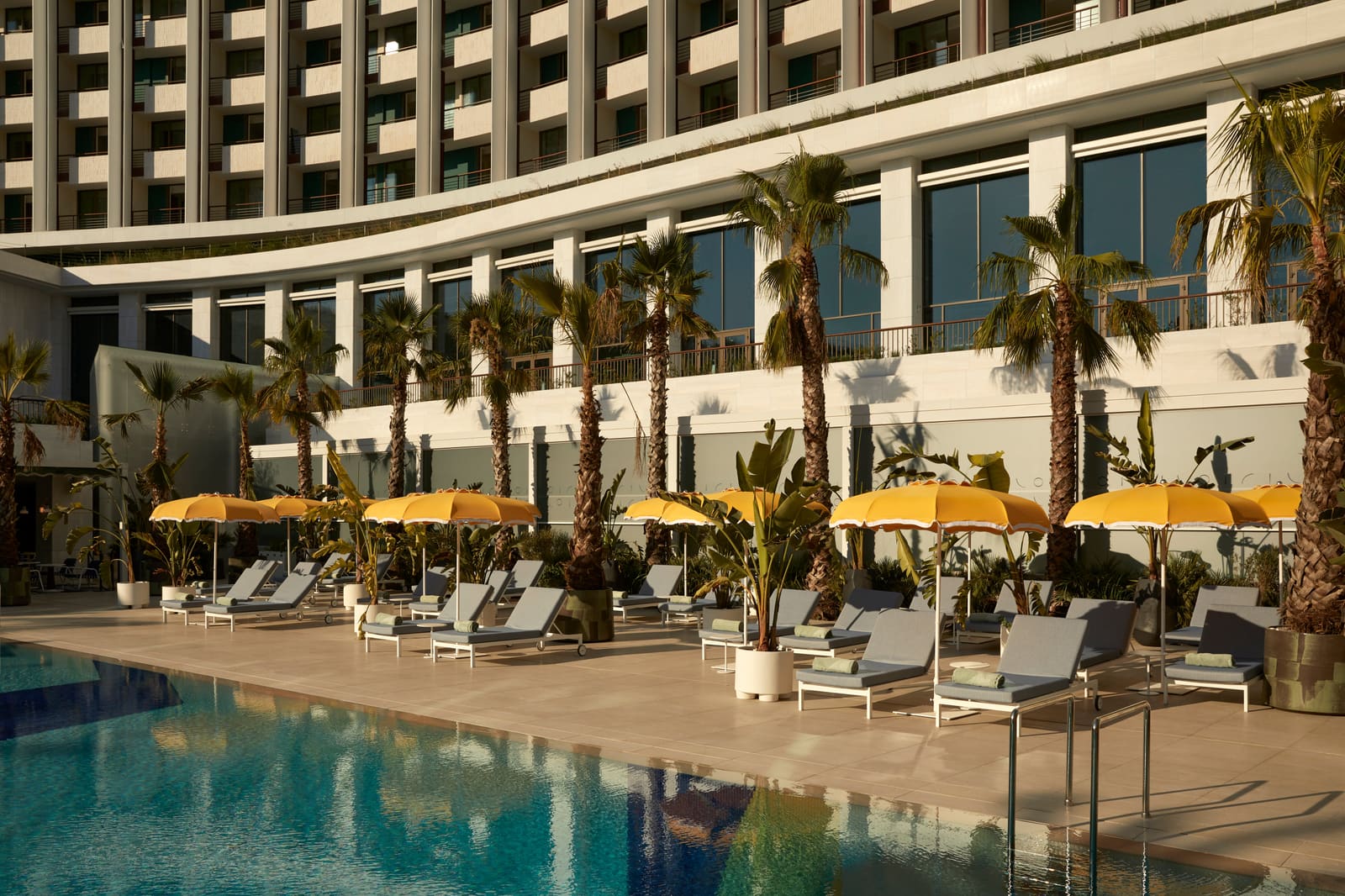
The Conrad, The Ilisian Athens represents a particular kind of transformation: the reinvention of an existing landmark into something that honors its history while serving contemporary expectations. The property, which opened in April, occupies the site of the former Hilton Athens, a building that first welcomed guests in nineteen sixty-three.
According to Hilton, the redesigned hotel contains two hundred seventy-eight rooms and suites, many with views toward the Acropolis or Lycabettus Hill. AvroKO, the design firm behind the interiors, pursued a minimalist aesthetic that allows the views and the building's inherent scale to take precedence over decorative flourishes.
The wellness complex includes a longevity clinic, a concept that reflects growing interest in preventive health and personalized wellness protocols. Indoor and outdoor pools, a spa, and dedicated treatment areas suggest a property designed for guests who view travel as an opportunity for physical and mental recalibration. Dining options include Byzantino, a French-Greek brasserie, and Onuki, a Japanese restaurant with poolside seating and an extensive sake selection. Rates begin at four hundred fifty dollars per night.
Cape Town's Waterfront Evolution
The V&A Waterfront in Cape Town has evolved from a working harbor into one of the city's most visited mixed-use developments, combining retail, dining, and hospitality with ongoing maritime operations. The Cape Town Edition, scheduled to open in September, will be among the latest additions to this evolving district.
According to Marriott, the property was designed by Shanghai-based Neri & Hu in collaboration with local firm StudioMas. The collaboration between international and South African architects suggests an attempt to balance global design language with regional context. The hotel will contain one hundred forty-two rooms and suites, with six residential units planned as part of the development.
Edition Hotels have established a recognizable aesthetic across their portfolio: neutral palettes, natural materials, and restrained detailing that allows location and light to define each space. A rooftop bar will offer views toward Table Mountain, the geological formation that anchors Cape Town's identity. A spa and pool round out the amenities.
Cape Town remains one of the world's most compelling urban destinations, where dramatic topography, complex history, and contemporary creativity coexist within a compact geographic area. The addition of another well-executed hotel only strengthens the city's appeal for travelers seeking substance alongside comfort.
The Broader Pattern
Taken together, these seven properties suggest several themes shaping luxury hospitality in 2026. There is a continued emphasis on conservation and sustainability, particularly in ecologically sensitive areas like safari reserves and coastal zones. Urban properties are growing more ambitious in their wellness offerings, moving beyond standard spa facilities toward comprehensive health programming. And across categories, there is a recognition that travelers increasingly value authenticity of place over generic luxury, that the best hotels are those that could exist nowhere else.
We will be watching these properties closely as they mature beyond their opening seasons, as the initial polish gives way to the patina of daily operation. The true measure of a hotel is not how it photographs in its first months but how it performs over years, how it integrates into its community, and whether it earns the loyalty of travelers who return not out of convenience but conviction.
Photo: CONRAD ATHENS, THE ILISIAN
Spot something wrong? Email editors@globalchicvoyage.com. We log every correction publicly.
RELATED
SEE ALL →
8 Aug 2026 / 5 min
18 Jul 2026 / 5 min
13 Jul 2026 / 5 min
22 Jun 2026 / 5 min