
The Mansion That Remembers When Hotels Were Private Affairs
Inside the 28th Street property where a 19th-century residence still whispers its original purpose
CG
22 Jul 2026 · 5 MIN READ · UPDATED 17 AUG 2026
When Hotels Lived in Houses
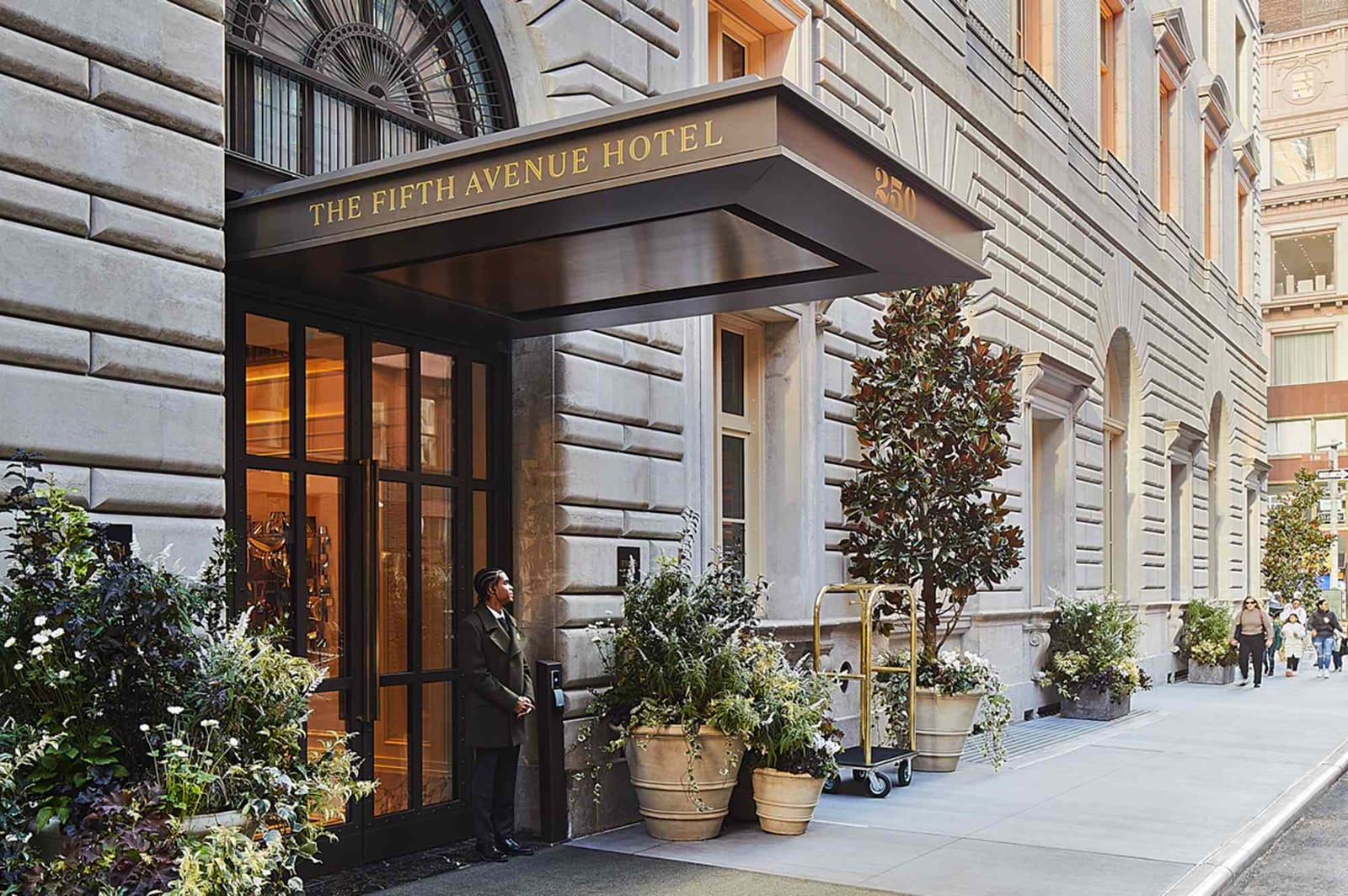
There is a particular quality to entering a building that was never meant to welcome strangers. The Fifth Avenue Hotel, set within a 19th-century mansion on 28th Street, carries that quality still. Its threshold does not announce itself with revolving doors or bellmen in formation. Instead, you step into what feels like an inheritance: rooms that remember their first lives as parlors and libraries, hallways that once belonged to a single family's daily rituals.
At Global Chic Voyage, we've watched the luxury hotel industry wrestle with intimacy for years, attempting to manufacture the feeling of home through ever-smaller properties and ever-softer adjectives. Yet most of these efforts betray themselves the moment you cross the lobby. The Fifth Avenue Hotel solves this differently. It begins with architecture that was domestic from birth, then asks hospitality to adapt to the bones rather than the reverse.
The property holds 153 guest rooms within its historic shell, a number that seems improbable until you understand how the mansion's original floor plan has been preserved rather than gutted. Corridors turn at unexpected angles. Ceiling heights shift between floors. Windows overlook interior courtyards that were designed for privacy, not for views. These are not affectations added during renovation; they are the structural memory of a building that once housed a single household and its attendant rhythms.
The Geography of Restraint
Twenty-Eighth Street sits in that stretch of Manhattan where the grid loses some of its commercial urgency. North of Madison Square, south of the frenetic midtown corridors, the neighborhood retains a scale that predates the skyscraper. The Fifth Avenue Hotel's location is less about proximity to landmarks than about existing within a pocket of the city that still permits a slower pace.
This matters more than it might seem. A mansion hotel in the Financial District would feel like cosplay. On 28th Street, surrounded by mid-rise buildings and storefronts that change hands every decade rather than every season, the property can afford to behave as though it never stopped being a private residence. The street itself asks for no performance.
We've noticed that the most successful adaptive-reuse hotels share this quality: they occupy neighborhoods that allow them to remain legible. A Gilded Age mansion in a Gilded Age-scale district. A warehouse in a district of warehouses. Context, in these cases, is not backdrop but permission structure.
Dining as Domestic Ritual
The hotel's French-Italian restaurant operates without a name that announces its culinary ambitions in bold serif. This is not an oversight. The dining room functions more as the mansion's original function would suggest: a space where meals happen because households require feeding, not because a restaurant concept demands an audience.
French-Italian cuisine, when done with restraint, allows for exactly this kind of understatement. It is a culinary vocabulary rooted in technique rather than theater, in ingredients that require little introduction. The menu here, we understand, shifts with the seasons in the manner of a household kitchen responding to what the market offers, rather than a restaurant chasing trends or Michelin validation.
This approach to dining reflects a broader philosophy that runs through the property. Luxury, in the mansion-hotel model, is not about abundance or spectacle. It is about precision, about things done exactly as they should be, without the need to explain themselves. A well-set table. A dish that arrives at the correct temperature. Silverware that balances properly in the hand. These are not innovations; they are standards that predate the modern hospitality industry and its metrics.
The Bar as Drawing Room
Adjacent to the restaurant, the hotel's bar occupies what might once have been a drawing room or library. The space retains the proportions of a room meant for conversation rather than consumption. Seating is arranged in clusters that suggest private gatherings, not solo drinking or networking.
This design choice reflects an understanding that has been largely lost in contemporary hotel bar design: the bar in a private home was never the destination. It was the pause between activities, the place where guests assembled before dinner or lingered after. The Fifth Avenue Hotel's bar returns to that logic. It is chic in the way that well-maintained private spaces are chic, through care rather than concept.
The drink menu, predictably, avoids the craft-cocktail pyrotechnics that have become shorthand for upscale hotel bars. Instead, it offers classics executed with precision, plus a wine list that skews French and Italian in deference to the restaurant's orientation. This is not conservatism; it is coherence. A mansion built in the 19th century, housing a French-Italian kitchen, pouring Negronis and Martinis without apology. The logic holds.
Rooms That Remember Their First Purpose
The 153 guest rooms distribute themselves across the mansion's multiple floors with none of the uniformity that defines purpose-built hotels. Some rooms are larger, some smaller. Some have fireplaces that no longer function but remain as architectural punctuation. Others have windows that frame slices of neighboring buildings rather than sweeping views.
This irregularity is the point. A mansion was never designed to house strangers equitably. Its rooms reflected hierarchy, function, and the idiosyncrasies of the family that commissioned it. The Fifth Avenue Hotel has preserved these distinctions rather than sanding them away. The result is a property where returning guests develop preferences not based on square footage or amenities, but on the specific character of individual rooms.
We've stayed in enough boutique hotels to recognize when irregularity is a design affectation versus when it is a structural inheritance. The Fifth Avenue Hotel's rooms feel like the latter. The moldings are original, not reproductions. The floor plans are dictated by load-bearing walls, not by maximizing the number of keys per floor. This creates occasional inconveniences: a bathroom that feels too small, a closet tucked into an awkward corner. But it also creates authenticity, which is a commodity far more scarce than convenience.
What Repetition Reveals
The Fifth Avenue Hotel has now held its ranking as a top New York City property for two consecutive years, a detail that suggests more than temporary acclaim. Repeat recognition of this kind indicates that travelers are responding not to novelty but to consistency, to a property that understands what it is and executes that vision without drift.
In an industry that often mistakes reinvention for relevance, this kind of steadiness is radical. The hotel has not, as far as we can observe, launched a new concept restaurant, rebranded its bar with a celebrity mixologist, or announced a partnership with a wellness guru. It has simply continued to operate as a 19th-century mansion that happens to accept paying guests, which is a more difficult proposition than it sounds.
The challenge of the mansion hotel is that it cannot scale. It cannot replicate itself in other markets or expand to accommodate more rooms. Its appeal is inseparable from its specific architecture, its specific location, its specific history. This makes it a poor investment by conventional hospitality metrics, but a compelling one by the standards of travelers who have exhausted the sameness of even the most upscale hotel chains.
The Luxury of Not Performing
What we return to, in considering The Fifth Avenue Hotel, is the question of what luxury means when stripped of performance. The property does not offer a rooftop bar with panoramic views. It does not have a spa with Himalayan salt rooms or a lobby designed for Instagram. It does not promise transformation or transcendence or any of the other abstractions that luxury hotels have borrowed from wellness culture.
Instead, it offers something simpler and more elusive: the feeling of being a guest in a private home where everything has been attended to without needing to announce that attention. Rooms that are cleaned but not fussed over. Meals that are excellent without being experimental. Service that is present without being intrusive.
This is the luxury that existed before luxury became a category of commerce. It is what wealthy families practiced in their own homes, not because they were performing for guests, but because they understood that comfort and beauty and precision were their own rewards. The Fifth Avenue Hotel has managed to translate that ethos into a commercial enterprise without losing the thread of what made it valuable in the first place.
For travelers who have begun to suspect that modern luxury hospitality has lost its way in the pursuit of novelty and scale, this mansion on 28th Street offers a quiet counterargument. Hotels do not need to be spectacles. They need to be exactly what they are, without apology or embellishment. The Fifth Avenue Hotel remembers this, and in remembering, it offers something that feels increasingly rare: a place to stay that does not ask you to perform your own stay.
Credit: The Fifth Avenue Hotel
Spot something wrong? Email editors@globalchicvoyage.com. We log every correction publicly.
RELATED
SEE ALL →
17 Jul 2026 / 5 min
15 Jul 2026 / 5 min
30 Jul 2026 / 5 min
30 Jul 2026 / 5 min