
The Palace on the Mountain: How St. Moritz's Most Storied Hotel Reimagined Itself
After welcoming the likes of Coco Chanel and Alfred Hitchcock for over a century, Badrutt's Palace unveils a new wing that honors its legacy while embracing the future of alpine hospitality.
SI
27 Jul 2026 · 5 MIN READ · UPDATED 17 AUG 2026
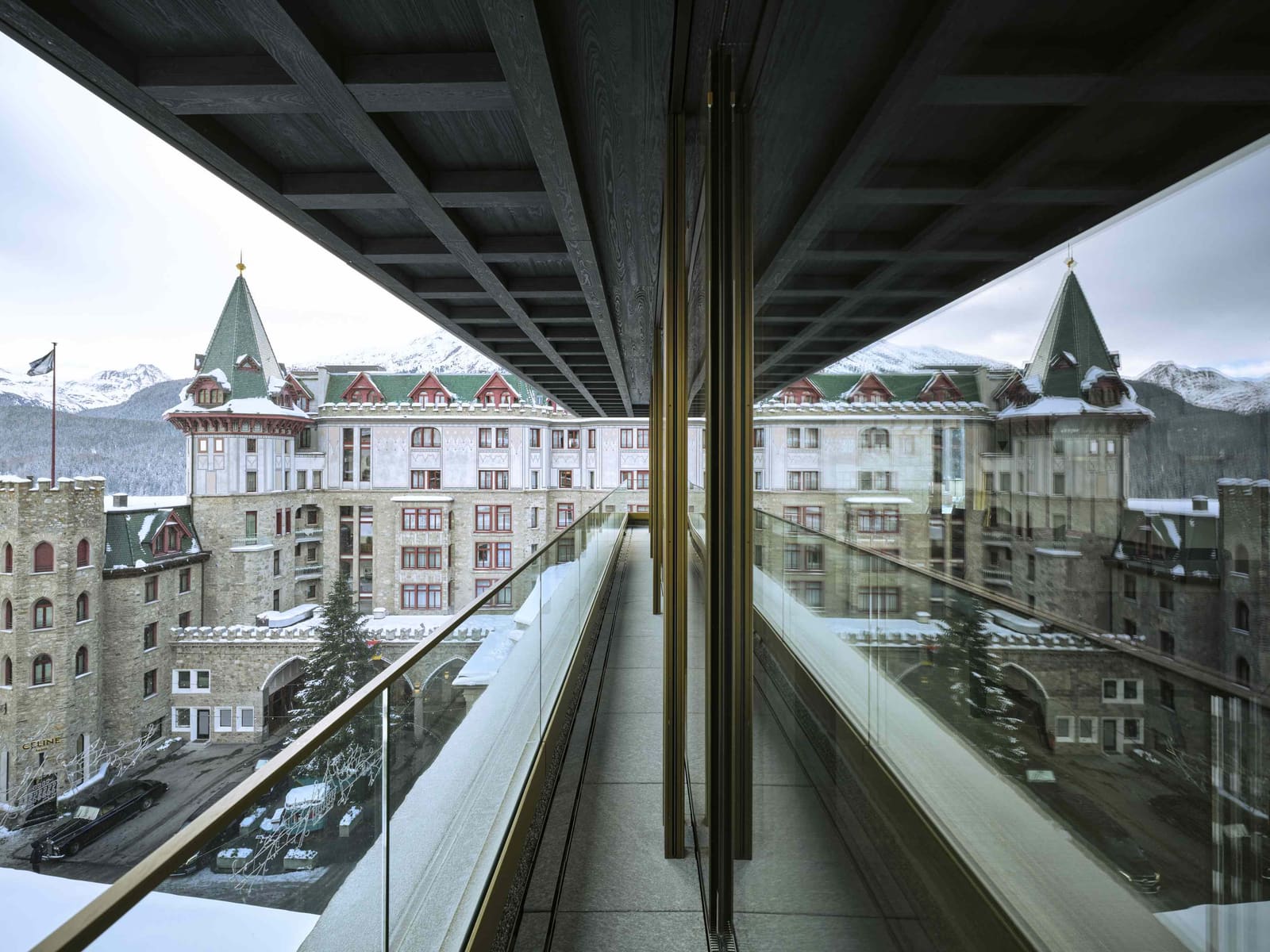
A Palace Reborn
There is a particular quality of light that exists only at high altitude, where the air is thin and the sun strikes snow with such intensity that even shadows seem to glow. In St. Moritz, that light has drawn travelers for more than a century and a half - artists and aristocrats, filmmakers and fashion icons, all seeking something beyond mere recreation. Badrutt's Palace has stood witness to this parade since 1896, its Belle Époque façade as familiar a landmark as the Engadin peaks themselves.
At Global Chic Voyage, we've watched grand hotels navigate the tension between preservation and evolution, often stumbling when they lean too heavily toward one pole. The debut of the Serlas Wing at Badrutt's Palace suggests a different approach - one that doesn't ask guests to choose between history and comfort, but instead weaves both into a single narrative.
The Architecture of Continuity
The Serlas Wing takes its name from the mountain range that rises to the south of St. Moritz, a gesture that roots the addition in geography rather than marketing. The structure itself occupies what was once ancillary space, reimagined now as a series of accommodations that privilege silence and sightlines. Where the original palace revels in ornament - gilded moldings, frescoed ceilings, the kind of maximalist detail that defined turn-of-the-century luxury - this new quarter speaks more quietly.
According to Badrutt's Palace, the design philosophy centered on bringing natural materials and contemporary spatial logic to rooms that still honor the property's heritage. Stone and timber dominate, their textures left visible rather than concealed beneath layers of finish. Windows expand to frame the landscape, acknowledging what has always been the hotel's greatest asset: its position above the lake, with the Alps as backdrop.
This is not minimalism for its own sake. The restraint reads instead as confidence, a recognition that the mountains need no embellishment and that true luxury often lies in what is edited away rather than added.
Layers of History
Coco Chanel spent winters here in the 1930s, occupying a suite that overlooked the frozen lake where she watched skiers carve lines into fresh powder. Alfred Hitchcock arrived in the 1950s, drawn by the same combination of discretion and spectacle that made St. Moritz a favored retreat for those whose fame required occasional escape. These are the stories that cling to historic properties, the kind of anecdotal patina that cannot be manufactured.
The challenge for any hotel of this vintage is how to honor such legacy without becoming a museum to it. Badrutt's Palace has long walked this line, maintaining public spaces that feel deliberately preserved - the King's Club with its leather banquettes, the Grand Hall with its chandeliers - while allowing guest rooms to evolve with each generation's expectations of comfort.
The Serlas Wing extends this logic. It does not attempt to replicate the ornate aesthetic of the original structure, nor does it reject it. Instead, it offers a counterpoint, a space where guests can retreat from the grandeur when they choose, returning to it when the occasion calls for cocktails in a room where the wallpaper alone tells a century of stories.
The New Language of Alpine Luxury
Quiet luxury has become something of a catchphrase in recent years, often deployed to describe anything that avoids logos or loud patterns. But in the context of alpine hospitality, the term carries more weight. It speaks to a shift away from the see-and-be-seen energy that once defined ski resorts, toward something more introspective.
The accommodations in the Serlas Wing reflect this sensibility. Beds are positioned to wake facing the mountains. Bathrooms incorporate heated stone floors, a practical luxury at altitude. Lighting is layered, allowing guests to modulate ambiance rather than toggle between extremes. These are details that reveal themselves slowly, the kind that matter more on a third night than a first.
What strikes us most is the absence of unnecessary flourish. No statement art pieces commanding attention, no accent walls insisting on being photographed. The design trusts that the view will provide drama enough, and that guests who choose Badrutt's Palace are seeking substance over spectacle.
The Broader Context
St. Moritz has never lacked for luxury accommodation. What it has lacked, in recent decades, is a clear articulation of what alpine luxury might mean in an era when sustainability and authenticity have become non-negotiable. The Serlas Wing does not solve every question - the carbon footprint of high-altitude tourism remains, as does the tension between exclusivity and accessibility - but it does suggest that historic properties can evolve without erasing what made them significant in the first place.
We see parallels in other mountain destinations attempting similar recalibrations. Zermatt, Chamonix, Aspen - all are grappling with how to preserve heritage while meeting contemporary expectations around design, service, and environmental responsibility. Badrutt's Palace offers one model: invest in infrastructure that reduces impact, honor architectural legacy through thoughtful addition rather than imitation, and trust that guests will value restraint as much as opulence.
A Place in the Pantheon
There is a pantheon of alpine hotels that have defined mountain travel for generations - the Kulm in St. Moritz itself, the Grand Hotel des Bains in Lavey, the Palace Luzern on its lake. These properties endure not because they remain frozen in time, but because they understand which elements are essential and which can be reconsidered.
The Serlas Wing positions Badrutt's Palace firmly within this tradition while acknowledging that tradition itself is a living thing. The hotel's identity has never rested solely on its past guests or its Belle Époque bones, but on its ability to remain relevant across eras. This latest chapter continues that trajectory, offering a vision of alpine hospitality that feels both deeply rooted and unmistakably contemporary.
The View from Here
On a clear morning in St. Moritz, the light arrives early, spilling across the Engadin Valley and turning the lake into a mirror. From the windows of the Serlas Wing, that light becomes the room's primary ornament, shifting through the day in ways that no fixture could replicate. It is a reminder that the best luxury properties understand their role not as destinations unto themselves, but as frames for the landscape beyond.
Badrutt's Palace has always understood this. The Serlas Wing simply makes it explicit, stripping away what is superfluous to reveal what has mattered all along: the mountains, the light, and the rare quality of stillness that exists only at altitude. For those of us who return to the Alps year after year, seeking not just recreation but a particular kind of clarity, this new addition feels less like a renovation and more like a homecoming.
The palace on the mountain has evolved once more, and in doing so, has reminded us why it became a palace in the first place.
Credit: Steve Herud / Badrutt's Palace Hotel
Spot something wrong? Email editors@globalchicvoyage.com. We log every correction publicly.
RELATED
SEE ALL →
23 Jun 2026 / 5 min
22 Jun 2026 / 5 min
10 Jun 2026 / 5 min
8 Aug 2026 / 5 min