
The Return of the Hand: Why Restaurants Are Choosing Craft Over Code
In a feed saturated with algorithmic imagery, the analog gesture has become the most radical statement a restaurant can make.
SI
22 Jul 2026 · 5 MIN READ · UPDATED 17 AUG 2026
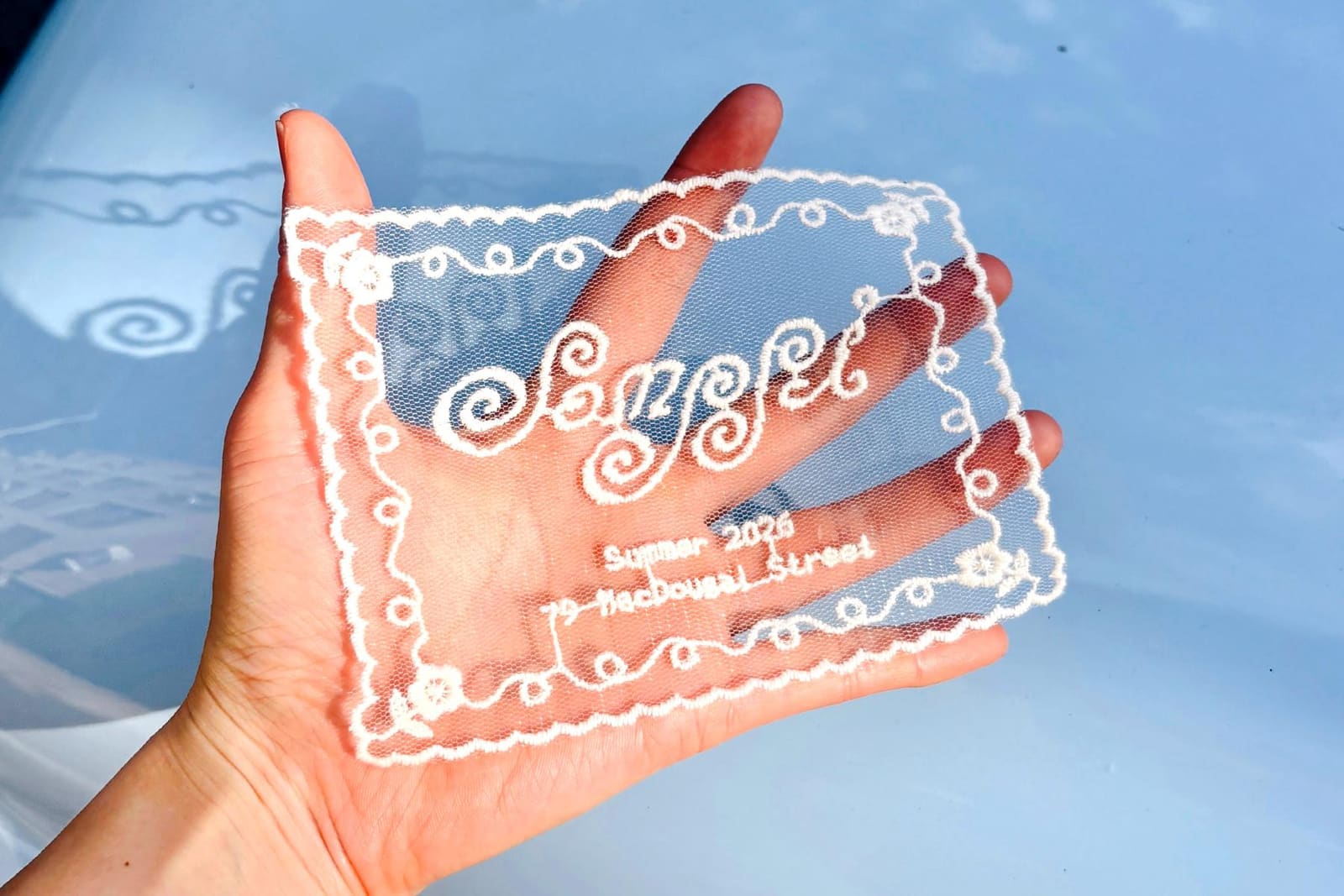
The Lace That Stopped the Scroll
There was something about the light. The way it filtered through the custom-made lace, casting shadows of looping swirls and scalloped edges against the powder-blue sheen of a car hood. The photograph, announcing a new Korean restaurant in Manhattan called Somssi, possessed a quality that has become increasingly rare in our feeds: the unmistakable texture of reality. A hand held the lace. Sunlight was involved. Someone had sewn the restaurant's name and address into white thread, stitch by careful stitch.
The term "somssi" refers to a skill polished over time, a knack for crafting things by hand. Managing partner Ahris Kim chose the name deliberately, and the commitment extends through every layer of the restaurant's identity. The logo features stitched cloth. The typeface evokes Asian calligraphy. At the entrance, a curtain made from vintage crochet and lace tablecloths spells out the restaurant's name in embroidered cutouts. Margaret Muza, Kim's childhood friend, sourced vintage glassware and curated the interiors. Muza's mother constructed the curtains from her own decades-old fabric collection.
In an era when so much feels generated rather than made, the gesture reads as something between manifesto and refuge.
The Grotesque Abundance
At Global Chic Voyage, we've watched the visual landscape shift. The sandwiches that defy physics. The cocktails casting shadows that violate the laws of light. Event flyers so overstuffed with impossible flourishes they collapse into unintentional parody. A cat holding two tacos, which might charm if drawn by an illustrator but instead arrives cynical and hollow, the product of prompts rather than imagination.
The backlash has arrived. Across certain corners of culture, sentiment has crystallized: better a poster scrawled with marker on cardboard than another algorithmic confection. Writer Kathryn Jezer-Morton coined the term "frictionmaxxing" to describe the deliberate rejection of convenience technologies in favor of slower, analog processes. The word has escaped its original context to encompass a broader cultural pivot toward pre-digital methods of creation and problem-solving.
And restaurants, those friction-filled enterprises by nature, are leading a quiet charge back toward the handmade.
True Materials in an Age of Simulation
The cultural response extends beyond dining. Photographer Szilveszter Makó has swept through fashion with work that relies on absurd physical props and natural daylight, what he calls "true materials." Publications have followed suit. Recent work from major food media outlets has embraced stop-motion animation with wobbly paper cutouts, creative choices that announce their physicality, their evidence of human effort.
We wondered, in the early days of algorithmic image generation, whether its inevitable saturation might trigger a renewed appreciation for the analog and the explicitly human-made. That prediction has materialized faster than expected.
Consider Market Basket, the New England grocery chain, which released a limited edition of its weekly circular entirely hand-illustrated by artist Katie Christensen. The gesture deliberately recalls the store's earlier decades, when circulars were always drawn by a person. Or Fearless Coffee in Johnson City, Tennessee, which commissioned photographer Jamey Booher for a shoot meant to evoke the late 1990s, complete with cassette tapes staged alongside a banana latte. The shop's Instagram caption acknowledged the cultural moment directly, noting the saturation of digital noise and the dominance of algorithmic promotions. The post became the shop's most-liked ever, reaching audiences far beyond eastern Tennessee.
In Toronto, the new Japanese restaurant Shinji caught attention through a video shared by calligrapher Sylvia Wong, who had been commissioned to hand-engrave the restaurant's logo onto wine glasses. Wong acknowledged in her post that hand-engraving is less efficient than machine work, but the choice aligned with Shinji's ethos on craftsmanship. Friction as value system.
The Handwritten Menu as Rebellion
Amid the glut of algorithmic content, photographs of handwritten menus now carry a particular weight. Melissa Martin of Mosquito Supper Club in New Orleans has recently shifted her social media approach, posting simply taken shots of paper menus handwritten in marker instead of the styled professional photography from her cookbooks. After a slow summer, the posts serve as reminders that the restaurant remains open, but Martin also appreciates the ritual of the task itself. She described the process to us: writing the menu by hand, trimming it with scissors, photographing it, posting it. Even when the handwritten menu exists only for Instagram, the process feels more personal. In the dining room, menus appear on chalkboard, partly to reduce printing costs but also for the analog appeal.
Superiority Burger in lower Manhattan has always carried a punk irreverence, a legacy of chef and owner Brooks Headley's background in the hardcore music scene. The restaurant champions vegetarianism in a distinctly non-trendy register, even as plant-based diets cycle out of fashion, and celebrates produce from small farms with the enthusiasm some reserve for rare wines. Specials are often announced via notes hand-scrawled with marker on paper, then photographed and shared online. A collaboration with Queens sandwich shop Salty Lunch Lady's Little Luncheonette was announced through cutout paper letters, wrinkled and haphazard, spelling out the news.
What might once have read as affectation now registers as reaffirmation. Someone made this, just as someone made your food, just as someone nurtured the vegetables from seeds. Sometimes, marker on scraps says more than algorithmic imagery ever could.
The English Hand
At Dean's, the anticipated British restaurant in New York City, the menu is also handwritten. Each week, interim director of operations Tommy Hunt receives updates and writes the menu by hand for photocopying. Co-owner Annie Shi explained the choice: when the team discussed the British pubs they most admired, sources of inspiration across the United Kingdom, handwritten menus appeared consistently. The experience felt personal. Hunt's handwriting reads as classically English to Shi, bold, somewhere between cursive and print. She imagines the handwriting might change over time, and she welcomes this possibility as a way of tracking the restaurant's evolution.
At Shi's other restaurant, King, which opened in 2016, the branding carries a similar handcrafted quality, with illustrations by artist RF. Alvarez. The logo is a scratchy, squiggly scrawl. For Shi, these clearly handmade visuals connect to her restaurants' perspectives on food. Even during the peak of farm-to-table evangelism, her style has never been to broadcast sourcing from the rooftops. But there are other ways to signal that a project is personal and craft-driven, and those signals live in details like a handwritten menu.
The Cost of Friction
None of this is new for restaurants. Handwritten menus, custom typography, and analog photography have long histories in dining culture. But in the current landscape, these markers of real hands behind something carry heightened resonance. They confront what has taken over.
Kim, from Somssi, put it plainly: anywhere the team could impose a handmade detail, they did. Algorithmic work would contradict what "somssi" stands for. It's difficult to imagine a path of more friction than operating a restaurant. Why add more?
The answer, increasingly, is that the friction itself communicates values. Yes, hiring a photographer costs more than generating an image through prompts. But it's also increasingly clear that many people would rather encounter a badly taken, grainy photograph than an engineered algorithmic image. The choice reflects a value system, a statement about what matters.
At Global Chic Voyage, we've come to see restaurants that employ algorithmic art as capitulating to a culture of shortcuts, akin to reheating premade institutional food. It becomes impossible to square with a value system that claims to care about craft and integrity. The handwritten menu, the embroidered curtain, the lace photographed in natural light: these are not merely aesthetic choices. They are declarations of allegiance to the slow, the imperfect, the irreducibly human.
In a feed full of impossible shadows and gravity-defying sandwiches, the hand-scrawled note on paper has become the most radical gesture a restaurant can make. It announces, without irony or apology: a person was here. A person made this. And that, in this particular cultural moment, is worth stopping for.
Credit: Ji Park
Spot something wrong? Email editors@globalchicvoyage.com. We log every correction publicly.
RELATED
SEE ALL →
21 Jun 2026 / 5 min
4 May 2026 / 5 min
20 Apr 2026 / 5 min
10 Mar 2026 / 5 min