
The Volcanic Lake That Rivals Como
Ringed by fire-born peaks and Maya villages, Lake Atitlán asks to be savored slowly - not merely photographed.
SI
8 Jul 2026 · 5 MIN READ · UPDATED 17 AUG 2026
A Caldera of Uncommon Beauty
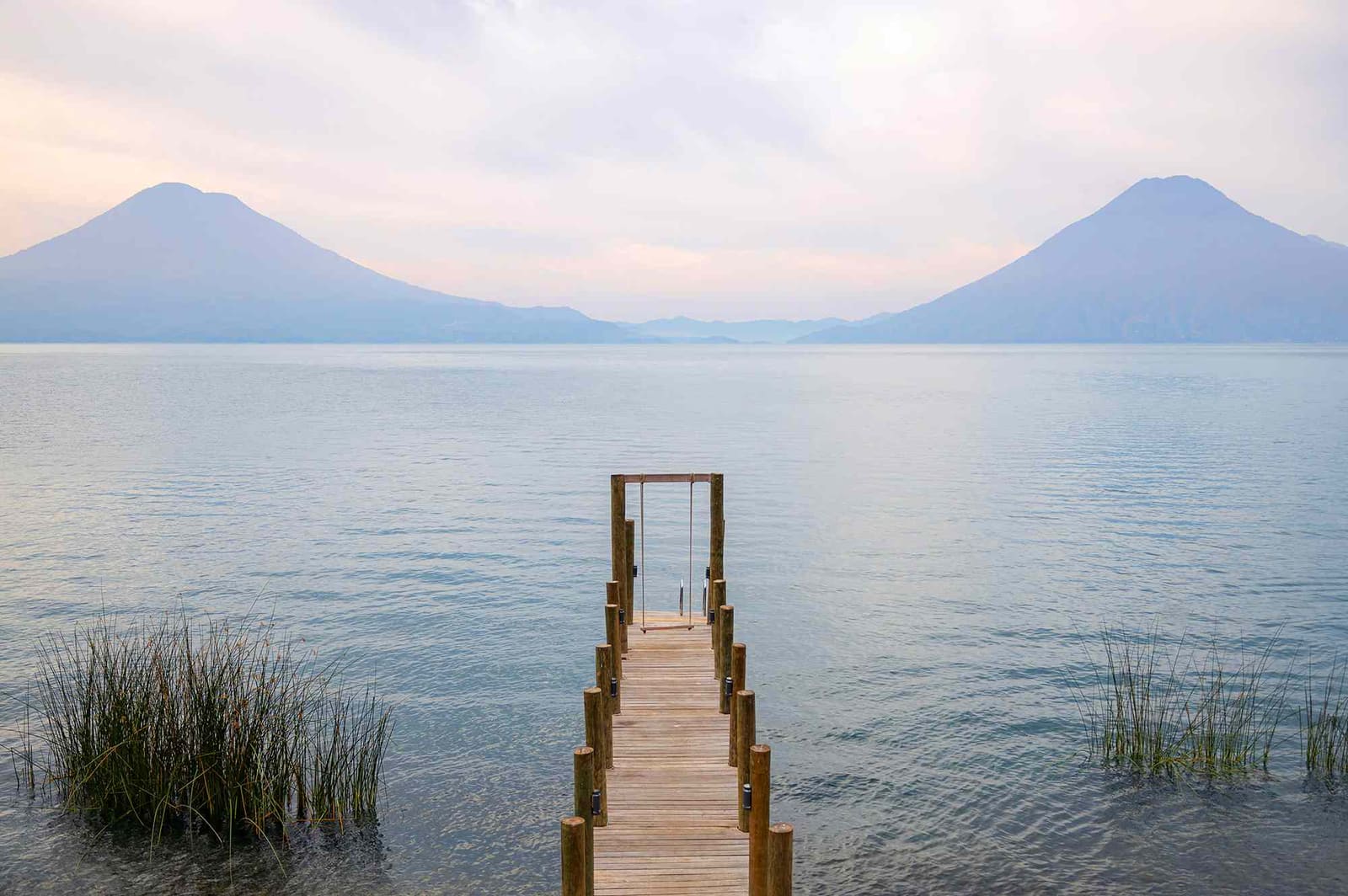
There is a moment, usually just after dawn, when the surface of Lake Atitlán becomes a mirror. The three volcanoes that guard its southern shore - Tolimán, Atitlán, and San Pedro - appear twice: once in stone and ash, and again in the inverted world below. The water shifts from cobalt to jade depending on the light, the hour, the season. Fishermen paddle wooden cayucos through the stillness, their silhouettes dark against the brightening sky. It is a scene that invites comparison to the Italian lakes, yet the resemblance is only superficial. Atitlán possesses a different grammar entirely.
At Global Chic Voyage, we have long been drawn to destinations that refuse easy categorization - places where natural grandeur coexists with living culture, where beauty is inseparable from the people who inhabit it. Lake Atitlán, cradled in the highlands of southwestern Guatemala at nearly 5,000 feet above sea level, is such a place. Formed by a volcanic eruption some 84,000 years ago, the lake stretches across roughly 50 square miles, its shores dotted with a dozen Maya Tz'utujil and Kaqchikel villages. Each maintains its own weaving patterns, market days, and ceremonial calendar. The comparison to Como - a phrase that appears with some regularity in travel writing - captures the topography but misses the essence. Como is about villas and speedboats and mid-century glamour. Atitlán is about maize and textiles and the persistence of indigenous lifeways in the face of centuries of pressure.
The Villages: Threads in a Broader Tapestry
To visit Lake Atitlán is to navigate a constellation of small towns, each distinct in character and accessible primarily by boat. Panajachel, the largest and most tourist-facing, serves as the de facto gateway. Its main street is a tangle of souvenir stalls, shuttle-bus offices, and budget hostels - functional rather than charming, but necessary. From the public dock, lanchas (water taxis) depart throughout the day for the other villages.
San Pedro La Laguna, on the western shore, has become a magnet for backpackers and digital nomads, drawn by low prices and a permissive atmosphere. Spanish schools proliferate; so do yoga studios and juice bars. The energy is transient, youthful, sometimes cacophonous. San Marcos La Laguna, just a short boat ride away, offers a quieter counterpoint: a village that has styled itself as a center for wellness and spiritual tourism. Meditation centers and holistic retreats nestle into the hillside; the vibe is earnest, occasionally precious, but undeniably serene.
Santiago Atitlán, the largest of the Tz'utujil communities, feels more rooted, less performative. The market hums with commerce conducted in Tz'utujil; women in richly embroidered huipiles sell vegetables and incense. The town is also home to the cult of Maximón, a syncretic folk saint venerated with offerings of cigarettes, rum, and candles. His effigy is housed in a different location each year, tended by a cofradía (religious brotherhood). Visitors are welcome, but this is not a spectacle staged for tourists - it is a living practice, complex and often misunderstood.
Across the lake, the villages of Santa Cruz, Jaibalito, and Tzununá cling to steep slopes, accessible only by boat or footpath. Here the pace slows further. Accommodations tend toward the rustic or the boutique; meals are taken on terraces overlooking the water. These are places for those who seek immersion rather than itinerary, who are content to spend days reading, swimming in the lake's cool depths, or hiking the narrow trails that link one hamlet to the next.
The Volcanoes: Ascent and Perspective
The three volcanoes are more than backdrop. They shape the weather, the agriculture, the mythology. San Pedro, the smallest at just over 9,900 feet, is the most frequently climbed. The trail begins in the village of the same name and ascends through coffee plantations and pine forest. The hike takes roughly three hours, depending on fitness and acclimatization. The summit offers a panoramic view of the lake and, on clear days, the distant Pacific coast. It is a rewarding climb, though not without challenge - altitude and loose volcanic scree test the legs and lungs.
Tolimán and Atitlán, both exceeding 11,500 feet, are more serious undertakings. Tolimán requires a pre-dawn start and a guide familiar with the route; the final approach involves scrambling over rock and ash. Atitlán, the highest and most dramatic, is technically demanding and rarely attempted. These are not casual hikes. They require preparation, respect for the mountain, and an acceptance that weather can turn quickly at elevation.
For those less inclined to summit fever, the lower slopes offer gentler rewards. The trail between Santa Cruz and Jaibalito hugs the lakeshore, passing through small farms where coffee is grown in the shade of banana and avocado trees. Another path leads from San Marcos to the village of Tzununá, winding through forest thick with bromeliads and orchids. Walking here, you encounter the dailiness of rural life: children herding goats, women washing clothes at communal pilas, men repairing stone walls. It is travel at a human scale, unmediated by glass or horsepower.
Textiles and the Endurance of Craft
The textiles of the Lake Atitlán region are among the most accomplished in Mesoamerica. Each village possesses its own iconography, rendered on backstrap looms that have remained essentially unchanged for centuries. In Santiago Atitlán, huipiles feature stylized birds and flowers in saturated purples and reds. In San Antonio Palopó, the palette shifts to blues and greens, the motifs more geometric. These garments are not folklore preserved in amber; they are daily wear, markers of identity and community.
Several cooperatives and independent weavers welcome visitors to their workshops. In San Juan La Laguna, women's collectives produce textiles using natural dyes extracted from plants, insects, and minerals - indigo for blue, cochineal for red, marigold for yellow. The process is labor-intensive and deeply knowledgeable, a form of applied botany passed down through generations. Purchasing directly from these artisans ensures fair compensation and supports the continuation of the craft. It is also an education in the economics of beauty: a single huipil may represent weeks of work, its price a fraction of what a comparable piece of haute couture would command.
The lake's market days - Monday and Thursday in Sololá, Friday in Santiago, Sunday in Chichicastenango (a larger town north of the lake) - offer another window into this textile tradition. Vendors spread their wares on cobblestones and under awnings: blankets, belts, bags, table runners. The quality varies; discernment is required. But amid the tourist kitsch, there are pieces of genuine artistry, woven with skill and intention.
Practical Considerations for the Thoughtful Traveler
Lake Atitlán is not difficult to reach, but neither is it effortless. Most visitors arrive via Guatemala City or Antigua, both served by international flights. From Antigua, the drive to Panajachel takes roughly two and a half hours, much of it along winding mountain roads. Shared shuttles are plentiful and inexpensive; private transfers offer more comfort and flexibility.
Accommodations span the spectrum. Panajachel has the most options, from budget guesthouses to mid-range hotels. The smaller villages offer fewer choices but often more character: family-run posadas, eco-lodges built into hillsides, boutique properties with infinity pools and farm-to-table dining. In places like Santa Cruz or San Marcos, the absence of road access means supplies arrive by boat; this logistical constraint tends to filter out the merely curious, leaving a clientele more inclined toward patience and presence.
The lake's altitude and tropical latitude create a climate of perpetual spring - warm days, cool nights, the occasional afternoon thunderstorm. The dry season, roughly November through April, is the most popular time to visit. The rainy season, from May to October, brings greener landscapes and fewer tourists, though clouds can obscure the volcanoes for days at a stretch. Water quality has become a concern in recent years; algae blooms, fueled by agricultural runoff and inadequate sewage treatment, appear periodically. Swimming is generally safe, but local advice should be heeded.
Spanish is the lingua franca, though many older residents speak primarily Tz'utujil or Kaqchikel. English is common in tourist-facing businesses but cannot be assumed elsewhere. A few phrases of Spanish - buenos días, gracias, cuánto cuesta - go a long way toward goodwill.
Why Atitlán Endures
There are lakes that dazzle and lakes that soothe; Atitlán does both, though not always at the same time. Its beauty is undeniable, but it is a beauty complicated by history, by inequality, by the pressures of tourism on fragile ecosystems and indigenous communities. The villages around the lake are not theme parks. They are living places, grappling with modernity on their own terms - sometimes successfully, sometimes not.
What draws us back, and what we believe will draw others, is precisely this complexity. Atitlán resists the flattening impulse of the postcard. It demands engagement, curiosity, a willingness to see beyond the surface. The volcanoes will be there at sunrise, reflected in water the color of old glass. But so will the weaver at her loom, the farmer tending his milpa, the child paddling a too-large canoe across the bay. To visit Lake Atitlán well is to hold all of these in view at once - to understand that the landscape and the life lived within it are inseparable, and that both deserve our attention and respect.
Photo: Nicholas Schmidt / Travel + Leisure
Spot something wrong? Email editors@globalchicvoyage.com. We log every correction publicly.
RELATED
SEE ALL →
27 Jul 2026 / 5 min
23 Jul 2026 / 5 min
13 Jul 2026 / 5 min
8 Jul 2026 / 5 min