
When a Hotel Room Becomes a Fable You Can Sleep Inside
At La Fantaisie in Paris, Hungarian artist Szabolcs Bozó transforms a guest suite into a nine-month immersive artwork where folk tradition meets playful surrealism.
SI
6 Jul 2026 · 5 MIN READ · UPDATED 17 AUG 2026
A Room That Dreams in Folk Idioms
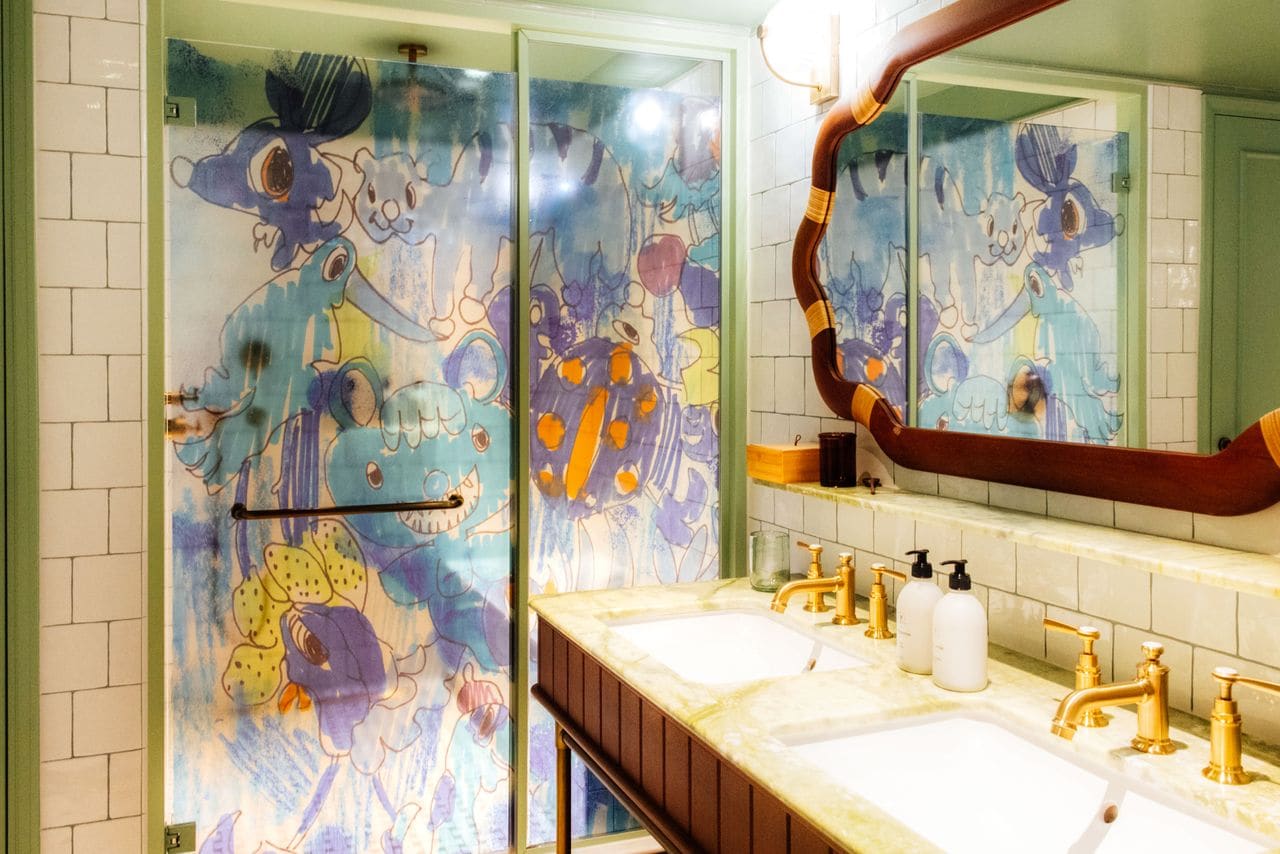
There is something quietly subversive about falling asleep inside someone else's imagination. Room 607 at La Fantaisie no longer behaves like a hotel suite in the conventional sense. Its walls pulse with hand-painted creatures that seem suspended between childhood storybook and fever dream, its soft furnishings stitched with motifs that recall both Hungarian village textiles and playground doodles. For the next nine months, until late February 2027, this 42-square-meter space belongs not to the usual inventory of boutique hospitality but to the visual universe of Szabolcs Bozó, a Hungarian artist whose work moves with the cadence of spontaneous drawing and the pull of half-remembered fables.
At Global Chic Voyage, we have watched hotels increasingly position themselves as incubators for contemporary art, yet few manage to dissolve the boundary between accommodation and installation as thoroughly as this. La Fantaisie's latest artist residency does not simply hang paintings on existing walls or place sculpture in lobbies. It reimagines the suite as an in-situ canvas, layering every surface with works created specifically for the architecture of rest.
The Folk Vocabulary of a Self-Taught Hand
Bozó's visual language emerged outside formal academies, shaped instead by the oral and textile traditions of his Hungarian roots. His creatures, zoomorphic and fluid, occupy a liminal territory where animal, human, and abstraction blur into one another. They are not quite mascots, not quite totems. They possess the familiarity of something glimpsed in peripheral vision during childhood, figures that inhabit the edges of memory rather than its center.
Inside Room 607, these beings proliferate. Large-scale soft sculptures introduce a tactile dimension rarely encountered in hotel interiors; guests are invited not only to observe but to touch, to rearrange, to inhabit the work physically. Hand-painted lampshades cast the room in amber and ochre glows, altering the mood as daylight fades. Handmade cushions and bespoke bedspreads continue the narrative across textiles, embedding the collaboration into the most intimate gestures of hospitality: the act of lying down, of pulling a cover close, of waking into color.
Every existing artwork has been removed. The suite now operates as a total environment, a Gesamtkunstwerk calibrated to the scale of overnight stay rather than gallery visit. A booklet left for guests offers context on the artist and lists which pieces can be purchased, a quiet acknowledgment that some visitors may wish to take fragments of the experience home. Exclusive co-branded objects, including caps, stickers, playing cards, and trays, are available only at the hotel, further blurring the line between souvenir and art multiple.
Hospitality as Curatorial Practice
La Fantaisie has been methodical in its approach to artist collaborations. Before Bozó, French contemporary artist Ben Arpéa occupied a suite, transforming it into a distinct aesthetic statement. The model is one of seriality and rotation, each residency lasting long enough to become part of the hotel's identity without calcifying into permanence. It is a curatorial strategy borrowed from the gallery world but applied to the rhythms of hospitality, where turnover, transience, and the needs of sleep impose different constraints than white-cube exhibition.
The hotel itself, designed by Martin Brudnizki, already operates at a high pitch of visual intensity. Botanical exuberance, saturated color, pattern layered upon pattern: the interiors read as a love letter to maximalism, with a glass-roofed restaurant, garden terrace, street-facing café, rooftop bar, and spa distributed across its 73 rooms in the 9th arrondissement. Bozó's intervention does not compete with this aesthetic so much as amplify it, introducing a more handmade, folkloric counterpoint to Brudnizki's polished eclecticism.
The artist himself has noted the personal resonance of the location. Paris was the site of his first exhibition, and his current collaboration with La Fantaisie runs parallel to a solo show at Semiose, a gallery in the city. The hotel residency, he has said, allowed him to work with unfamiliar materials, fabric and everyday objects, pushing his practice into spaces it does not typically occupy. The result is a suite that functions simultaneously as bedroom, gallery, and studio echo, a hybrid space where the boundaries of each category soften.
The Suite as Lived Experience
Functionally, Room 607 retains the infrastructure of luxury hospitality. It accommodates up to three guests, with a large walk-in closet, a bathroom fitted with both bathtub and shower, and a sofa bed that converts into additional sleeping quarters. It overlooks the hotel's garden, offering a rare buffer of greenery in central Paris. Rates start at 1,000 euros per night, inclusive of breakfast, positioning the experience at the upper end of boutique pricing but still within reach of travelers for whom art and accommodation are not separate budget categories.
What distinguishes the suite is not its amenities but its atmosphere. To sleep here is to consent to immersion, to wake surrounded by creatures that do not explain themselves, to move through a visual field that operates according to the logic of play rather than decoration. It is hospitality inflected by installation art, a temporary dwelling that asks to be read as much as inhabited.
We have seen other hotels commission artists to enliven their interiors, but the gesture often remains ornamental, a veneer applied to otherwise unchanged architecture. Here, the artist's hand is legible in every detail, from the lampshade to the bedspread, creating a coherence that feels less like curation and more like authorship. The suite does not contain art; it is art that happens to offer a bed.
A Residency That Redefines Rest
The nine-month duration of Bozó's residency is significant. It is long enough for the suite to be encountered by dozens of guests, each bringing their own interpretive frame to the work, but short enough to retain the aura of the temporary, the unrepeatable. When the residency concludes in February 2027, the suite will be dismantled, its contents dispersed through sales and the artist's archive, and the room will revert to a blank slate awaiting the next collaborator.
This ephemerality is central to the project's appeal. It resists the museum impulse to preserve and instead embraces the logic of performance, of the event, of the experience that cannot be revisited in identical form. Guests who book Room 607 are not simply purchasing a night's accommodation; they are entering a limited-run installation, a time-bound encounter with an artist's practice at a specific moment in its evolution.
At Global Chic Voyage, we find this model compelling precisely because it refuses the static. Hotels have long been spaces of transience, but they have historically aspired to consistency, to the promise that the room you book will be the room you expect. La Fantaisie's artist residencies invert that contract, offering instead the allure of the singular, the unrepeatable, the suite that will only ever exist in this configuration for these nine months.
It is a gamble on curiosity, on the traveler who seeks not comfort alone but friction, surprise, the productive disorientation of waking inside someone else's visual world. And for those who find themselves drawn to folk idioms rendered in contemporary materials, to creatures that hover between memory and invention, Room 607 offers a rare opportunity: to inhabit, for a night or two, the interior of a fable still being written.
Photo: Agence Pancake
Spot something wrong? Email editors@globalchicvoyage.com. We log every correction publicly.
RELATED
SEE ALL →
31 Jul 2026 / 5 min
28 Jul 2026 / 5 min
28 Jul 2026 / 5 min
27 Jul 2026 / 5 min