
When a Marrakesh Garden Becomes a Twelve-Room Universe
Inside Jnane Rumi, where intimacy, contemporary art, and botanical refuge redefine the notion of a boutique sanctuary.
SI
22 Jun 2026 · 5 MIN READ · UPDATED 17 AUG 2026
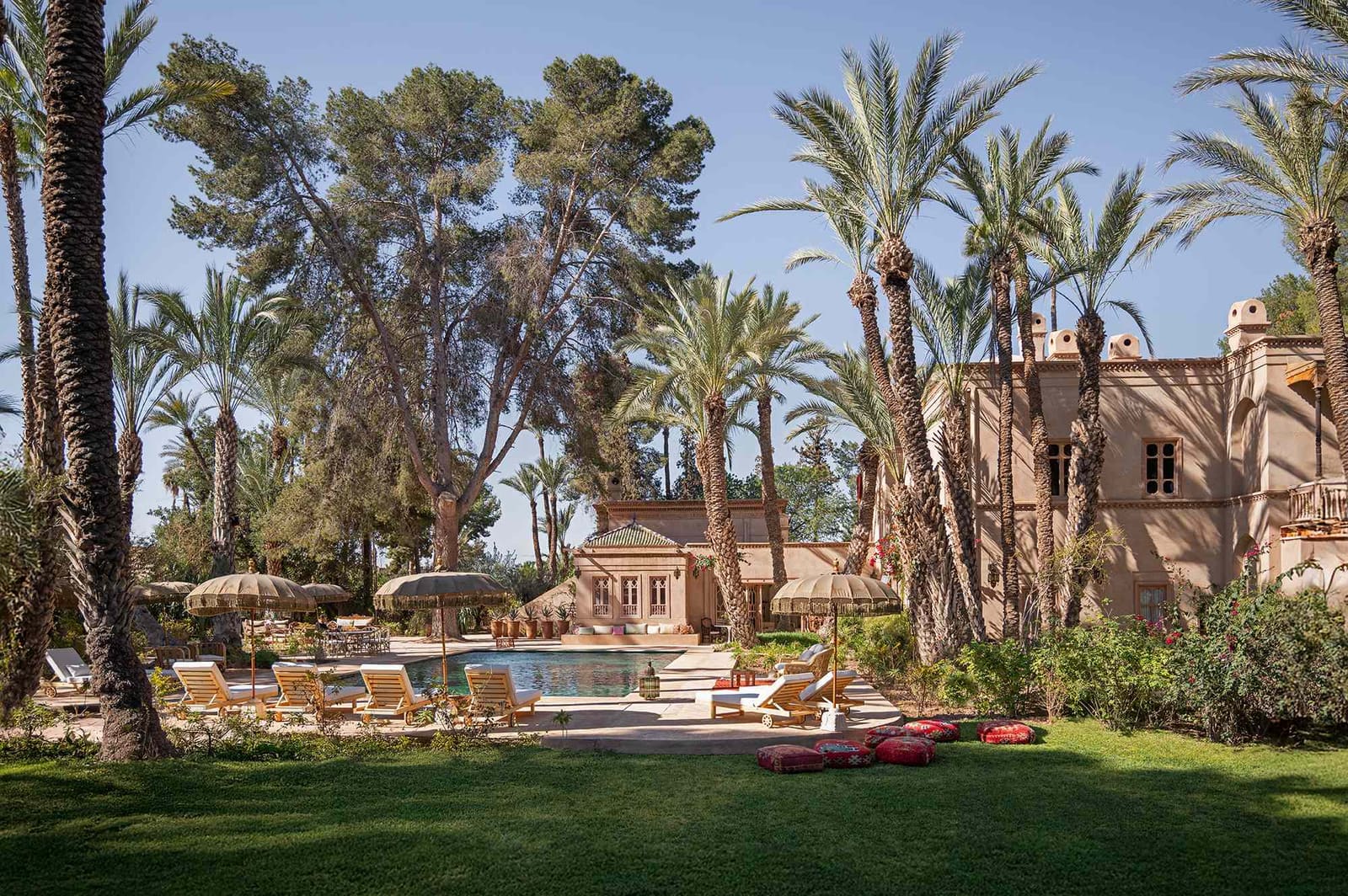
A Threshold Between Public and Private
There is a particular quality to entering a place that refuses the language of hotels. No lobby as stage, no desk staffed by strangers performing hospitality. At Jnane Rumi, the threshold is a door in ochre, heavy with age, opening onto gardens that seem to have existed long before the twelve rooms were ever imagined. The air smells of orange blossom and wet stone. Somewhere beyond the palms, a fountain murmurs. You are not checking in; you are being received.
This is Marrakesh at its most interior. Not the souks, not the Jemaa el-Fna with its acrobats and smoke, but the walled universe that Moroccans have perfected over centuries: the riad as cosmos, garden as philosophy. Jnane Rumi takes that inherited logic and bends it gently toward the present, layering in contemporary art, a curatorial eye, and a scale so intimate that the word "boutique" feels almost too commercial. Twelve rooms. A single courtyard. The rhythm of a private home that happens, for now, to welcome strangers.
At Global Chic Voyage, we have watched the boutique hotel category splinter into a thousand micro-niches, each promising intimacy, authenticity, some ineffable sense of place. Most fail. They are too precious, or too studied, or they mistake smallness for soul. Jnane Rumi succeeds because it does not try to be a hotel at all. It is a residence that has simply opened its doors.
The Architecture of Stillness
The bones of the property are traditional: thick tadelakt walls, carved cedar, the geometric precision of zellige tilework underfoot. But the sensibility is quieter, less ornamented than the riot of pattern you might expect in the medina. Rooms are spare without being austere, furnished with pieces that feel collected rather than sourced from a single supplier. A low brass table here, a kilim there, a daybed upholstered in linen the color of desert sand.
Light moves through the space as though it has been choreographed. Morning sun slants across the courtyard, catching the rim of a ceramic bowl, the edge of a framed canvas. By afternoon, the rooms retreat into shadow, cool and dim. This is architecture that understands the climate, that works with heat and shade rather than against them. There is no air conditioning hum competing with birdsong, no glass wall separating you from the garden. The boundaries are porous. You sleep with the windows open, wake to the call to prayer drifting over the rooftops.
The art collection is woven into this spatial logic, not hung as an afterthought. Canvases by contemporary Moroccan and regional artists line the corridors, lean against walls in the library, punctuate the transition between public and private zones. It is a collection built on relationships, not auctions, and it shows. The works speak to one another, to the architecture, to the light. They are not decoration; they are part of the argument the house is making about what it means to dwell.
Gardens as Grammar
To speak of Jnane Rumi without centering the gardens would be to miss the point entirely. The name itself, "Jnane," means garden in Moroccan Arabic, and here it is both literal and metaphorical. The property unfolds across multiple garden rooms, each with its own character, its own microclimate. There is the central courtyard, anchored by a rectangular pool lined in dark zellige, reflecting the sky and the colonnade in equal measure. Beyond it, a citrus grove, heavy with fruit even in summer. Further still, a kitchen garden where mint and coriander grow in neat rows, destined for the evening tagine.
These are not ornamental gardens. They are working, living systems, tended daily, integral to the life of the house. Meals are served under the shade of a centuries-old olive tree, or beside the pool at dusk, when the heat finally relents and the swallows begin their acrobatics overhead. The gardens dictate the rhythm of the day. You rise early to walk them in the cool morning light. You retreat indoors during the fierce midday sun. You return at twilight, when the jasmine releases its scent and the stone walls exhale the heat they have been holding all day.
There is a lesson here, one that the best hotels in North Africa have always understood: luxury is not about marble and gold leaf. It is about shade and water and the sound of leaves moving in a breeze. It is about creating a microclimate where life can unfold at a different tempo, where the body remembers rhythms it has forgotten in the fluorescent hum of cities.
The Intimacy of Twelve
Twelve rooms is not a number chosen lightly. It is the upper limit of intimacy, the point beyond which a property begins to tip into the logic of scale, of operations, of the impersonal machinery that defines most of the hospitality industry. At twelve, everyone knows your name. The kitchen knows you prefer your coffee without sugar. The gardener nods as you pass each morning on your way to the pool.
This scale allows for a kind of flexibility that larger properties cannot manage. There is no fixed breakfast time, no menu printed weeks in advance. If you want to eat at ten in the morning, or four in the afternoon, or not at all, that is simply noted and accommodated. If you want to take your meal in your room, or by the pool, or under the olive tree, someone will set a table there, wordlessly, as though it had always been the plan.
The staff-to-guest ratio is high, but the service is so discreet as to feel almost invisible. Rooms are refreshed while you are at lunch. Towels appear, folded, beside the pool. A pot of mint tea materializes on the terrace at dusk. There is none of the performative hospitality that can feel suffocating in more self-conscious properties. Just a quiet attentiveness, a sense that the house is taking care of you without requiring your notice.
Art as Anchor
The art collection at Jnane Rumi deserves its own consideration. This is not a hotel that has hired a consultant to fill wall space with safe abstracts. The works on view reflect a deep engagement with contemporary practice in Morocco and the wider Maghreb, artists working at the intersection of tradition and modernity, local and global.
In the main salon, a large canvas by a Casablanca-based painter dominates one wall, its surface layered with calligraphic gestures that hover between script and pure mark-making. Nearby, a series of photographs document the changing light over the Atlas Mountains, each frame a meditation on time and geology. In the library, smaller works line the shelves, interspersed with books on Moroccan architecture, Sufi poetry, the history of the garden in Islamic culture.
The collection is not static. Works rotate, new pieces appear, the house evolves. This is a living archive, and it positions Jnane Rumi as more than a place to sleep. It is a cultural space, a platform for dialogue, a place where travelers might encounter work they would not otherwise see, by artists they would not otherwise know.
For those of us who travel in search of cultural depth, not just comfort, this curatorial ambition matters. It signals that the property understands its context, that it is embedded in a conversation larger than itself. It is the difference between a hotel that happens to be in Marrakesh and a hotel that could only be in Marrakesh.
The Ritual of Arrival
To arrive at Jnane Rumi is to undergo a kind of decompression. The city outside is a sensory assault: the motorbikes threading through narrow lanes, the vendors calling out their wares, the riot of color and noise and movement. You step through the door, and it all falls away. The courtyard absorbs you. The fountain, the palms, the cool stone underfoot. You are handed a glass of something cold and floral. Someone takes your bag. You are shown to your room, not rushed, the tour unfolding at a walking pace.
The rooms themselves are studies in restraint. High ceilings, whitewashed walls, a bed dressed in linen so soft it feels like an apology. A writing desk faces the window, looking out onto the garden. A daybed piled with cushions invites afternoon reading. The bathroom is generous, all tadelakt and brass fixtures, a deep tub that fills slowly, the water almost too hot.
There is no television, no minibar, none of the usual clutter of modern hotel rooms. Just space, light, a sense of calm so profound it borders on the religious. You unpack slowly, hang your clothes in the cedar armoire, arrange your books on the nightstand. Within an hour, the room feels like yours. Within a day, you cannot imagine leaving.
Meals as Ceremony
The food at Jnane Rumi is rooted in Moroccan tradition but interpreted with a lightness that respects contemporary palates. Breakfast is a spread of fresh bread, local honey, olive oil pressed from fruit grown in the region, yogurt thick enough to stand a spoon in. There are dates, almonds, seasonal fruit cut into geometric arrangements. Coffee is strong and served in small glasses. Mint tea arrives in a silver pot, poured from a height, the foam rising to the rim.
Lunch and dinner are more composed, though no less grounded in place. Tagines cooked low and slow, the meat falling from the bone, the preserved lemons adding their sharp, fermented brightness. Salads of roasted vegetables, dressed simply with cumin and lemon. Couscous on Fridays, as tradition dictates, served family-style, the semolina grains impossibly fine, steamed over a fragrant broth.
The kitchen sources from the property's own garden where possible, and from the souks when not. There is a transparency to the cooking, a directness. You taste the tomato, the coriander, the saffron. Nothing is over-sauced or over-complicated. It is the kind of food that makes you slow down, that makes you notice what you are eating, that turns a meal into a meditation.
Wine is available, though not emphasized. This is not a property trying to be a European fantasy of Morocco. It is the real thing, rooted in local culture, local rhythms, local codes of hospitality. If you want wine, it will be brought. If you prefer tea, that is just as welcome. The house adapts to you, not the other way around.
The Longer Stay
Jnane Rumi is designed for the longer stay, the week or more that allows you to settle into the rhythm of the place, to stop performing tourism and start simply living. There is enough variety in the gardens to keep daily walks interesting. The library is deep enough to support a reading habit. The staff can arrange excursions to the souks, to the Jardin Majorelle, to the Atlas foothills, but there is no pressure to fill your days with activity.
Many guests, we suspect, will spend entire days within the walls. Reading by the pool. Napping in the shade. Taking meals at odd hours. Sketching in the garden. This is the luxury the property offers: permission to do nothing, to move slowly, to let time unspool without agenda.
In an era when travel has become a form of productivity, a box to check, a feed to populate, there is something radical about a place that invites you to simply be. Jnane Rumi is not interested in your itinerary. It is interested in your presence, your attention, your willingness to slow down enough to notice the way light falls on a wall, the way a garden smells after rain, the way a house can hold you.
What It Signals
The opening of Jnane Rumi arrives at a moment when travelers are increasingly fatigued by the homogenization of the boutique hotel category. The same rattan furniture, the same reclaimed wood, the same Edison bulbs, the same carefully curated Instagram moments. There is a hunger for properties that feel genuinely rooted, that resist the pressure to become a branded experience, that trust their own context enough to let it speak.
Jnane Rumi is a signal that this other path is possible. That a hotel can be small without being precious. That it can be luxurious without being ostentatious. That it can honor tradition without becoming a museum. That it can be contemporary without erasing its past.
It is also a reminder that the best travel experiences are often the quietest ones. Not the headline-grabbing, once-in-a-lifetime spectacles, but the slow accumulation of small, perfect moments. A morning in a garden. A meal under an olive tree. A room that feels like home. A city glimpsed through the filter of stillness, rather than speed.
For those willing to trade the grand hotel for the intimate one, the curated experience for the lived one, Jnane Rumi offers something rare: a chance to disappear into a place, to let it shape your days, to emerge changed in ways you might not be able to articulate but will certainly feel.
The Return
We left Jnane Rumi on a Thursday morning, the city already loud and bright beyond the walls. The door closed behind us, and the garden vanished. But the sense of it lingered, the way certain places do. The smell of jasmine. The sound of water. The weight of silence.
It is the kind of property you measure not by the nights you spend there, but by how often you think about returning. And we are already thinking about it.
Spot something wrong? Email editors@globalchicvoyage.com. We log every correction publicly.
RELATED
SEE ALL →
6 Jul 2026 / 5 min
31 Jul 2026 / 5 min
28 Jul 2026 / 5 min
28 Jul 2026 / 5 min