
Where Chefs and Turquoise Surf Meet Under Caribbean Stars
The Ritz-Carlton, Grand Cayman returns each year with a sand-between-your-toes culinary gathering that has quietly redefined luxury food festivals in the region.
SI
18 Jul 2026 · 5 MIN READ · UPDATED 17 AUG 2026
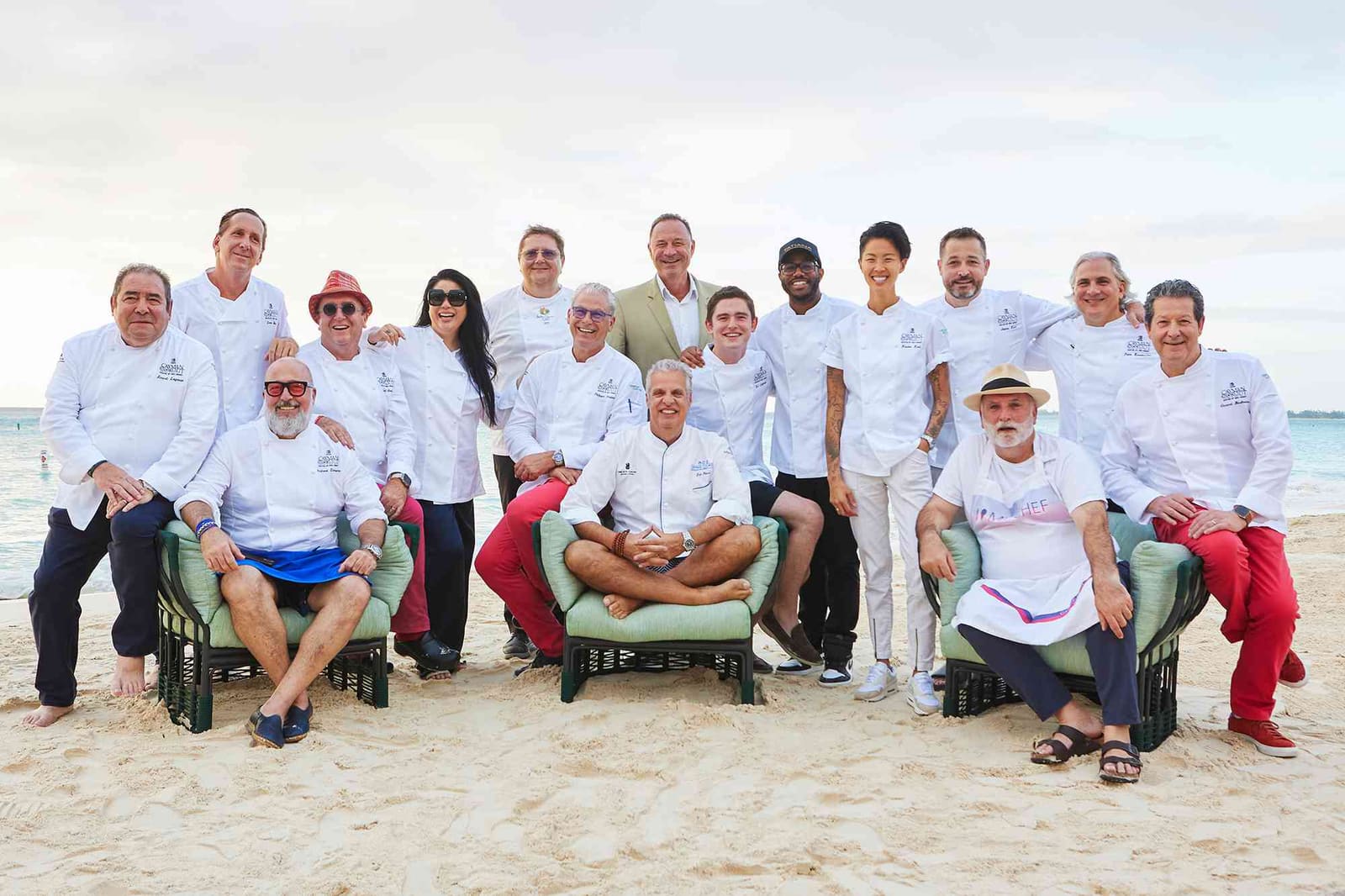
The Festival That Refuses to Shout
There is a particular hour on Seven Mile Beach when the afternoon heat begins to soften, when the sand holds warmth but no longer burns, and when the first scent of charred citrus and island spice drifts through the salt air. It is in this threshold moment, somewhere between day and evening, that the Cayman Cookout truly begins. Not with fanfare or ribbon-cutting, but with the quiet assembly of cutting boards, the arrival of fishermen with their morning catch, and chefs rolling up their sleeves to work in open kitchens framed by coconut palms and an impossibly blue horizon.
At Global Chic Voyage, we've watched beachfront food festivals multiply across the Caribbean over the past decade, each promising its own version of culinary paradise. Yet the annual gathering hosted by The Ritz-Carlton, Grand Cayman has carved out something more considered, something that resists the breathless energy of pop-up spectacle in favor of a slower, more deliberate communion between place, ingredient, and craft.
This is not a festival that announces itself with pyrotechnics or celebrity chef pronouncements broadcast on giant screens. Instead, it unfolds across several days as a series of intimate encounters: a morning demonstration on the resort's oceanfront lawn, a sunset tasting in a beachside cabana, an evening dinner where courses are passed hand to hand and conversation moves as freely as the rum. The setting itself becomes co-author of the experience, the sound of surf a constant low hum beneath every plate, every pour, every shared laugh.
Culinary Talent in Conversation With Island Terroir
What distinguishes this particular event from the parade of branded food festivals that now dot the luxury travel calendar is its commitment to dialogue rather than demonstration. The chefs who gather here, many of them repeat participants over the years, do not arrive to perform their greatest hits. They come to experiment, to taste, to learn from the island's fishermen and farmers and from one another.
We have observed over multiple editions how the programming resists the tired format of the celebrity chef showcase. Instead, sessions are structured as collaborations: a Michelin-decorated chef from Europe working alongside a Grand Cayman native who knows the precise moment when hogfish is at its peak, or a pastry virtuoso rethinking dessert through the lens of Caribbean fruits that ripen only in a narrow window each year.
The island's own culinary traditions, often overshadowed in glossier food narratives, are given equal billing. Local spiny lobster, conch prepared in ways that honor generations of island technique, and produce from small-scale farms across Grand Cayman all find their way onto tasting menus that could easily have defaulted to imported luxury ingredients. The result is a kind of culinary conversation, where technique and tradition speak to each other rather than compete.
The Architecture of Appetite
The Ritz-Carlton's beachfront property provides not merely a backdrop but a deliberate framework for how appetite and environment intersect. Meals are staged across the resort's various terraces, gardens, and stretches of sand, each location chosen for the way light and breeze and view shape the experience of eating.
Morning sessions often take place in the open-air pavilions near the water, where the clarity of early light makes every ingredient visible in high relief: the pink blush of just-caught snapper, the deep green of callaloo, the gloss of tamarind glaze catching sun. By evening, tables are set closer to the surf line, where the transition from daylight to dusk becomes part of the meal's pacing, each course timed to a shifting palette of sky and sea.
This is not incidental staging. The festival has always understood that luxury, at its most refined, is not about insulation from place but about deeper immersion in it. To eat grilled mahi-mahi while sand shifts beneath your feet, to taste a rum cocktail calibrated to the specific humidity of a Caribbean January evening, is to experience food as geography, as climate, as culture.
Why the Model Endures
In an era when many high-profile food festivals have begun to feel interchangeable, their programming dictated more by sponsorship obligations than by culinary curiosity, the Cayman Cookout has maintained its relevance by staying small, staying specific, and staying rooted in its location.
The festival's longevity speaks to a broader shift in how discerning travelers approach luxury dining experiences. There is less appetite now for the spectacle of the celebrity chef flown in to cook a single meal before departing. Instead, travelers seek events that offer genuine insight into a place, that create space for serendipity and improvisation, and that honor local knowledge as much as international acclaim.
The Ritz-Carlton's stewardship of the event has been crucial to this continuity. Rather than expanding the festival into a sprawling multi-venue affair or inflating attendance to maximize revenue, the property has kept the gathering intentionally intimate. Tickets are limited, sessions are small, and the emphasis remains on quality of interaction rather than quantity of programming.
The Gathering's Quiet Influence
What happens at the Cayman Cookout does not stay contained within the resort's boundaries. Over the years, collaborations forged during the festival have led to menu innovations at restaurants across the Caribbean and beyond. Chefs return to their home kitchens with new techniques learned from island cooks, new relationships with Caribbean producers, and a renewed sense of how place can inform flavor.
For Grand Cayman itself, the festival has become an annual reminder of the island's culinary identity, a counterpoint to the perception of the Caymans as merely a financial services hub or a cruise ship stopover. The event draws attention to the island's fishing traditions, its agricultural potential, and its emerging community of chefs and food artisans who are building a cuisine that is both rooted and forward-looking.
We have also noted how the festival has influenced the broader conversation around sustainable luxury travel. By centering local ingredients and honoring traditional methods, the Cookout models a version of high-end hospitality that does not rely on constant importation, that values seasonality and specificity, and that treats the surrounding community as collaborator rather than backdrop.
An Invitation to Slow Down
Perhaps the most enduring quality of the Cayman Cookout is its insistence on a different pace. In a world where food festivals increasingly resemble trade shows, where attendees rush from one tasting to the next in pursuit of maximum consumption, this gathering asks participants to linger.
Sessions are spaced to allow for rest, for swimming, for wandering the beach between events. Meals are served in courses that stretch across hours, with time built in for conversation, for watching the light change, for letting one flavor fully register before the next arrives. There is no sense of urgency, no anxiety about missing out.
This unhurried rhythm is not laziness but intention. It reflects an understanding that the best meals are not those consumed in haste but those that unfold in sync with the body's own rhythms, with the rhythms of the natural world. To eat well, the festival seems to argue, is to eat with attention, with presence, with time.
The Recipe for Return
The hotels and resorts we return to at Global Chic Voyage are rarely those that dazzle on first encounter. They are the ones that reveal themselves slowly, that offer something new with each visit, that feel less like destinations and more like ongoing conversations. The Cayman Cookout, in its quiet way, has achieved something similar.
Year after year, the festival manages to feel both familiar and surprising. The format remains consistent, the location unchanged, yet each edition brings its own particular alchemy of chefs, ingredients, and serendipitous moments that cannot be replicated. It is this balance, this marriage of continuity and discovery, that keeps participants returning and that has secured the event's place as one of the Caribbean's most considered culinary gatherings.
In the end, what makes the Cayman Cookout iconic is not its scale or its celebrity wattage but its fidelity to a simple idea: that the best food happens when talent, place, and time are given room to breathe. That a beachfront cookout, approached with care and respect, can be as memorable as any tasting menu served in a temple of gastronomy. And that sometimes, the most luxurious thing you can offer a guest is not more, but better. Not louder, but deeper. Not faster, but slower, with the surf as your soundtrack and the sand still warm beneath your feet.
Photo: The Ritz-Carlton, Grand Cayman
Spot something wrong? Email editors@globalchicvoyage.com. We log every correction publicly.
RELATED
SEE ALL →
22 Jul 2026 / 5 min
13 Jun 2026 / 5 min
7 Aug 2026 / 5 min
30 Jul 2026 / 5 min