
A 230-Foot Yacht That Sails Without Burning a Single Drop of Fuel
After seven years of development, Zero launches in the Netherlands as the first large sailing yacht to run entirely on renewable power - and her creators are sharing every blueprint with the world.
AM
14 Jul 2026 · 5 MIN READ · UPDATED 17 AUG 2026
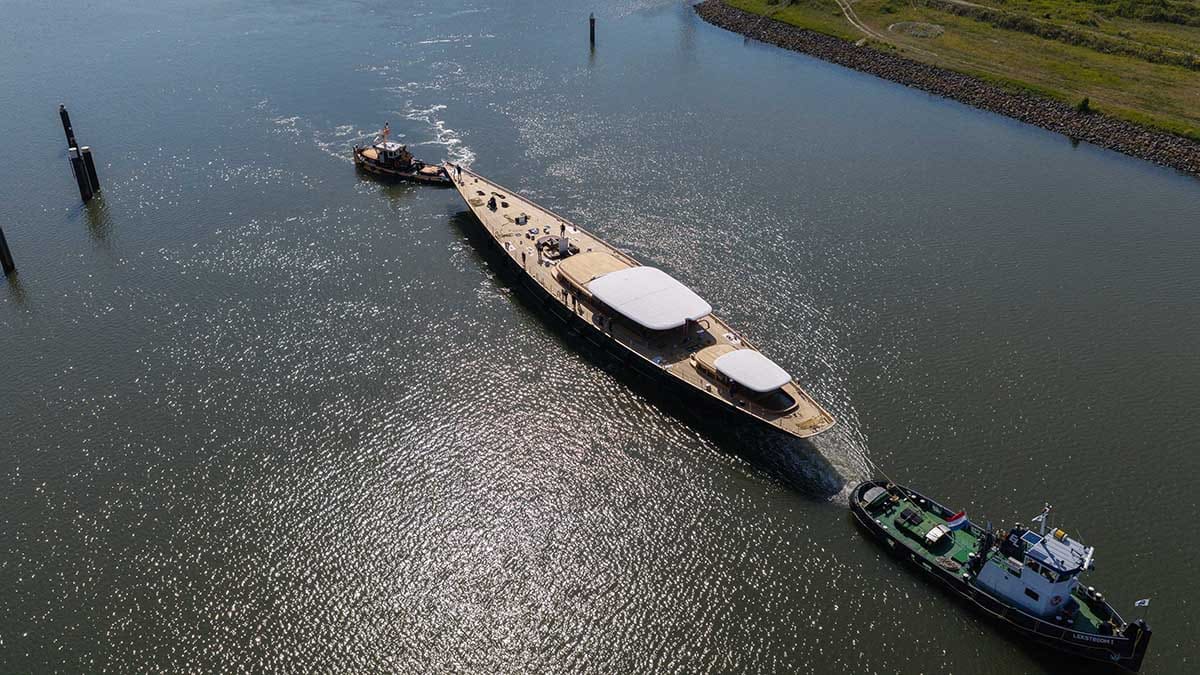
The Yacht That Started as a Dare
There is a particular shade of blue - Palma Blue, to be exact - that catches the light differently when it moves through water. Against the flat grey waters of Harlingen, the Netherlands, that color announced something unusual this July: a 230-foot sailing yacht that had emerged from her construction hall after three years of building, seven years of imagining, and more than 60,000 hours of engineering work aimed at answering a single question. Could a vessel this size sail indefinitely without fossil fuel?
At Global Chic Voyage, we have watched the superyacht industry grapple with its environmental footprint for the better part of a decade. The conversations at boat shows and design studios have shifted from horsepower to kilowatt-hours, from speed to range per charge, from ostentation to something quieter and more complex. Zero represents the furthest edge of that conversation - not a hybrid, not a compromise, but a complete rethinking of how power moves through a yacht.
Energy From Motion, Sun, and Wind
The engineering premise is elegant in theory, fiendishly difficult in execution. While Zero sails, a 250-kilowatt hydrogeneration system captures energy from the movement of water past her hull. Approximately 1,000 square feet of solar panels blanket her surfaces, drawing power from the sun. Wind contributes another 200 kilowatts of electrical generation. All of this flows into onboard battery banks, managed by software designed to balance generation and consumption with the kind of precision that makes two weeks of energy autonomy possible.
Vripack, the Dutch studio that led the design, describes the project as their "perfect storm" - a challenge that tested every assumption about how yachts are conceived, engineered, and built. Dykstra Naval Architects handled the hull and sailplan, while Vitters Shipyard executed the construction that began in 2023. The result is a vessel that can, in ideal conditions, sail with virtually unlimited range, drawing from the same forces that moved ships across oceans for millennia, now converted into electrons instead of simply forward motion.
The concept is not entirely new - hydrogeneration has appeared on smaller vessels, solar panels are increasingly common, and wind turbines have been tested in various marine contexts. What distinguishes Zero is the integration at scale, the ambition to power not just propulsion but the full suite of systems that make a modern superyacht habitable: climate control, desalination, galley equipment, entertainment systems, navigation electronics. The yacht is, in effect, a floating microgrid, and the question now moving into sea trials is whether the theory holds when weather turns foul and guests expect hot showers.
Design That Borrows From the Past
Zero's exterior silhouette reads as a conversation between eras. Her lines recall the classic proportions of early 20th-century sailing yachts - low superstructure, uncluttered deck, a sense of purpose rather than spectacle. The choice of FSC-certified Brazilian teak for exterior surfaces and the streamlined form suggest that sustainability here extends beyond the powerplant into material sourcing and hydrodynamic efficiency.
Inside, Vripack has leaned into natural materials with a restraint that feels almost radical in a sector known for gilt and gloss. Smoked European oak, stone treated with a "leathered" finish that softens its tactile presence, and a palette drawn from coastal landscapes rather than hotel lobbies. The yacht accommodates twelve guests across four cabins, each inspired by a destination meaningful to the owner - a detail that hints at the vessel's intended use as both private retreat and itinerant research platform.
The design choices reflect a broader shift we have observed in luxury travel: a move away from environments that insulate guests from place, toward spaces that frame and amplify the experience of being somewhere specific. Zero is not a floating palace; she is a conveyance, and her interiors acknowledge that the real luxury is what lies beyond the portholes.
Open-Source Ambition
Perhaps the most unusual aspect of Zero is what happens after her delivery later this year. The vessel has been structured as a fully open-source science project, with all design data, performance metrics, and engineering solutions made publicly available through the non-profit Foundation Zero. In an industry where intellectual property is fiercely guarded and competitive advantage is measured in knots and guest-cabin counts, this represents a fundamentally different approach.
The logic is pragmatic: if renewable-energy yachting is to move from boutique experiment to industry standard, the learning curve must be shared. Vitters Shipyard and the design team have effectively turned Zero into a teaching tool, a publicly accessible proof-of-concept that other yards, designers, and owners can study, adapt, and improve upon. The yacht will be used for private cruising, select charters, and ongoing scientific research - each voyage generating data that feeds back into the broader project of decarbonizing marine leisure.
This openness also functions as a form of accountability. By making performance data public, the team behind Zero has committed to transparency about what works and what does not. Sea trials beginning this summer will test the hydrogeneration system under varying conditions, validate the battery management software, and measure the gap between theoretical energy autonomy and real-world usage patterns. Those results will be shared, not buried in proprietary reports.
The Pragmatics of Renewable Cruising
The question that follows Zero from her launch is not whether renewable energy can power a superyacht - clearly, it can - but whether it can do so in a way that meets the expectations of owners accustomed to go-anywhere, do-anything capability. Two weeks of energy autonomy sounds impressive until you consider that traditional yachts can refuel in a matter of hours at any port with a diesel pump. Battery-dependent vessels require longer charging windows, more careful route planning, and a willingness to accept that some itineraries may need to bend around available sunlight and wind.
This is where Zero's dual identity as private yacht and research platform becomes relevant. Early adopters of any technology accept trade-offs in exchange for the satisfaction of pushing boundaries. The owner of Zero is, by definition, someone comfortable with the idea that this voyage is as much experiment as vacation. Future iterations, informed by data from Zero's sea trials, will presumably smooth out the rough edges, shorten charging times, increase energy density, and expand the operational envelope.
At Global Chic Voyage, we remain curious about how renewable propulsion reshapes not just the mechanics of yachting but the culture of it. If range becomes a function of weather and season, if itineraries must account for solar exposure and prevailing winds, does that constraint become a feature rather than a bug - a return to the kind of sailing that requires attention to natural forces, that rewards patience and planning over brute-force motoring? Zero suggests that the future of luxury on the water may look less like a hotel that happens to float and more like a sophisticated instrument for engaging with the sea on its own terms.
A Benchmark, Not a Finish Line
Zero's launch in Harlingen marks a beginning rather than a conclusion. The yacht now enters a phase of rigorous testing, with systems subjected to the kind of stress that no design studio can fully simulate. Hydrogeneration performance in rough seas, battery longevity under repeated deep cycles, the efficiency of energy management software when demand spikes - these are questions that can only be answered with time and miles.
What Zero offers the broader industry is a benchmark, a data point against which future projects can be measured. She demonstrates that renewable operation at this scale is technically feasible, economically viable for a certain class of owner, and aesthetically coherent - that sustainability and beauty need not be opposing forces. Whether she represents a template that other yards will follow or a singular experiment tied to one visionary owner's commitment remains to be seen.
The yacht will sail privately, host select charter guests, and serve as a platform for marine research - a hybrid life that mirrors her hybrid identity as luxury vessel and scientific instrument. And through Foundation Zero, her story will continue to unfold in public, a rare transparency in an industry that typically keeps its innovations behind locked doors and non-disclosure agreements.
As Zero sets off on her sea trials this summer, she carries with her not just passengers and crew, but the accumulated hope of designers, engineers, and sailors who believe that the future of yachting can be written in wind, sun, and water - renewable, endlessly replenished, and as old as the sea itself.
Spot something wrong? Email editors@globalchicvoyage.com. We log every correction publicly.
RELATED
SEE ALL →
31 Jul 2026 / 5 min
14 Jul 2026 / 5 min
14 Jun 2026 / 5 min

8 Aug 2026 / 5 min