
Scale and Singularity: Inside the New Era of Bespoke Superyachts
As European yards turn toward vessels exceeding 260 feet, one Italian shipbuilder reveals how radical customization is reshaping the definition of floating luxury.
VJ
31 Jul 2026 · 5 MIN READ · UPDATED 17 AUG 2026
The Return to Radical Individualism
There is a moment, somewhere past the 250-foot threshold, when a yacht stops being a vessel and begins to resemble a private archipelago. The air changes. The scale no longer suggests mobility but permanence, as though the ocean itself has been asked to accommodate a piece of architecture that happens to float. At Global Chic Voyage, we've watched this transformation unfold over the past decade, as the world's most ambitious shipyards have quietly begun to speak a new language: not of standard models or production lines, but of singular creations that exist only once.
ISA Yachts has just entered this conversation with unusual clarity. The Italian shipyard recently introduced its Large Yacht Collection, a portfolio of vessels spanning 262 to 295 feet, each one built entirely to specification. There are no catalog options here, no shared platforms dressed in different veneers. Instead, the yard offers what it calls a technical foundation, honed through years of building large-displacement yachts, upon which owners and designers can construct something that has never existed before.
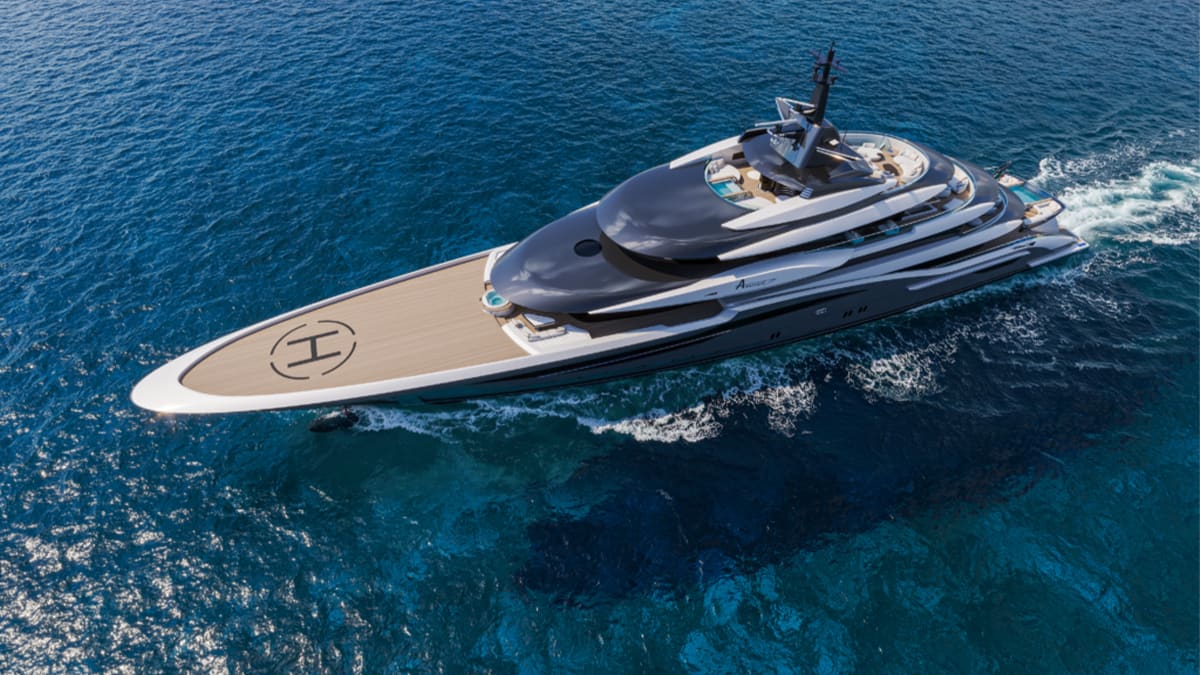
Leading this new chapter is Amarcord 82, a 269-foot concept designed by Nuvolari Lenard. The yacht's profile speaks in the taut, muscular vocabulary of Italian automotive design: long, horizontal lines that stretch the eye toward the horizon, a bow that tapers like the prow of a racing hull, and a superstructure that appears to hover rather than rest. It is not a subtle silhouette, but neither is it bombastic. There is restraint in the proportions, a sense that every line has been earned.
Transparency as Architecture
What distinguishes Amarcord 82 from many of its peers is not its size but its use of light and void. A glass-bottomed pool sits directly on the main deck, filtering sunlight and shadow down into the beach club below. The effect is less about spectacle than atmosphere: the interplay of water, light, and steel transforms the lower deck into something closer to a subaquatic pavilion. Two fold-down balconies extend the beach club laterally, creating a platform that hovers just above the waterline, a liminal space between vessel and sea.
Above, the bow is given over almost entirely to a helipad, a functional necessity that also serves as a visual anchor. The expanse of open deck at the forward end balances the layered terraces at the stern, where two additional pools and a series of alfresco dining zones cascade down the aft section. It is a composition that reads less like a boat and more like a vertical resort, each level offering a different relationship to the water and sky.
Inside, five VIP cabins accompany an owner's suite that spans more than 1,070 square feet. The accommodations are designed for a maximum of twelve guests, a modest number given the yacht's overall volume. But that restraint is the point. The Large Yacht Collection is not about maximizing berths or optimizing occupancy. It is about creating the kind of spatial generosity that allows a journey to feel unhurried, where corridors are wide enough to forget you are at sea, and where the owner's quarters can unfold across multiple rooms without compromise.
The Philosophy of the Unrepeatable
Giuseppe Palumbo, who leads Palumbo Superyachts, the parent company of ISA, has described the Large Yacht Collection as an exercise in turning vision into reality without compromise. It is a statement that sounds like marketing until you consider what it actually requires: a shipyard willing to forego the efficiencies of serial production, a design studio capable of working without templates, and an owner prepared to invest not just capital but patience.
We have seen this model succeed before, in the world of custom architecture and haute couture, where the value lies not in replication but in the impossibility of replication. The yacht becomes a portrait of its owner, a three-dimensional autobiography rendered in steel, teak, and glass. But it also demands a different kind of relationship between builder and client, one that resembles collaboration more than transaction.
ISA has been building toward this moment for years. Its Gran Turismo 80, Gran Turismo 100, and ISA Custom collections have all included vessels well over 200 feet, each one contributing to the yard's understanding of how large-displacement yachts behave, how their systems integrate, and how their interiors can be organized to feel coherent rather than labyrinthine. Earlier this month, the yard delivered Sea Raider X, a 220-footer that held the title of ISA's largest yacht until Amarcord 82 enters the water.
The Economics of Singularity
There is an economic logic at work here, though it operates on a timescale that defies quarterly earnings. A fully customized superyacht in the 260-foot range represents a multi-year commitment, often involving dozens of artisans, engineers, and designers working in concert. The cost is substantial, but so is the result: a vessel that cannot be purchased off the shelf, that will not be duplicated, and that carries with it the unmistakable patina of human craft.
This is not a market driven by volume. It is driven by clients for whom the primary luxury is not amenities but authorship, the ability to commission something that reflects not just taste but identity. In this context, the Large Yacht Collection is less a product line than a manifesto: a declaration that the most valuable thing a shipyard can offer is not efficiency but the freedom to imagine without constraint.
What the Shift Signals
The emergence of collections like ISA's suggests a broader shift in how the ultra-luxury marine sector understands its role. For years, the industry has oscillated between two poles: the bespoke atelier model, where each yacht is a one-off, and the semi-custom approach, where buyers select from a menu of options within a fixed hull. The Large Yacht Collection attempts to occupy both positions simultaneously, offering the structural backbone of a proven platform while leaving every visible and experiential element open to reinvention.
It is a model that places enormous trust in the design process. Without the guardrails of a standard layout, every decision - from the placement of a staircase to the orientation of a sun deck - becomes consequential. The result can be transcendent, but it can also be incoherent if the vision is unclear or the execution falters. ISA is betting that its accumulated experience building large yachts will provide the necessary ballast, the invisible structure that allows radical customization to succeed.
The Horizon Ahead
Amarcord 82 is still a concept, a set of renderings and specifications that await the commitment of an owner and the reality of construction. But its introduction signals where ISA believes the future lies: not in incremental refinements of existing models, but in the creation of vessels that exist outside any category, that answer only to the vision of the person who commissions them.
At Global Chic Voyage, we have always believed that the most compelling journeys are those that cannot be replicated, that unfold according to their own internal logic rather than a predetermined itinerary. The same principle applies to the vessels that make those journeys possible. In an age when so much of luxury has been standardized, when even bespoke experiences often follow familiar scripts, the promise of something truly singular remains the rarest offering of all. ISA's Large Yacht Collection is a wager that this kind of singularity still matters, that there are clients who seek not just a superyacht but the superyacht that could only ever belong to them.
Credit: ISA Yachts
Spot something wrong? Email editors@globalchicvoyage.com. We log every correction publicly.
RELATED
SEE ALL →
14 Jul 2026 / 5 min
29 Jul 2026 / 5 min

8 Aug 2026 / 5 min
8 Aug 2026 / 5 min