
Inside the Four-Restaurant Journey Redefining Luxury Food Experiences in Europe
Elysian Tales opens kitchen doors and secures impossible reservations across Madrid, Lisbon, and Barcelona.
SI
10 Jul 2026 · 5 MIN READ · UPDATED 17 AUG 2026
When Access Becomes the Experience
There is a moment, midway through an evening in Madrid's Justicia neighborhood, when you realize you are standing inside a Michelin-starred kitchen with a pair of tweezers in one hand and a glass of Corpinnat in the other. The chef is guiding your hand as you arrange delicate vegetables into a menestra, the traditional northern Spanish stew now plated like edible architecture. Around you, the kitchen hums with pre-service energy. This is not observation. This is immersion.
At Global Chic Voyage, we have watched the luxury travel industry wrestle with authenticity for years, often mistaking exclusivity for depth. What Marwa Preston has built with Elysian Tales since launching in May feels different. The company offers four-hour, four-restaurant itineraries across Madrid, Barcelona, and Lisbon, with Paris slated to join the roster this autumn. But the structure barely hints at the real ambition: to collapse the distance between traveler and city, between diner and kitchen, between wanting to understand a place and actually tasting it.
Preston, a former Microsoft professional who pivoted into hospitality, describes the 400-euro-per-person experience as something beyond a food tour. She is correct. The model she has engineered operates more like a series of private, timed interventions, each calibrated to reveal a different layer of a city's culinary identity. The logistics alone require constant coordination with chefs, sommeliers, and hosts, ensuring that guests move seamlessly from one setting to the next without the friction of reservations, translations, or indecision.
The Architecture of an Evening
Every Elysian Tales itinerary begins inside a Michelin-recognized kitchen. In Madrid, that means Saddle, where guests are ushered behind the line just before dinner service. A cone-shaped tower of Normandy butter arrives alongside sourdough from Panic, a local bakery with a permanent waitlist. You eat. You drink premium Cava. You participate in the assembly of your own dish, guided by the brigade. Preston notes that Saddle had never opened its kitchen to diners in this way before she proposed the partnership. The restaurant agreed, and the format became the blueprint for every city Elysian Tales now serves.
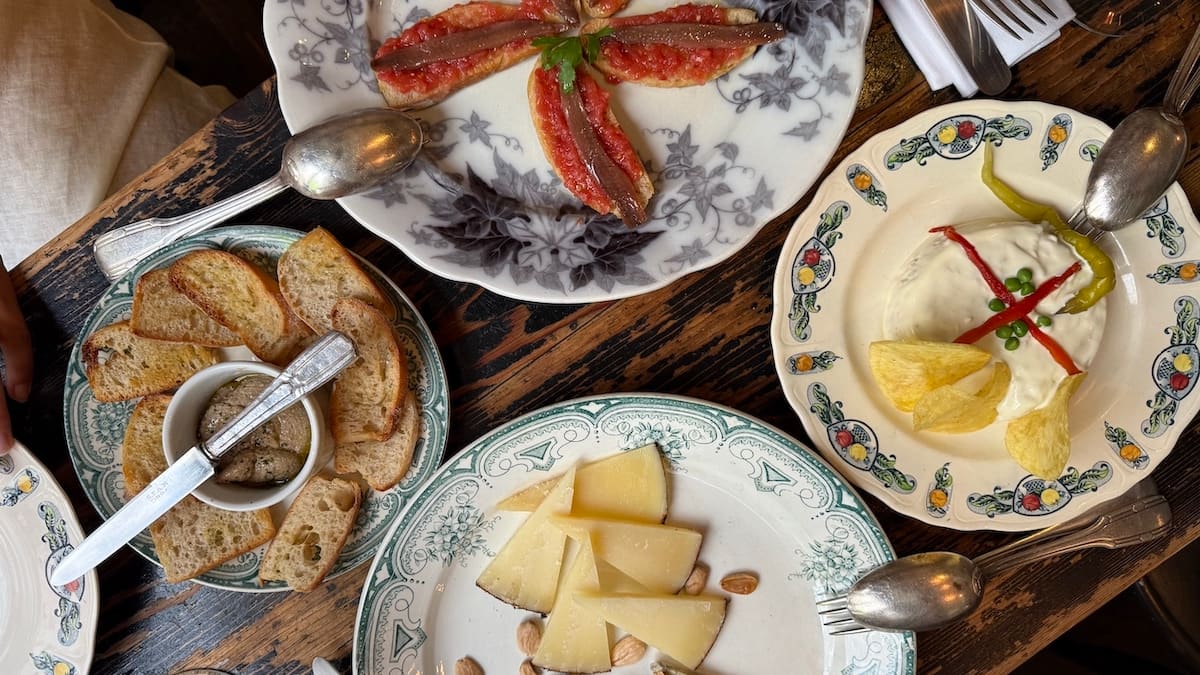
The second stop pivots to tradition. In Madrid, this means a taberna, a category Preston is fiercely protective of. She seeks out establishments where Spanish remains the dominant language, where tiles and marble and century-old recipes still hold court. Carmencita, a 19th-century relic adorned with hand-painted ceramics, serves vermouth in glassware selected exclusively for Elysian Tales guests. Cantabrian anchovies, Russian salad, housemade beef pâté. The menu is small, deliberate, and increasingly rare. Preston describes these venues as the last ones standing, places that have resisted the homogenizing tide of English menus and Instagram-first design.
The third restaurant swings in the opposite direction. Here, the brief is heat: the tables everyone wants right now, the reservations that require persistence or luck. In Madrid, that means Charrúa, a dimly lit Uruguayan steakhouse where the tomatoes are as celebrated as the beef. The room buzzes with romantic dinners and family celebrations. You understand, immediately, that you have landed somewhere coveted.
The Cocktail as Conversation
The final act unfolds in a cocktail bar. In Madrid, Bar Manero provides the setting, a maximalist interior that feels more like a cabinet of curiosities than a drinks venue. But the real departure happens in how the cocktail is conceived. Instead of asking guests what they typically order, the host presents them with perfumes, music, occasionally art. Preferences are intuited from mood and sensory response. The drink that arrives is less a menu selection and more a distillation of the evening's energy.
Preston resists the label of tour operator. She prefers to describe what Elysian Tales does as hospitality engineering. Hosts manage dietary restrictions in real time. Menus are pre-arranged with each restaurant to showcase both the venue and the destination, whether that means a bifana sandwich in Lisbon or a Catalan-inflected interpretation of Alain Passard's egg dish at Franca Barcelona. Guests make no decisions for four hours. The element of surprise, Preston has found, is part of the appeal.
The Geography of Taste
Each city in the Elysian Tales portfolio has been chosen not for its tourism infrastructure but for the density and diversity of its culinary landscape. Madrid's Justicia and Chueca neighborhoods, where the company was founded, offer a tight cluster of traditional tabernas, Michelin kitchens, and buzzing contemporary dining rooms. Lisbon's tascas provide a different kind of intimacy, one rooted in neighborhood rhythms and century-old recipes. Barcelona layers in Catalan identity, zero-waste philosophy, and a design sensibility that runs through even the smallest plate.
The walking component is deliberate. Preston confines each itinerary to one or two neighborhoods, ensuring that guests never walk more than fifteen minutes between stops. For those with mobility concerns or an aversion to summer humidity, cars can be arranged. The tours are typically conducted in the evening, though daytime versions are available and often feature the same venues.
What Luxury Means Now
We have returned to the question of access repeatedly this year. In an era when nearly every restaurant menu is available online, when reservations can be secured through apps, when Google Reviews flatten the hierarchy of taste, what does it mean to offer something truly exclusive? Elysian Tales answers by collapsing time and opening doors. The company negotiates terms that regular diners cannot. A 45-minute window inside Quique Dacosta's Deessa. A private tasting in a taberna that does not advertise. Glassware reserved for a single tour operator. These are not experiences you can replicate by reading the right blog or following the right account.
Preston's background in technology is evident in the systems she has built. Timing is precise. Communication between venues is constant. The experience feels effortless because the infrastructure behind it is obsessively managed. This is luxury as logistics, as the removal of friction, as the orchestration of moments that feel spontaneous but are, in fact, meticulously choreographed.
The Last Ones Standing
There is a thread of preservation running through the Elysian Tales model, even if Preston does not frame it in those terms. The traditional tabernas and tascas she partners with are disappearing. Rising rents, shifting demographics, and the pressure to cater to international tourists have eroded the category. By directing well-heeled travelers to these venues and paying premium rates for exclusive access, Preston is creating an economic case for their survival. It is not activism. It is market logic in the service of culture.
The expansion into Paris this fall will test whether the model translates beyond the Iberian Peninsula. French bistros occupy a similar cultural position to Spanish tabernas, but the dining culture in Paris operates under different codes. Preston will need to negotiate not just access but trust, particularly in a city where culinary tradition is both fiercely guarded and endlessly commodified.
The Measure of Four Hours
At the end of an Elysian Tales evening, you will have eaten in four restaurants, met at least one chef, walked through two neighborhoods, and consumed more vermouth and Cava than you planned. You will not have waited for a table, puzzled over a menu, or wondered whether you ordered the right dish. You will have been guided, fed, and entertained. Whether that constitutes a tour or something else entirely depends on how you define the terms.
What is certain is that the experience Preston has designed operates at the intersection of curation and convenience, two qualities that luxury travelers increasingly expect to coexist. The food is excellent. The access is real. The stories are layered. And for four hours, you are not a tourist navigating a foreign city. You are a guest inside it, moving through kitchens and dining rooms with the ease of someone who belongs.
Photo: Elysian Tales
Spot something wrong? Email editors@globalchicvoyage.com. We log every correction publicly.
RELATED
SEE ALL →
21 Jul 2026 / 5 min
31 Jul 2026 / 5 min
19 Jul 2026 / 5 min

18 Jul 2026 / 5 min