
Ojai Holds Secrets the Coast Cannot Keep
California's Valley of the Moon unfolds beyond the highways - a place where pink light touches ancient mountains and the pace belongs to another century.
CG
16 Jun 2026 · 5 MIN READ · UPDATED 17 AUG 2026
The Valley Time Forgot
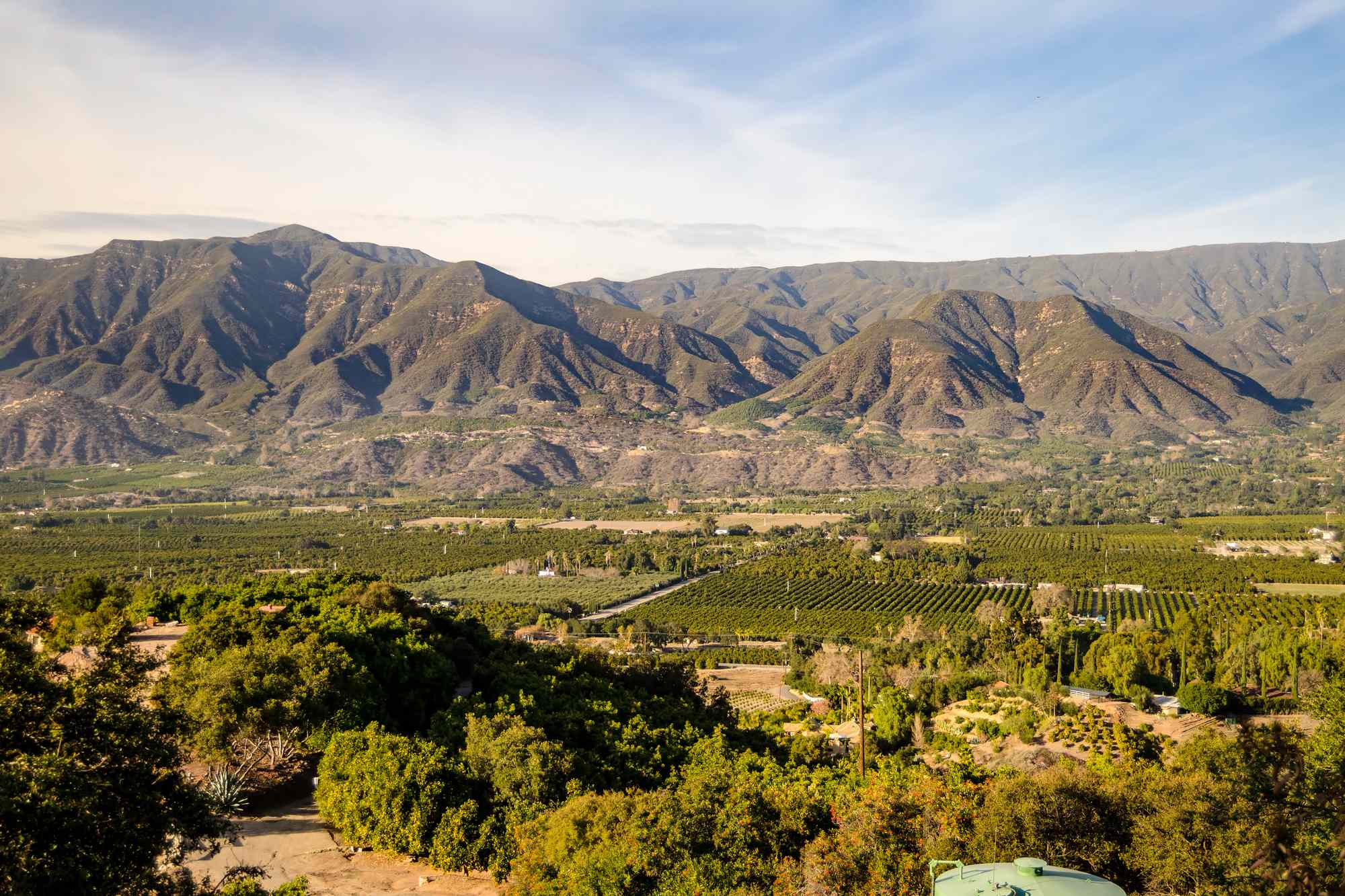
There is a moment, just after the sun begins its descent behind the western ridges, when the Topatopa Mountains blush. Locals call it the Pink Moment - a phenomenon that has nothing to do with filters or exaggeration and everything to do with geology, angle, and a kind of atmospheric alchemy that turns stone the color of rosé. We have watched visitors stop mid-sentence when it happens, their phones lowered, their faces turned eastward toward peaks that have held this valley in their embrace for millennia.
Ojai sits four square miles wide, cradled in those rolling mountains northeast of Santa Barbara, far enough from Interstate 5 and Highway 101 that it has remained stubbornly itself. The Chumash people called this place home for more than ten thousand years; their word for moon gave the valley its name and its nickname. Later came cattle ranches sprawling across golden hills, then seekers drawn in the 1920s by whispers of energy vortexes and spiritual resonance. While California's great transportation corridors carved paths elsewhere, Ojai was left to its quiet.
At Global Chic Voyage, we have returned to places that resist the velocity of modern travel, and Ojai is among them. It is not a destination that rewards the itinerary-obsessed or the checklist traveler. It is, instead, a place that asks you to slow down - to walk its four-mile breadth, to linger over a meal that stretches into evening, to understand that the best experiences here are the ones that cannot be scheduled.
Where the Streets End and the Groves Begin
Downtown Ojai unfolds in a way that feels deliberate, almost cinematic - a main thoroughfare lined with oak trees, pedestrians moving without urgency, a vintage trolley parked as if waiting for a film crew that never arrived. The Ojai Valley Museum occupies a converted church, its modest galleries offering both ecological context and local history, staffed by residents who know which trails flood in winter and which cafés open earliest.
Around the corner, Bart's Books sprawls across an indoor-outdoor labyrinth that its founders have been building since 1964. More than a hundred thousand titles - new, used, forgotten, rediscovered - fill shelves that spill into open air beneath the branches of mature oaks. We have spent hours in such places, coffee in hand, the boundary between commerce and leisure dissolved into something closer to ritual.
The shops that radiate outward from this center reflect a particular sensibility: Fig Curated Living and Cercana traffic in home goods that lean toward the handmade and the considered; Kariella offers clothing that suggests a life lived outdoors but styled with intention. The Heavenly Honey Company conducts tastings that reveal the terroir of local apiaries, while the family-operated Ojai Olive Oil Company cultivates fifty acres of olive varietals a short drive from downtown. The bottles make fine souvenirs, but more than that, they carry the flavor of a place - peppery, grassy, unmistakably Californian.
Trails That Lead Nowhere Urgent
Ojai's proximity to Los Padres National Forest transforms the valley into a staging ground for exploration. The 15-mile Ojai Valley Bike Trail stretches southwest toward Ventura and the Pacific, drawing cyclists who prefer their routes scenic rather than flat. On foot, the 3.6-mile Shelf Road Trail winds through Valley View Preserve, offering vistas that justify the elevation gain. Ojai Meadows Preserve holds its own quieter paths, the kind where you are more likely to encounter a hawk than another hiker.
We have long believed that a destination reveals its character not in its landmarks but in its margins - the trail that does not appear in guidebooks, the farm open to visitors by appointment, the llama sanctuary that exists because someone decided this valley could support such whimsy. Ojai offers these margins generously. Orange groves stretch in tidy rows, their blossoms perfuming spring air. The landscape rewards aimlessness.
And then, of course, there is the light. The Pink Moment occurs with enough regularity that locals can predict it, yet it retains the quality of a gift. The Topatopa range catches the last indirect rays, the stone turning shades of salmon and coral and something that has no proper name. It lasts only minutes. Firepits are oriented eastward for this reason; restaurant patios fill at golden hour; cameras are readied not out of obligation but because some things should be remembered.
Tables That Anchor the Day
Ojai's dining scene operates at a scale and ambition that contradicts its size. Ojai Rotie occupies a Mediterranean niche, its outdoor patio designed for the kind of meal that stretches from late afternoon into evening. The rotisserie chicken arrives simple and correct - golden skin, herb-flecked, the sort of dish that requires no flourish because the technique is sound. After a day on the trails, it is exactly what the body wants: nourishing, unfussy, rooted in quality rather than concept.
The Dutchess has earned recognition from Michelin inspectors for Burmese American cooking that balances tradition and invention - coconut chickpea curry rich with spice, a fried chicken sandwich elevated by chili sauce that builds heat slowly. The bakery program here is equally serious; sourdough loaves and pastries draw regulars who arrive early and linger over coffee, the morning unfolding without hurry.
Rory's Place, also Michelin-recognized, sources from the Channel Islands and the California coast. Broiled oysters arrive glossed with chili butter; California king salmon is plated alongside trout roe, each element speaking to seasonality and proximity. The natural wine list skews toward small producers, the kind of bottles that reflect a winemaker's hand rather than a corporate portfolio. The space itself feels intimate, the service warm without formality - a reflection, perhaps, of Ojai's broader ethos.
For Vietnamese cooking, the Ojai Noodle House delivers without pretense. The Nest of Ojai leans into Californian idiom - salmon tacos, a jalapeño bacon smash burger substantial enough to satisfy post-hike appetites. Between meals, Three Birds operates as both bookstore and coffeehouse, the dual function so natural it seems strange that more establishments do not follow suit. A latte and a novel, sunlight slanting through windows, the hours passing as they should.
Rooms That Understand Rest
Lodging in Ojai ranges from the compact and quirky to the sprawling and full-service. Ojai Valley Inn anchors the latter category - a historic property covering enough acreage to accommodate 305 rooms, a spa, four pools, a golf course, tennis and pickleball courts, and six on-site restaurants. The scale might suggest resort anonymity, yet the inn manages a certain intimacy, perhaps because it has been here long enough to feel woven into the valley's fabric.
The firepits are positioned for evening viewing of the Pink Moment, a detail that speaks to an understanding of place. Guest terraces open onto landscaped grounds with the mountains beyond, the view a reminder that even at a property of this size, Ojai's geography remains the primary architecture. The inn functions as both destination and base camp - a place to retreat entirely or a hub from which to venture into the surrounding trails, groves, and preserves.
Elsewhere in town, smaller inns and boutique properties offer a different scale of hospitality, the kind where the proprietor knows your name and your coffee order by the second morning. We have stayed in both, and each serves its purpose. The choice depends less on budget than on temperament - whether you seek the amenities of a full resort or the quiet of a guesthouse where the only sound at night is wind moving through oak branches.
What the Valley Teaches
Ojai is accessible - an hour and a half from Los Angeles, close enough for a weekend yet far enough to feel removed from the city's centrifugal pull. But accessibility is not the same as ease, at least not in the contemporary sense. There is no algorithm here for optimizing your time, no app that will unlock hidden experiences. The valley rewards presence over efficiency.
We have written often about places that resist commodification, that hold themselves slightly apart from the machinery of modern tourism. Ojai is such a place. It has Michelin-recognized restaurants and a well-appointed inn, yes, but these exist within a broader context - a town of four square miles where the most memorable moments are often the simplest. A sunset that turns mountains pink. A bookstore where you lose track of time. A trail that leads to a view you did not expect.
The Chumash understood something about this valley that later arrivals have spent centuries trying to articulate. There is an energy here, though not the mystical kind that draws seekers with crystals and incense. It is the energy of a place that has remained largely itself despite the changes swirling around it - a valley where cattle once grazed, where olive trees now grow in orderly rows, where the light at day's end performs the same transformation it has performed for millennia.
Tourism, when done thoughtfully, is not about consumption but about exchange - what we bring to a place and what it offers in return. Ojai asks little: that you slow down, that you pay attention, that you allow the valley's particular rhythms to reshape your own. In exchange, it offers something increasingly rare - a pocket of California where quiet is not an absence but a presence, where beauty is not curated but inherent, where the best itinerary is the one you abandon in favor of wherever the day leads.
The Pink Moment will happen again this evening, and tomorrow evening, and the evening after that. The mountains will glow, the light will shift, and visitors will pause to watch. Some will photograph it; others will simply stand and look. Both responses are correct. Ojai does not demand anything of you except that you be there, in that moment, when the valley reveals what it has always been: a place where time moves differently, where the moon gave its name to the land, and where the secrets the coast cannot keep are held safe in the embrace of ancient stone.
Spot something wrong? Email editors@globalchicvoyage.com. We log every correction publicly.
RELATED
SEE ALL →
27 Jul 2026 / 5 min
27 Jul 2026 / 5 min
27 Jul 2026 / 5 min
24 Jul 2026 / 5 min