
The Quiet Lure of Laos: Southeast Asia's Last Unhurried Country
Beyond the well-worn trails of Thailand and Vietnam lies a landlocked nation where rivers still set the pace of life and visitors remain welcome guests, not revenue streams.
SI
27 Jul 2026 · 5 MIN READ · UPDATED 17 AUG 2026
Where Time Moves Differently
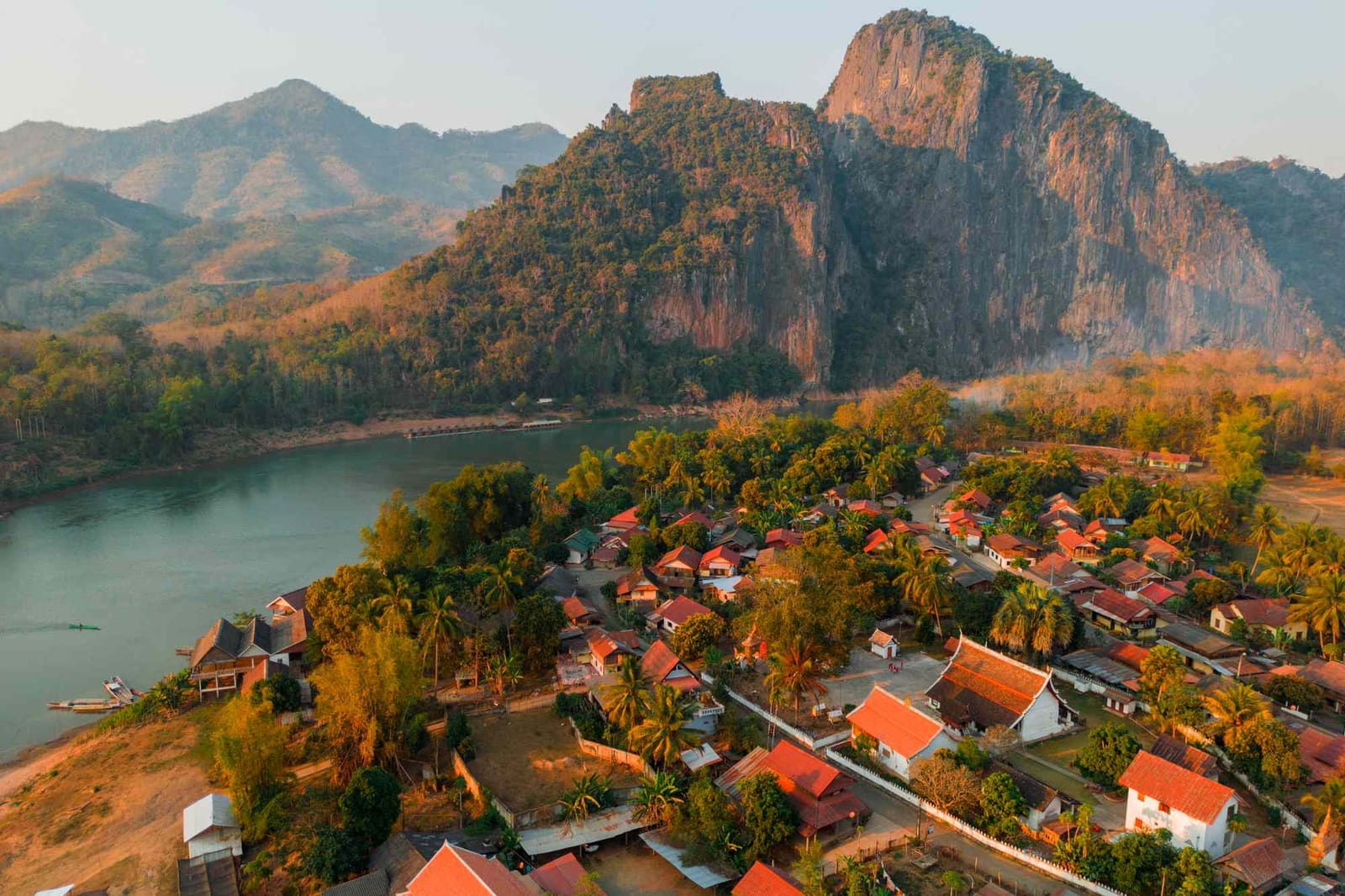
There is a particular quality to mornings along the Mekong that resists translation. Mist rises from the water in slow, deliberate layers. Monks in saffron robes walk barefoot through Luang Prabang's quiet streets, collecting alms as they have for centuries. By the time the sun burns through the haze, the day has already established its rhythm: unhurried, deliberate, profoundly its own. At Global Chic Voyage, we have watched Southeast Asia's tourism corridors swell and strain over the past decade, yet Laos remains curiously, blessedly apart from the frenzy.
The country occupies a geographic paradox. Landlocked between Thailand, Vietnam, Cambodia, Myanmar, and China, it should be a crossroads. Instead, it has become a refuge. While neighboring nations have built expressways and high-speed rail, Laos has preserved its network of rivers and mountain roads. While Bangkok and Hanoi race toward vertical expansion, Vientiane's skyline remains low and modest. This is not backwardness. It is deliberation.
The Architecture of Stillness
What draws discerning travelers to Laos is not a lack of development but a different vision of what development might mean. The country's UNESCO World Heritage sites, Luang Prabang chief among them, demonstrate how colonial French architecture can coexist with Buddhist temples without erasing either. Wooden shophouses lean gently against whitewashed villas. Gilt stupas rise above red-tile roofs. The effect is neither museum nor theme park, but a living town where aesthetic continuity has been valued over rapid transformation.
This philosophy extends beyond the built environment. In the countryside, traditional stilt houses still predominate, their elevated platforms serving practical functions in a landscape shaped by monsoon cycles. Villages remain small, organized around communal spaces rather than commercial strips. Rice paddies follow the contours of valleys rather than the geometry of industrial agriculture. The landscape reads like a palimpsest: layers of history and ecology visible at once, each informing the other.
The River as Protagonist
To understand Laos is to understand its relationship with water. The Mekong is not merely a geographic feature but the country's central artery, shaping settlement patterns, trade routes, and cultural identity. Traveling upriver from the Thai border to Luang Prabang, one passes through terrain that has resisted easy categorization: limestone karsts that jut from the jungle like the bones of an ancient world, riverside villages accessible only by boat, stretches of forest so dense they seem to absorb sound.
The slow boat journey between Huay Xai and Luang Prabang has become something of a rite of passage for travelers seeking an alternative to air travel's compression of distance. Two days on the water, sleeping in guesthouses along the way, watching the river's moods shift from placid to churning and back again. It is inefficient by design, and therein lies its appeal. In an era when every journey is optimized for speed, the slow boat insists on a different calculus: immersion over efficiency, observation over arrival.
Culinary Quiet
Lao cuisine has not exploded onto the global stage the way Thai or Vietnamese food has, and this too feels intentional. The food here is subtle, built on fermented fish, sticky rice, and an array of herbs that grow wild along riverbanks and forest edges. Larb, the minced meat salad seasoned with lime and fish sauce, varies from village to village, each version reflecting local tastes and available ingredients. Tam mak hoong, the Lao cousin of papaya salad, arrives at the table with a funkiness that speaks to the country's embrace of fermentation as both preservation technique and flavor philosophy.
At the night markets in Luang Prabang, vendors grill fish wrapped in banana leaves, the smoke mingling with the scent of jasmine rice steaming in bamboo tubes. There are no Michelin stars here, no celebrity chefs packaging "authentic" experiences for export. Instead, there is the quiet confidence of a cuisine that has not needed to shout to be heard. The meals we have shared in Laos, from riverside shacks to family-run guesthouses, have been marked by generosity rather than spectacle, flavor rather than theater.
The Elephant in the Valley
Laos was once known as Lan Xang, the Kingdom of a Million Elephants. Today, only a few hundred remain, most in captivity or semi-wild sanctuaries. The decline mirrors broader patterns across Asia, where habitat loss and historical exploitation have devastated elephant populations. Yet Laos has also emerged as a leader in ethical elephant tourism, with several sanctuaries pivoting away from riding and performances toward observation and conservation.
Visiting these sanctuaries offers a window into the complexity of wildlife tourism in the developing world. The elephants, many rescued from logging operations or abusive tourism operations in neighboring countries, now live in protected forests where visitors can observe their behavior without direct interaction. It is a model that prioritizes animal welfare over visitor gratification, a rare stance in a region where tourism dollars often dictate conservation policy. The experience is less Instagram moment than quiet education, and it asks travelers to reconsider what it means to encounter wild animals on their own terms.
What Remains Unseen
Laos holds secrets that resist easy discovery. The Plain of Jars, scattered across the Xieng Khouang plateau, remains one of Southeast Asia's great archaeological mysteries: thousands of stone jars, some weighing several tons, their origins and purpose still debated among scholars. The Vieng Xai caves, northeast of the capital, served as a hidden city during the Secret War, sheltering thousands of civilians and government officials from American bombing campaigns. These sites do not advertise themselves. They require effort, curiosity, and a willingness to sit with discomfort.
The country's modern history is inseparable from the Vietnam War, during which Laos became the most heavily bombed nation per capita in history. Unexploded ordnance still litters the countryside, a deadly legacy that organizations continue to address decades later. Traveling through rural Laos means reckoning with this past, visible in the bomb casings repurposed as planters and fence posts, in the prosthetics worn by farmers who lost limbs to cluster munitions. It is a reminder that beauty and trauma often occupy the same geography.
The Question of Scale
At Global Chic Voyage, we have long argued that the measure of a destination is not how many visitors it attracts but how well it maintains its identity under the pressure of those arrivals. Laos, with its modest infrastructure and limited air connections, has so far avoided the overtourism that has strained Bali, Phuket, and Angkor Wat. The question is whether this is a temporary reprieve or a sustainable model.
The Lao government has stated ambitions to increase tourist arrivals, seeing the sector as a path to economic development. New hotels are rising in Vientiane and Luang Prabang, and Chinese investment has funded roads, dams, and a high-speed rail link that now connects the capital to the Chinese border. These developments promise prosperity but also risk eroding the very qualities that make Laos distinctive: its slowness, its quiet, its refusal to commodify every experience.
Why Now
There is a window, narrow and closing, when a place exists in a state of becoming without yet having arrived. Laos occupies that threshold. It has enough infrastructure to welcome travelers comfortably but not so much that the experience feels engineered. It offers luxury, in the form of boutique hotels and river cruises, without sacrificing authenticity. It remains affordable without feeling cheap, welcoming without being dependent.
For travelers weary of overtourism's homogenizing effects, Laos offers an alternative vision: a place where development is measured, where tradition is not performance, where the journey itself retains value. It is Southeast Asia as it was before the algorithms optimized it, before every vista became a backdrop for content creation. In an increasingly hurried world, Laos insists on its own pace. That, more than any temple or waterfall, is its greatest luxury.
Credit: Oleh Slobodeniuk / Getty Images
Spot something wrong? Email editors@globalchicvoyage.com. We log every correction publicly.
RELATED
SEE ALL →
31 Jul 2026 / 5 min

28 Jul 2026 / 5 min
22 Jul 2026 / 5 min
14 Jun 2026 / 5 min