
The 250-Hectare Madrid Club Where 35,000 Members Go to Escape the City
A morning at Real Club de Campo Villa reveals why this storied country club - part sporting institution, part time capsule - remains one of Spain's most coveted memberships.
VJ
27 Jun 2026 · 5 MIN READ · UPDATED 17 AUG 2026
The Morning Ritual
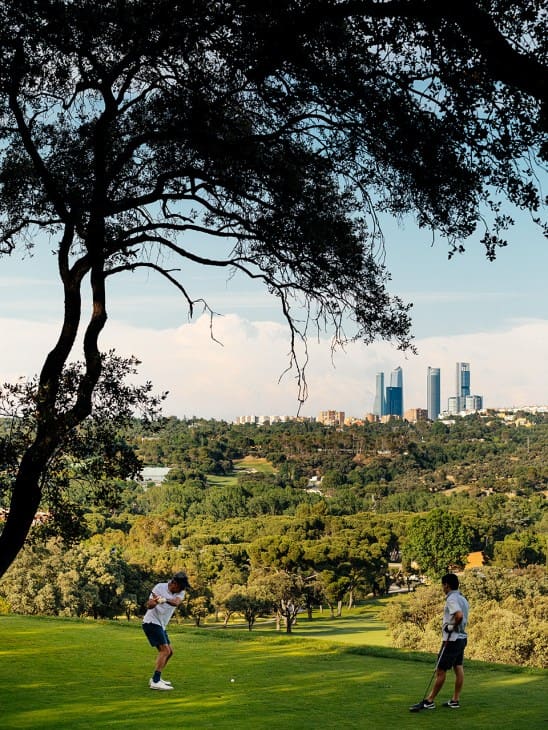
Half past eight. Sunlight filters sideways through the pines, casting long shadows across the lawns. Juan Carlos Vera Pró, general manager of Real Club de Campo Villa, begins his day the way he has since taking the role in 2019: a slow circuit of the grounds in his Volvo, windows down, noting what needs attention. The club sprawls across 250 hectares of rolling terrain wedged between the hum of a busy highway and the quieter presence of the Manzanares river. From above, it must look like an anachronism - all that green, all that stillness, just minutes from the centre of one of Europe's fastest-moving capitals.
At Global Chic Voyage, we've long held that the most revealing clubs are not the ones that announce themselves loudly, but the ones that simply persist. Real Club de Campo Villa is precisely that: a place whose popularity - 35,000 members, a waiting list measured in years - speaks less to marketing than to something deeper. It is a retreat in the truest sense, not from the world but from its pace.
Pró himself is an unlikely custodian of leisure. Before arriving here, he spent 26 years in Spain's national parliament. Now he spends his time handing out trophies - more than 600 participation medals to children at a recent hockey tournament alone - and overseeing an institution that houses 240 horses, an equestrian club, hockey pitches, croquet lawns, padel courts, and 34 tennis courts. The driving range is busy even at this hour, the rhythmic crack of eight-irons sending balls skyward the only sound that punctures the morning quiet.
A Landscape of Privilege and Access
What makes a club desirable is rarely the sum of its facilities. Real Club de Campo Villa has those in abundance - 14,000 golfers use its courses, and a planned virtual training centre promises to refine their swings with data-driven precision. But the real draw, the thing that keeps the waiting list long and the gates selective, is something less tangible: the sense that you are stepping into a version of Madrid that no longer exists elsewhere.
Only five minutes by car from the city centre, the club occupies land that feels impossibly removed. The architecture clings to an earlier era. The rhythms are slower. In the afternoons, tables in the clubhouse fill with games of bridge and canasta, the shuffle of cards and murmur of conversation a counterpoint to the digital hum of the city beyond. The adjoining café sees members reading newspapers in leather chairs crafted by Spanish firm Casa & Jardin, sipping cortados with the unhurried air of people who have nowhere else to be.
There is a lottery system in place for tee times, developed - according to club leadership - to eliminate any hint of favouritism. It is a small detail, but a telling one. In a club where some 6,000 members are expected to pass through the gates on a given weekend, fairness must be engineered, codified, made visible. The alternative would be chaos, or worse, the perception of insider dealing in a place that has worked hard to shed its more exclusive past.
The Weight of History
Real Club de Campo Villa was born of pique. In 1930, a group of young aristocrats - among them a duke and a count - grew so irritated by price increases at another country club that they decided to found their own. They pooled land, added adjoining hectares granted by the crown, and created a private enclave that reflected their tastes and their station. A year later, the declaration of the Second Spanish Republic upended that arrangement. The land was ceded to the local government, a symbolic shift that mirrored the broader political upheaval sweeping the country.
When the Spanish Civil War ended in 1939, the club reverted to private hands, a status it maintained until 1984. That year, in a move that reflected the new, more democratic spirit of post-Franco Spain, the club reopened as a public institution. Six thousand new members were admitted in one stroke, transforming it from an aristocratic retreat into something more populist, though no less exclusive in practice.
Today, Real Club de Campo Villa is owned by Madrid City Council, which holds a 51 per cent stake. The remainder is split equally between the national heritage department and the Royal Spanish Equestrian Society. Annual memberships are priced at €950, according to the club, though new admissions have been frozen for several years. Openings appear only when a member voluntarily relinquishes their spot or passes away - a morbid calculus that underscores just how tightly held these memberships are.
There are exceptions. Rafael Nadal was recently granted honorary membership after hosting a charity tournament on the grounds. Last year, Spain's king bestowed a royal honour of sporting excellence on the club, prompting a subtle but significant update to its logo. These gestures matter. They signal continuity, tradition, the kind of institutional permanence that cannot be bought or engineered overnight.
The Architecture of Stillness
The Chalet de Arriba - known colloquially as Club Social - sits at the heart of the grounds, an event space designed by architect Luis Gutiérrez Soto in 1931. The scent of jasmine hangs in the air. From the terrace, a perfectly framed view of Madrid's skyline stretches across the valley, the city reduced to a distant silhouette. Inside, the clubhouse has the frozen-in-time quality of an embassy or a private library, all dark wood and leather and the kind of furniture that has been sat in by generations.
It is this atmosphere - part nostalgia, part anachronism - that defines the club's appeal. In a city that has modernised rapidly, Real Club de Campo Villa offers something increasingly rare: the chance to step out of time without leaving the city limits. The architecture does not announce itself. The service is discreet. The members, for the most part, are not here to be seen but to disappear.
We have noticed, in our travels, that the most enduring retreats are those that resist the urge to reinvent themselves. They understand that what people seek is not novelty but constancy, not spectacle but sanctuary. Real Club de Campo Villa, with its croquet lawns and equestrian rings and driving ranges, understands this implicitly. It does not chase trends. It does not rebrand. It simply persists, year after year, tournament after tournament, as the city around it transforms.
The Mechanics of Belonging
There is a paradox at the heart of Real Club de Campo Villa: it is a public institution that functions, in practice, like a private one. The frozen admissions list ensures that membership remains a privilege, not a right. The lottery system for tee times ensures fairness, but also reinforces scarcity. The result is a club that feels both accessible and exclusive, democratic in theory but selective in reality.
This tension is not unique to Real Club de Campo Villa. Many of the world's most coveted clubs operate in a similar grey area, balancing public ownership with private culture, openness with gatekeeping. What sets this club apart is its scale. With 35,000 members, it is not a small, rarefied circle but a sprawling community, one that encompasses families, retirees, competitive athletes, and casual players. The sheer number of members means that the club must constantly balance demand with capacity, tradition with innovation, exclusivity with inclusion.
The planned virtual training centre is one such innovation, a nod to the data-driven expectations of younger members who have grown up with swing analysis and performance metrics. But the driving range, with its simple pleasures and its unhurried pace, remains. The croquet lawns remain. The bridge games remain. The club evolves, but slowly, incrementally, in ways that do not alienate the members who have been coming here for decades.
Why It Endures
On a recent weekend morning, the grounds were alive with activity. Children in hockey jerseys chased balls across the pitch. Riders guided horses through the equestrian ring. Golfers lined up at the first tee, checking their watches, adjusting their grips. In the café, a group of older men debated politics over coffee, their voices rising and falling in familiar rhythms. Outside, the jasmine bloomed, and the skyline shimmered in the distance, and the city - for all its noise and urgency - felt very far away.
At Global Chic Voyage, we return to certain places not because they have changed but because they have not. Real Club de Campo Villa is one of those places. It is not perfect. It is not without its contradictions. But it offers something that cannot be replicated by a new hotel or a pop-up retreat or a wellness resort: a sense of continuity, of rootedness, of belonging to a tradition that predates you and will outlast you.
The waiting list will remain frozen. The lottery will continue to determine tee times. The jasmine will bloom each spring. And the members - all 35,000 of them - will continue to pass through the gates, seeking not escape but respite, not novelty but familiarity, not the future but a version of the past that still, somehow, endures.
Spot something wrong? Email editors@globalchicvoyage.com. We log every correction publicly.
RELATED
SEE ALL →
29 Jul 2026 / 5 min
23 Jul 2026 / 5 min
16 Jul 2026 / 5 min
10 Jul 2026 / 5 min