
The California Island Where Mediterranean Dreams Meet Pacific Blue
Twenty-two miles offshore, Catalina Island offers a European coastal sensibility without the transatlantic flight - and the kind of turquoise clarity that feels almost Caribbean.
ML
6 Jul 2026 · 5 MIN READ · UPDATED 17 AUG 2026
A Pocket of Another Climate, Another Pace
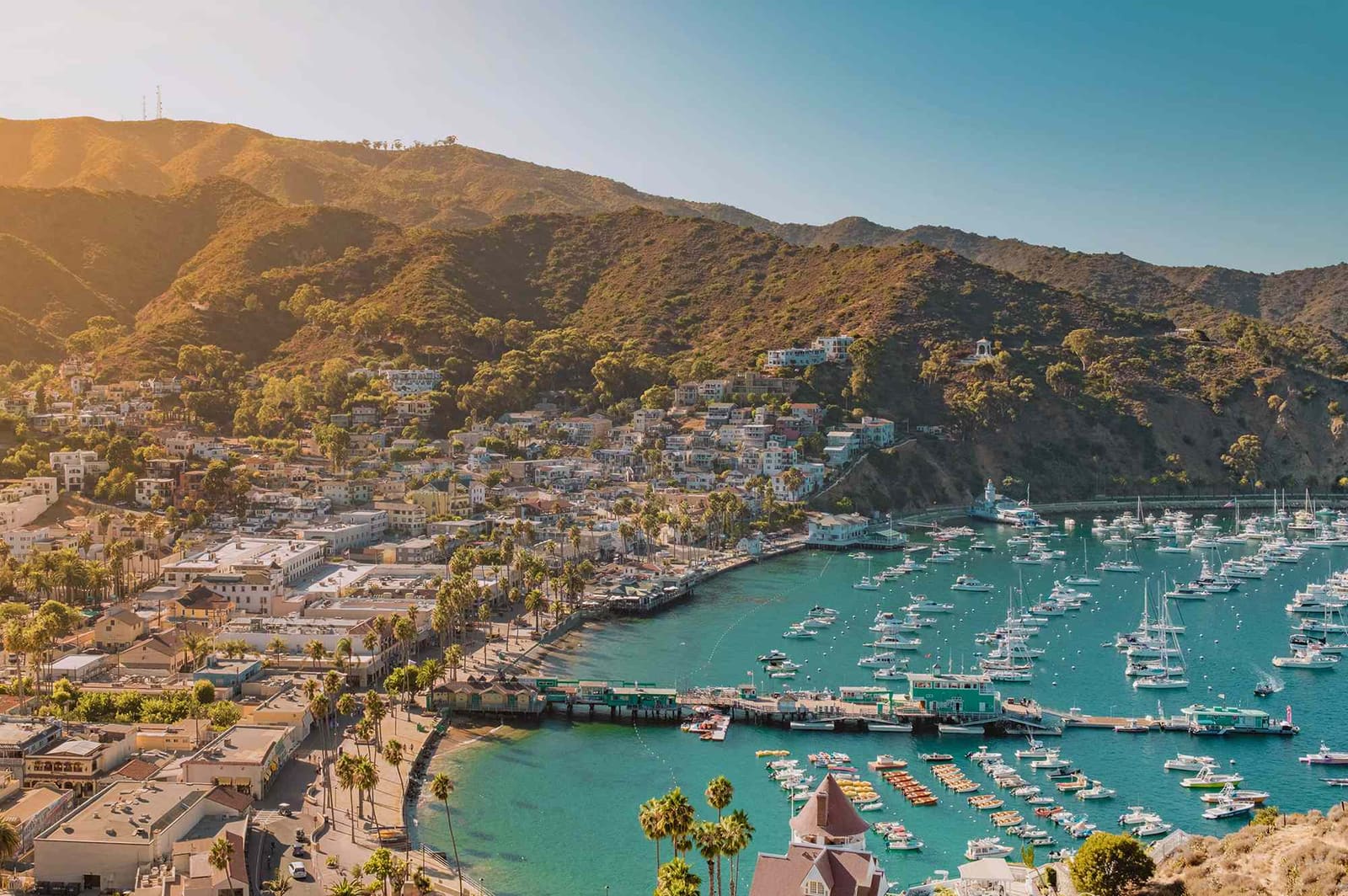
The ferry cuts through morning fog, and then - always suddenly - the outline of Catalina appears: rugged hills the color of dried grass, a harbor ringed by white-trimmed buildings, water so clear you can see the shadows of fish from the boat. Twenty-two miles from the Southern California mainland, this island feels like it belongs to a different geography entirely. The air is drier, the light sharper, the rhythm slower. At Global Chic Voyage, we've returned to Catalina often enough to recognize that what makes it compelling is not its proximity to Los Angeles, but its refusal to behave like California at all.
The nickname "Caribbean of California" is not marketing hyperbole. The waters here genuinely shimmer in shades of turquoise and jade, a trick of the island's unique microclimate and the kelp forests that filter sunlight in ways the open Pacific does not. The Mediterranean climate - dry summers, mild winters, minimal rainfall - creates conditions more akin to the Greek islands than the fog-draped California coast. And unlike much of the mainland, where cold currents make swimming a test of endurance, Catalina's sheltered coves hold warmth.
The Architecture of Restraint
Avalon, the island's only incorporated city, clusters around a crescent bay with the kind of compact charm that feels almost European. The buildings are low-slung, pastel-hued, arranged along narrow streets that were never designed for cars because, for the most part, cars are not allowed. Golf carts serve as the primary transport, a choice that began as necessity - the island's interior is mountainous and largely undeveloped - and became part of the island's identity.
The most iconic structure is the Casino, built in 1929, though it has never housed gambling. Instead, it holds a ballroom and a cinema, both decorated in Art Deco splendor, and it anchors the harbor with a round white silhouette that appears on every postcard. The building represents an era when Catalina was a playground for Hollywood, when big bands played and steamships brought weekend crowds. That glamour has faded, but the bones remain, and there is something quietly elegant about a place that preserves its past without turning it into spectacle.
Water as the Central Attraction
Catalina's appeal is fundamentally aquatic. The island sits within a marine protected area, and the waters around it are among the clearest on the West Coast. Visibility for divers and snorkelers often exceeds seventy feet, and the underwater landscape is dense with life - garibaldi fish in electric orange, bat rays gliding over sand, kelp forests swaying like submerged cathedrals.
Snorkeling at Lover's Cove or Descanso Beach requires only basic gear and a tolerance for cool water, though wetsuits are common even in summer. The experience is less about tropical abundance and more about the particular strangeness of California's marine ecosystem: spiny lobsters, moray eels, schools of opaleye circling in formation. For those who prefer to stay dry, glass-bottom boat tours offer a window into the same world, and kayaking along the coast reveals hidden coves and sea caves carved into volcanic rock.
Scuba diving draws more serious enthusiasts, particularly to sites like Ship Rock and the Farnsworth Bank, where the seafloor drops away and the water turns a deep, saturated blue. The island's dive shops are staffed by people who know the currents and the seasons, who can tell you when the squid spawn or when the leopard sharks gather in the shallows.
The Interior, Mostly Wild
Most visitors never leave Avalon, but the island's interior is where its true character lives. The Trans-Catalina Trail runs thirty-seven miles across the island's spine, passing through grassland, chaparral, and ridgelines with views that stretch to the mainland on clear days. Bison roam the hills, descendants of a herd brought over in the 1920s for a film shoot and never removed. They are surreal to encounter - massive, shaggy, utterly out of place in the California landscape, yet somehow they have become part of the island's mythology.
Hiking here is dry and exposed, more Mediterranean than temperate, and the flora reflects that: prickly pear, toyon, island oak. The trails are not crowded, and it is possible to walk for hours without seeing another person. The solitude is part of the draw, a counterpoint to the bustle of Avalon and the crowded beaches of the mainland.
A Place That Resists Change
Catalina has been shaped by a series of unlikely decisions. The Wrigley family, of chewing gum fortune, purchased the island in 1919 and invested in its development while also setting aside large portions for conservation. In 1975, much of the island was transferred to a nonprofit conservancy, ensuring that roughly eighty-eight percent of Catalina would remain undeveloped in perpetuity.
This means the island has avoided the kind of resort sprawl that defines many coastal destinations. There are no high-rises, no chain hotels lining the waterfront, no sprawling golf courses. What development exists is modest, and the island's infrastructure remains deliberately limited. This restraint is both its strength and its challenge - Catalina cannot expand, cannot chase trends, cannot reinvent itself every season. It must remain what it has always been.
The Practical Realities
Getting to Catalina requires a ferry from Long Beach, San Pedro, Newport Beach, or Dana Point, with crossings ranging from one to two hours depending on departure point. The boats are large, comfortable, and frequent, though they can be choppy in rough weather. Once on the island, most visitors stay in Avalon, where hotels range from historic inns to modern boutique properties. Two Harbors, on the island's west end, offers a quieter, more rustic alternative, accessible by boat or a long drive across the island's interior roads.
Dining on Catalina leans toward seafood and casual fare, with a handful of restaurants that take advantage of the island's setting - patios overlooking the harbor, tables set under strung lights. The food is rarely the point, but the atmosphere often is. The island's economy is almost entirely tourism-based, and prices reflect that captive market, though not to the degree of more remote destinations.
Why We Return
At Global Chic Voyage, we have watched Catalina hold steady while the California coast around it has transformed. The island has not tried to become something it is not - not a wellness retreat, not an adventure resort, not a luxury enclave. It remains a place where the primary activity is simply being somewhere else, somewhere quieter, somewhere the water is a different color and the pace is dictated by ferry schedules rather than freeway traffic.
The comparison to the Caribbean or the Mediterranean is useful only up to a point. Catalina does not have white sand beaches or swaying palms, and its beauty is more austere, more rugged. But it does offer something increasingly rare: a version of California that feels unhurried, a coastline where development has been held in check, a landscape that invites exploration without demanding transformation. In an era when every destination is pressured to optimize and expand, Catalina's refusal to change is itself a kind of luxury.
Photo: Getty Images
Spot something wrong? Email editors@globalchicvoyage.com. We log every correction publicly.
RELATED
SEE ALL →
7 Aug 2026 / 5 min
7 Jul 2026 / 5 min
27 Jul 2026 / 5 min
21 Jun 2026 / 5 min