
The Island City Where Cold Waters Meet Old-World Charm
Tasmania's capital has quietly perfected the art of coastal living - oysters pulled fresh from frigid bays, Georgian sandstone warmed by antipodean light, and a rhythm that refuses to hurry.
SI
21 Jun 2026 · 5 MIN READ · UPDATED 17 AUG 2026
A City Built on Water and Stone
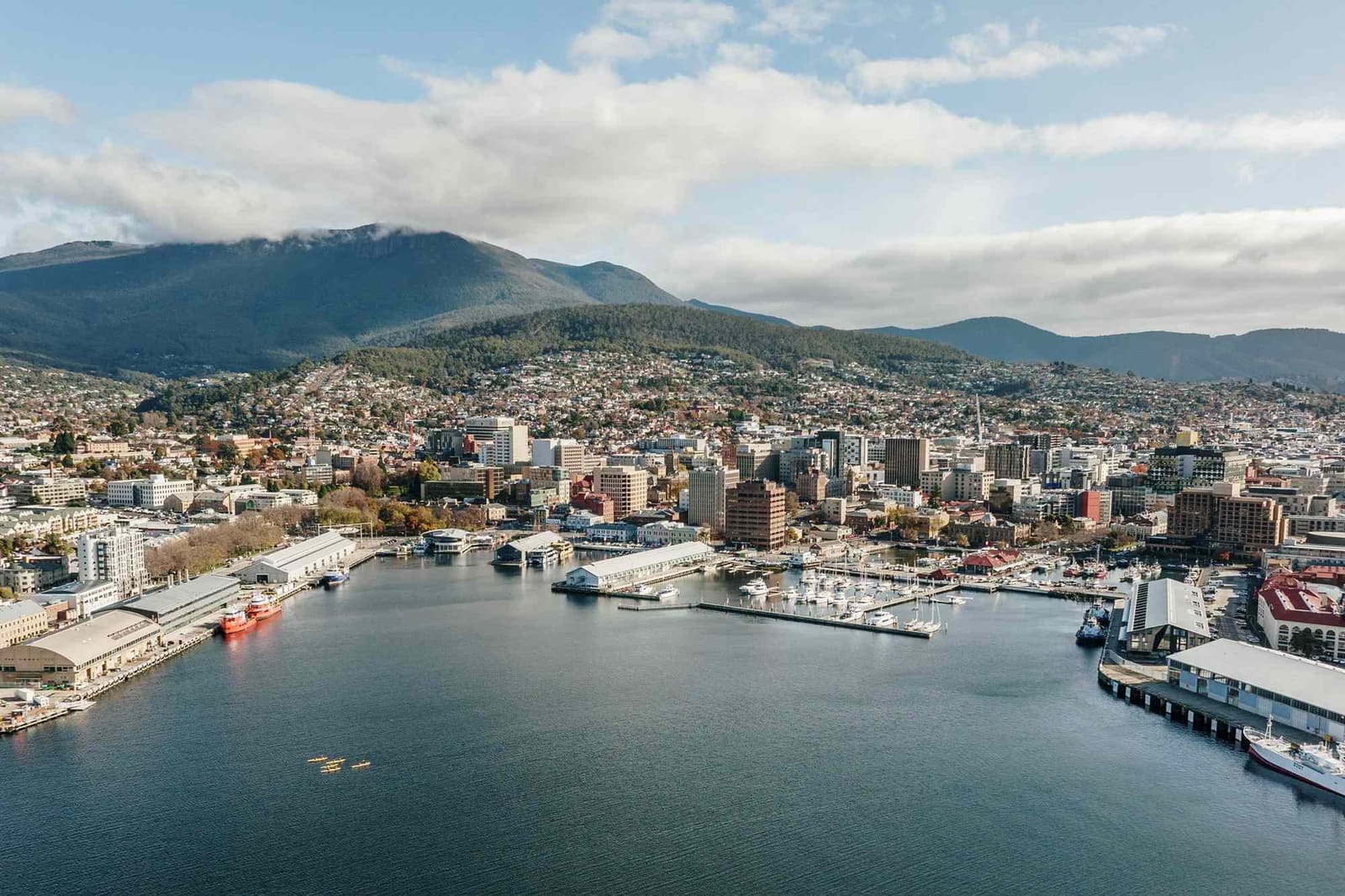
There is a particular quality to the light in Hobart that photographers spend careers trying to capture - something about the way Antarctic air sharpens the edges of things, how sandstone glows amber in the late afternoon, how the Derwent River holds the sky like polished pewter. Stand at the waterfront on a winter morning and you can taste salt and cold in equal measure, the kind of bracing clarity that makes you grateful for wool and coffee in the same breath.
At Global Chic Voyage, we have watched Tasmania's capital city shed its reputation as a sleepy colonial outpost and emerge as one of the Southern Hemisphere's most compelling urban destinations - not through reinvention, but through a kind of patient self-discovery. Hobart has not become something new so much as it has learned to articulate what it always was: a place where the wild edge of the world meets centuries of human settlement, where oyster farmers and contemporary artists occupy the same conversations, where you can walk from a museum of modern provocation to a Georgian cottage in under ten minutes.
This is not a city that announces itself loudly. Its charms are quieter, more textured - the kind that reveal themselves over days rather than hours, in the details rather than the skyline.
The Bivalves That Made a Reputation
If Hobart has a calling card to the wider culinary world, it arrives on the half shell. Pacific oysters from the D'Entrecasteaux Channel and native Angasi from the estuaries south of the city have built a global reputation for brininess, sweetness, and a clean mineral finish that sommeliers describe as almost Chablis-like. The waters here are some of the cleanest in the world - cold, nutrient-rich, and fiercely protected by both regulation and local pride.
You will find these oysters everywhere in Hobart, from white-tablecloth restaurants on Salamanca Place to the kind of dockside shacks where fishermen eat standing up. The ritual is the same: a squeeze of lemon, perhaps a mignonette if you are feeling European, and the sharp, cold rush of the southern ocean condensed into a single mouthful. We have returned to this city often enough to recognize the seasonal shifts - the plumper winter oysters, the slightly sweeter notes that emerge in spring - and to understand that for Hobartians, these bivalves are not luxury so much as birthright.
The oyster farms themselves, scattered across bays and inlets an hour south of the city, have become destinations in their own right. Some offer tastings on floating pontoons, where you can shuck your own while black swans drift past and the forested hills of Bruny Island rise in the distance. It is an experience that collapses the distance between harvest and table to nearly nothing, and in doing so, makes transparent the care required to produce something this good.
Sandstone, Warehouses, and the Weight of History
Hobart wears its colonial past more visibly than most Australian cities, in part because it never had the population or the capital to demolish and rebuild with quite the same enthusiasm as Sydney or Melbourne. The result is a streetscape that feels remarkably intact - Georgian row houses with iron lacework, sandstone warehouses that once held whale oil and wool, narrow lanes that still follow the cart paths of the 1820s.
Salamanca Place, the city's most photographed precinct, is the clearest expression of this preservation. A curving row of four-story sandstone warehouses faces the harbor, their ground floors now filled with galleries, wine bars, and restaurants that spill onto the pavement in warmer months. On Saturdays, the street transforms into one of the southern hemisphere's finest open-air markets - stalls selling everything from handmade ceramics to organic garlic, Huon pine cutting boards to lavender honey harvested in the highlands.
But it is Battery Point, the residential neighborhood that climbs the hill behind Salamanca, where the past feels most intimate. Here, cottages built for shipwrights and merchants have been lovingly maintained, their gardens spilling over low stone walls, their windows still fitted with wavy nineteenth-century glass. Walking these streets at dusk, when lamps glow behind lace curtains and the smell of wood smoke drifts from chimneys, you could almost convince yourself that the century had slipped.
We have found that the most rewarding way to experience Hobart is on foot, moving slowly enough to notice the details - the convict-carved sandstone lintels, the blue-green lichen on old slate roofs, the way certain streets frame views of Mount Wellington like a deliberate composition. This is a city scaled for walking, and it rewards patience.
The Museum That Changed Everything
No discussion of contemporary Hobart is complete without acknowledging the force that irrevocably shifted the city's cultural center of gravity. In 2011, a private museum of old and new art opened on the banks of the Derwent, a short ferry ride from the city center. Housed in a structure that burrows into a hillside like a brutalist cave, the institution presents antiquities alongside contemporary works in a sequence designed to provoke, unsettle, and occasionally delight.
The museum's impact on Hobart has been profound and multifaceted. It drew international attention, yes, but more importantly, it created a permission structure for ambition. Suddenly, Tasmania was a place where radical ideas could take physical form, where world-class art could exist outside the traditional metropolitan centers, where winter could be celebrated rather than endured (the museum's annual winter festival has become one of Australia's most anticipated cultural events).
The ripple effects are visible throughout the city. A new generation of galleries, design studios, and experimental restaurants has emerged, many staffed by people who moved to Hobart specifically because the museum proved that serious creative work could happen here. The city's self-image shifted - from provincial capital to a place that could hold its own in global conversations about art, food, and design.
Yet Hobart has absorbed this transformation without losing its essential character. It remains a city where you can still buy fresh fish directly from trawlers at the dock, where the premier might be spotted buying vegetables at the Saturday market, where a certain unpretentious pragmatism tempers even the most conceptual artistic gestures.
Mountain, River, and the Ever-Present Wild
What sets Hobart apart from other small cities is the immediacy of the landscape. Mount Wellington - called kunanyi in the language of the Muwinina people, the island's first inhabitants - rises directly behind the city to nearly 1,300 meters, its summit often snow-capped even when the city below basks in sunshine. The mountain is not backdrop but presence, shaping weather, framing views, and offering a kind of vertical wilderness that begins where the suburbs end.
Drive the winding road to the summit and you move through ecological zones as distinct as latitudes - temperate rainforest giving way to subalpine heath, then to the stark dolerite columns of the peak. On clear days, the view encompasses the entire city, the serpentine curves of the Derwent, the geometric patterns of the oyster leases in the channel, and, beyond, the blue-gray suggestions of the Southern Ocean.
The river itself is the city's other defining geography. Wide, tidal, and deep enough for ocean-going vessels, the Derwent has shaped Hobart's economy and identity since the first European ships anchored here in 1804. Today, it remains a working waterway - fishing boats, freight ships, and the occasional Antarctic research vessel share the harbor with yachts and ferries. Each December, the finish of the Sydney to Hobart yacht race brings a carnival atmosphere to the waterfront, but for most of the year, the river is simply part of the daily rhythm, crossed by bridges and ferries, fished at dawn, sailed in the afternoons when the southerly blows.
The Taste of Cold-Climate Terroir
Hobart sits at roughly the same latitude south as Bordeaux does north, but the comparison ends with the numbers. The climate here is cooler, shaped by Antarctic currents and the Roaring Forties, and the island's relative isolation has created agricultural conditions found nowhere else. The result is a distinct terroir that expresses itself across the entire food chain.
The wines from the Coal River and Derwent valleys, just outside the city, have gained international recognition for their elegance and restraint - Pinot Noir and Chardonnay that show bracing acidity and a kind of mineral precision. The cheeses from small dairies in the Huon Valley have won awards in Europe, their flavors shaped by pastures that never experience the stress of serious heat. Even the beef and lamb carry a different character here, grass-fed year-round on cool-climate pastures.
In Hobart's better restaurants, this regional specificity is treated as both ingredient and philosophy. Menus change with genuine seasonality because the growing season actually changes - asparagus in October, cherries in December, mushrooms when the autumn rains arrive. Chefs work directly with small producers, not as a marketing gesture but because the scale of the island makes it practical. You can trace a piece of fish from boat to kitchen in a matter of hours, know the name of the farmer who grew your potatoes, visit the orchard where your apples were picked.
We have noticed, across multiple visits, that Hobart's food culture avoids the preciousness that sometimes afflicts small-city dining scenes trying to prove themselves. There is a welcome lack of fussiness, a preference for letting good ingredients speak without excessive intervention. The best meals we have had here have been the simplest - line-caught flathead grilled over charcoal, a wedge of cloth-bound cheddar with local honey, a bowl of mussels steamed with cider and herbs.
A City Still Discovering Itself
What makes Hobart compelling in 2025 is the sense that its transformation is ongoing, not complete. The city is still small enough (population roughly 240,000 in the greater metro area) that individual projects and people can shift the culture. New hotels are opening in sensitively converted heritage buildings. Young winemakers are planting vineyards in microclimates once considered too marginal. Artists priced out of Melbourne and Sydney are establishing studios in former industrial spaces.
Yet there is also a wariness, a recognition that growth must be managed carefully if the qualities that make Hobart desirable are to be preserved. Conversations about development, tourism capacity, and infrastructure have an urgency here that feels appropriate to a place that understands its own fragility. The natural environment that surrounds the city - the clean waters, the intact forests, the relatively undisturbed coastlines - is both asset and responsibility.
We have found that the most engaged Hobartians are those who hold this tension consciously, who want their city to thrive without becoming a caricature of itself, who welcome visitors while protecting the rhythms and spaces that make local life livable. It is a delicate balance, and one that will define the next chapter of this island city.
The Quiet Magnetism of the Edge
There is a reason people speak of Hobart with a particular kind of affection, often tinged with surprise. It is not the easiest city to reach - flights from the mainland are short but frequent enough to remind you that you are crossing water to an island, and international visitors must route through Sydney or Melbourne. The weather can be capricious, offering four seasons in a single afternoon. Winter is genuinely cold, summer rarely hot.
And yet those who spend time here often find themselves plotting a return, or in some cases, a permanent relocation. The appeal is difficult to quantify but unmistakable - something about the combination of beauty and pragmatism, sophistication and unpretentiousness, the old and the new existing without obvious conflict. Hobart does not try to be anything other than itself, and in an age of relentless place-branding and manufactured authenticity, that refusal feels almost radical.
The city offers a particular vision of the good life, one built on proximity to both culture and wilderness, on eating food that comes from known places, on walking to work along a harbor where the water is clean enough to swim in, on living somewhere that still feels like a community rather than an economic zone. It is not a vision that will appeal to everyone - those who crave constant stimulation or anonymity will likely find Hobart too small, too quiet, too far from the centers of power and commerce.
But for those attuned to its frequency, this island city at the edge of the world offers something increasingly rare: a place that has managed to grow and evolve without losing the thread of what made it worth caring about in the first place. And that, more than any oyster or museum or mountain view, is the quality that keeps pulling us back.
Spot something wrong? Email editors@globalchicvoyage.com. We log every correction publicly.
RELATED
SEE ALL →
27 Jul 2026 / 5 min
6 Jul 2026 / 5 min
27 Jul 2026 / 5 min
8 Aug 2026 / 5 min