
The Lake Crossing That Threads Two Nations Through Patagonia's Blue Heart
A three-boat, four-bus journey between Argentina and Chile traces turquoise waters, volcanic silhouettes, and cascading falls along one of the continent's most storied routes.
SI
4 Jul 2026 · 5 MIN READ · UPDATED 17 AUG 2026
A Journey Measured in Vessels, Not Hours
There are border crossings that end at a checkpoint with a stamp and a nod, and then there are those that become the journey itself. The lake crossing between Argentina and Chile belongs firmly to the latter. Known locally as the Cruce Andino, this route stitches together three separate boat passages and four bus segments, weaving through a landscape where turquoise-hued lakes cradle volcanic cones and waterfalls tumble from forested cliffs. It is not efficient. It is not direct. And that, in a region as cinematically charged as Patagonia, is precisely the point.
At Global Chic Voyage, we've long held that the most memorable passages are those that refuse to hurry. The Cruce Andino exemplifies this philosophy. It is a crossing designed not for speed but for immersion, where each vessel and each stretch of road reveals a different face of the Andes.
Turquoise Threads Through the Cordillera
The palette of this crossing is dominated by color: the improbable blues and greens of glacial lakes fed by snowmelt, their surfaces reflecting peaks that rise abruptly from the water's edge. These are not the deep, moody blues of tropical seas but something cooler, more mineral, a hue born of rock flour suspended in alpine runoff. The lakes themselves - Nahuel Huapi on the Argentine side, Todos los Santos on the Chilean - function as liquid corridors through a landscape otherwise impassable by road.
Waterfalls punctuate the journey, particularly along the forested stretches where temperate rainforest clings to steep slopes. Some are delicate ribbons; others are full-throated cascades that send mist across the bow of passing boats. The sound of falling water is a constant companion, a reminder that this is a landscape shaped as much by hydrology as by tectonics.
The Silhouette of Osorno
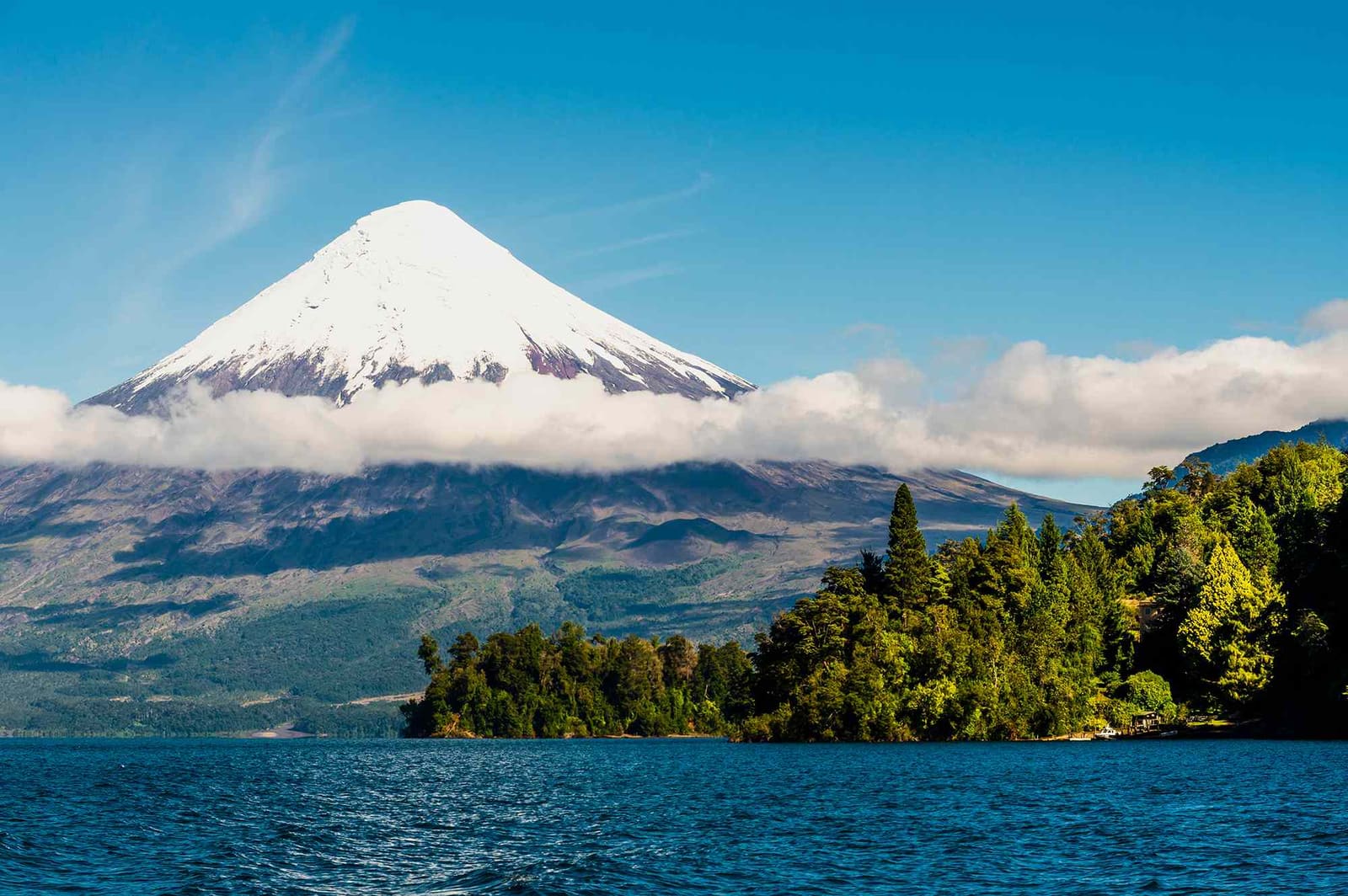
Dominating the western horizon is Volcán Osorno, a near-perfect cone whose symmetry has earned it comparisons to Mount Fuji. The resemblance is more than superficial. Both are stratovolcanoes, built layer by layer from successive eruptions, and both hold a place in their respective cultural imaginations as icons of natural geometry. Osorno's snow-draped slopes rise above Lago Todos los Santos, and on clear days the reflection doubles the effect, creating a mirrored pyramid that feels almost too composed to be real.
The volcano's presence lends the crossing a sense of destination, a visual anchor that orients the traveler even as the route bends and shifts. It is a landmark in the oldest sense, a feature so distinctive that it has guided travelers for generations.
The Architecture of Movement
The logistics of the Cruce Andino are a study in choreographed complexity. Three boats, each tailored to the particular lake it navigates. Four buses, each calibrated to the terrain between water segments. The transitions are timed to the season, the weather, and the whims of border formalities. There is no rushing this passage; the rhythm is dictated by the landscape itself.
What might seem cumbersome on paper becomes, in practice, a form of slow revelation. Each mode of transport offers a different vantage. From the deck of a boat, the mountains rise directly from the waterline, their scale unmediated by foreground. From the window of a bus, the forest closes in, and the experience becomes more intimate, more textured. The alternation between vessel and vehicle creates a cadence that prevents the eye from growing numb, a pacing that keeps the traveler alert to shifts in elevation, vegetation, and light.
A Route Rooted in History
This crossing is not a recent invention. Indigenous peoples moved through these passes long before borders were drawn, and early European settlers used similar combinations of lake and overland travel to navigate the Andes. The modern iteration of the Cruce Andino, formalized in the mid-twentieth century, follows routes that were already well-worn.
What has changed is the infrastructure. The boats are now purpose-built for passenger comfort, with observation decks and panoramic windows. The buses are modern coaches designed to handle the unpaved stretches that still characterize parts of the route. Yet the essential experience remains: a multi-day passage through terrain that resists easy transit, where the journey itself becomes the primary event.
Why Travelers Return
There is a particular kind of traveler drawn to crossings like this, one who values process over efficiency, who understands that the act of moving through a landscape can be as revelatory as arriving at a destination. The Cruce Andino rewards patience. It offers no single dramatic moment but rather a accumulation of impressions: the way light catches on glacial water, the sudden appearance of a waterfall around a bend, the slow unveiling of Osorno as the boat rounds a headland.
It is also, quietly, an exercise in border fluidity. To cross from Argentina to Chile by this route is to experience the Andes not as a dividing line but as a shared geography, a spine that both countries inhabit. The passage blurs the political in favor of the topographical, reminding the traveler that mountains and lakes recognize no flags.
Practical Considerations in a Landscape This Uncompromising
The Cruce Andino operates seasonally, typically from late spring through early autumn in the Southern Hemisphere, when weather conditions allow for reliable lake navigation. Departures are subject to change based on wind and visibility, and travelers are advised to build flexibility into their itineraries. This is not a crossing for those on tight schedules.
Luggage is transferred between vessels and buses, but the process is manual and occasionally chaotic. Pack light, and keep essentials - camera, layers, documents - within easy reach. The weather can shift rapidly; what begins as a sun-drenched morning on Nahuel Huapi may end in rain and wind by the time you reach Todos los Santos.
Accommodations are available at both endpoints - Bariloche on the Argentine side, Puerto Varas on the Chilean - and both towns have developed robust tourism infrastructure. Yet the crossing itself remains refreshingly free of commercialization. There are no onboard shops selling trinkets, no aggressive upselling. The experience is left largely unadorned, which is as it should be.
The Measure of a Journey
At Global Chic Voyage, we return often to the question of what makes a journey worth taking. Is it the destination? The novelty? The comfort? Or is it something less tangible, a quality that has to do with how a place makes you feel, how it alters your sense of time and space?
The lake crossing between Argentina and Chile offers an answer. It is a journey that insists on being experienced at its own pace, that refuses to be rushed or simplified. It threads two countries through a landscape so visually arresting that efficiency would be a form of loss. And in an era when so much travel is designed to compress distance and minimize friction, there is something quietly radical about a route that does the opposite, that asks the traveler to slow down, to change vessels, to look out the window, and to let the passage itself be the point.
Photo: Sebastian / Adobe Stock
Spot something wrong? Email editors@globalchicvoyage.com. We log every correction publicly.
RELATED
SEE ALL →
9 Feb 2026 / 5 min
27 Jul 2026 / 5 min
27 Jul 2026 / 5 min
27 Jul 2026 / 5 min