
The Quiet Architecture of Sleeping in Trees
From jungle canopies in Puerto Rico to cloud forests in Costa Rica, the world's most considered tree house stays prove that elevation changes everything.
CG
23 Jul 2026 · 5 MIN READ · UPDATED 17 AUG 2026
The Appeal of Height
There is a particular quality to waking twenty feet above ground. The air moves differently. Birdsong arrives unfiltered. Morning light enters through leaves rather than glass alone, and the boundary between sleep and the natural world dissolves in ways a ground-level room can never replicate. At Global Chic Voyage, we've watched tree house accommodations mature from nostalgic novelty into a legitimate architectural pursuit, one that asks how we might live lightly within a landscape rather than simply upon it.
The best examples occupy a space between shelter and exposure. They are not rustic cabins clinging to trunks, nor are they conventional hotel rooms hoisted into branches. Instead, they represent a deliberate rethinking of how structure and canopy might coexist, how design can amplify rather than obstruct the experience of being among trees. What follows is not a catalog of every elevated rental, but a selection of stays where architecture, landscape, and a certain quality of quietness converge.
Jungle Immersion in Vieques
On the small Puerto Rican island of Vieques, a three-story structure rises within dense jungle near the El Pilon neighborhood. The design prioritizes transparency: floor-to-ceiling glass panels invite palm fronds and dappled light into every room, while the top-floor bedroom opens to unobstructed ocean views. Two balconies extend the living space outward, and a sprawling pool sits at ground level, fed by rainwater and shaded by the canopy overhead.
The property functions as a private extension of Finca Victoria, an eco-focused hotel a short drive away. Guests gain access to resort amenities while maintaining the seclusion of a standalone residence. An outdoor kitchen and shower blur the line between interior and exterior, and at night, the native coquí frogs provide a rhythmic soundtrack that replaces the need for any other entertainment. The stay includes complimentary yoga sessions and Ayurvedic breakfast, though the real luxury here is spatial: the ability to move vertically through layers of jungle, from water to canopy to sky.
Cloud Forest Transparency in Monteverde
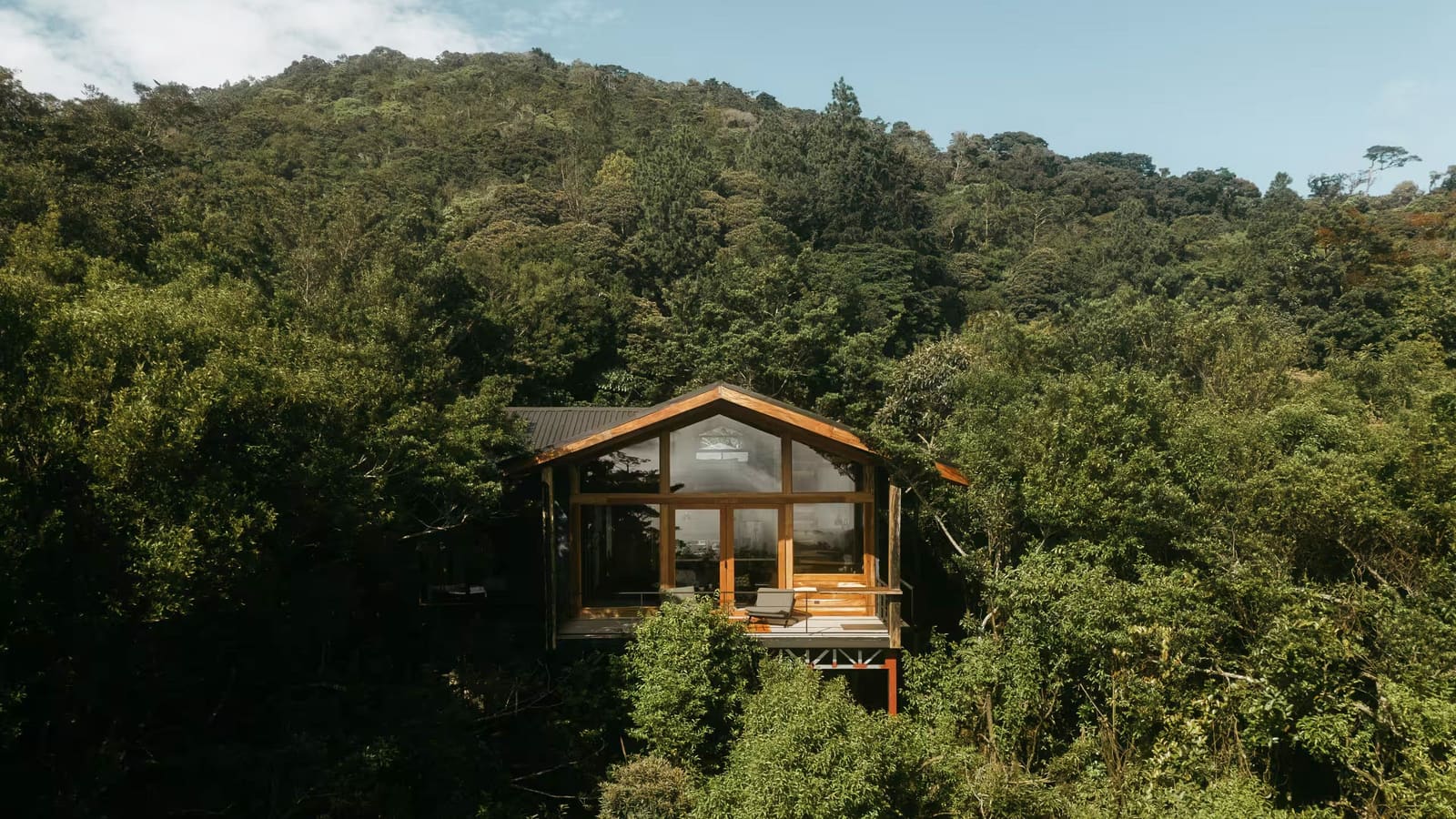
In Costa Rica's Monteverde Cloud Forest Reserve, a two-bedroom timber-frame home occupies a ridge between rainforest and coastline. The structure is less "tree house" in the traditional sense and more a dwelling that acknowledges its arboreal context through material and orientation. Floor-to-ceiling windows wrap the main living area, and a wide patio extends from the room like a promontory, offering panoramic views that stretch to the Gulf of Nicoya on clear days.
The surrounding cloud forest lends the property its distinctive atmosphere: mist drifts through the canopy most mornings, and the dense, layered greenery creates a sense of enclosure without confinement. A freestanding tub sits near the windows, positioned to take advantage of the view. The nearby Hotel Belmar, a five-minute walk away, provides farm-to-table dining and a craft brewery, while the town of Santa Elena offers local craft shops and natural history exhibits. The property itself, however, encourages stillness, a quality enhanced by its elevation and the enveloping presence of the forest.
Wellness and Elevation in the French Backcountry
Forty-five minutes from Nice, a tree house sits on twelve acres of mountainous terrain near the village of Tournefort. The interiors lean into a soft, bohemian aesthetic: hanging flowers, light wood, woven textiles, and linen bedding. The bedroom door opens directly onto a patio overlooking valleys and ridgelines, a threshold that collapses the distinction between sleeping quarters and landscape.
The host has built a wellness infrastructure around the property, offering bookable yoga sessions, massage treatments, and spa experiences. An outdoor hot tub and shower are positioned to take advantage of the mountain views, and walking trails lead to a nearby river or into the village itself. The property appeals to a particular type of traveler: those seeking not just scenery but a framework for slowing down, for reorienting daily rhythms around natural light and mountain air. Previous guests have described the stay as restorative, a word that speaks to the property's deliberate focus on retreat rather than activity.
Authentic Tree House Living in Kent
In the village of Elham, within the Kent Downs National Landscape, a tree house built from recycled timber sits twenty feet above a barley field, anchored by three oak trees. This is not a polished resort experience. It is a genuine tree house: small, self-contained, and requiring a certain comfort with simplicity. Guests bring their own provisions, and the only sounds are wind and birdsong.
The location offers proximity to both countryside and coast. Elham itself is a historic village less than two hours by train from London, and the seaside towns of Margaret's Bay and Folkestone are twenty minutes away. The tree house functions best as a weekend escape, a place to test one's appetite for solitude and elevation. A toilet is housed in a separate cabin below, and a shower may be available upon request in the main house, though the listing makes clear this is not a stay designed for extended comfort. It is, instead, an experiment in reduction: how much can be stripped away before a stay loses its appeal?
Urban Canopy in Atlanta
In Atlanta's Springlake neighborhood, a tree house spans seven trees and three distinct platforms connected by rope bridges. The host describes these spaces as representing mind, body, and spirit: a sitting room filled with antiques, a bedroom with a bed on wheels that can roll onto an open platform above a stream, and a hammock deck suspended in thick greenery. At night, string lights wrap the structure and bridges, creating a theatrical quality that leans into fantasy rather than away from it.
The property has become one of the most wishlisted stays in Georgia, notable for offering tree house immersion within a residential setting. While it lacks the deep silence of more remote locations, it provides something else: accessibility. Guests can explore Atlanta's museums, restaurants, and cultural sites during the day, then return to a canopy refuge at night. The design embraces whimsy, a quality that distinguishes it from more minimalist tree house projects. It is less about architectural purity and more about creating a sense of enchantment within an urban context.
Mountain Seclusion in Cascade
An octagonal tree house near Cascade, Colorado, sits within a small mountain community fifteen minutes from Colorado Springs. Floor-to-ceiling windows overlook a forested ravine, and the interior is outfitted with a wood-burning stove, a coffee maker, games, and a smart TV. The structure is compact but thoughtfully appointed, designed to encourage guests to remain inside rather than venture out, though hiking trails along Pikes Peak Highway are only five minutes away.
The property has earned a place on Airbnb's most wishlisted homes in Colorado, a designation that speaks to its balance of seclusion and comfort. Wildlife, including hummingbirds, frequent the area, and the octagonal shape creates sightlines in multiple directions, making the small space feel expansive. It is a stay that appeals to those who want mountain immersion without sacrificing modern amenities, a category that represents much of the contemporary tree house market.
Cedar Retreat in the Cascade Foothills
In North Bend, Washington, a cedar tree house offers a semi-off-grid experience within easy reach of hiking trails and mountain lakes. The structure includes a wraparound deck, an outdoor soaking tub that can be heated or left cold, and a 100-inch projector for evening entertainment. The design leans into the Pacific Northwest aesthetic: natural wood, large windows, and an emphasis on outdoor bathing and lounging.
Rattlesnake Lake and The Summit at Snoqualmie are nearby, as are the restaurants and breweries of North Bend's downtown. The tree house functions as a base for active travelers while also providing the infrastructure for complete retreat. The soaking tub, positioned among towering conifers, becomes the focal point of the stay, a place to linger after long days on trails or simply to sit and watch the light change through the canopy.
What Elevation Offers
The thread connecting these properties is not style or location but a shared commitment to a particular kind of experience. They are not hotels that happen to be elevated. They are accommodations designed around the specific qualities that height and proximity to trees provide: filtered light, layered sound, a sense of suspension. They ask guests to recalibrate their expectations, to find satisfaction in smaller gestures, quieter moments, and a different relationship to the landscape.
At Global Chic Voyage, we return to tree house stays not out of nostalgia but because they continue to reveal something about how we want to travel. They offer a counterpoint to the density and noise of urban environments, but they also challenge the conventional luxury model that equates comfort with insulation from the natural world. The best tree houses do the opposite. They dissolve that insulation, replacing it with something more valuable: a sense of being held, lightly, by the forest itself.
Credit: Airbnb
Spot something wrong? Email editors@globalchicvoyage.com. We log every correction publicly.
RELATED
SEE ALL →
29 Jul 2026 / 5 min
21 Jul 2026 / 5 min
8 Aug 2026 / 5 min
7 Aug 2026 / 5 min