
The Architecture of Desire: Inside Bangkok's Ever-Expanding Universe of Retail
As Thailand's capital races to build shopping complexes at unprecedented scale, a new generation of mixed-use developments is reshaping what it means to gather, consume, and live in Southeast Asia's most dynamic metropolis.
SI
28 Jul 2026 · 5 MIN READ · UPDATED 17 AUG 2026
A City Built Around Commerce
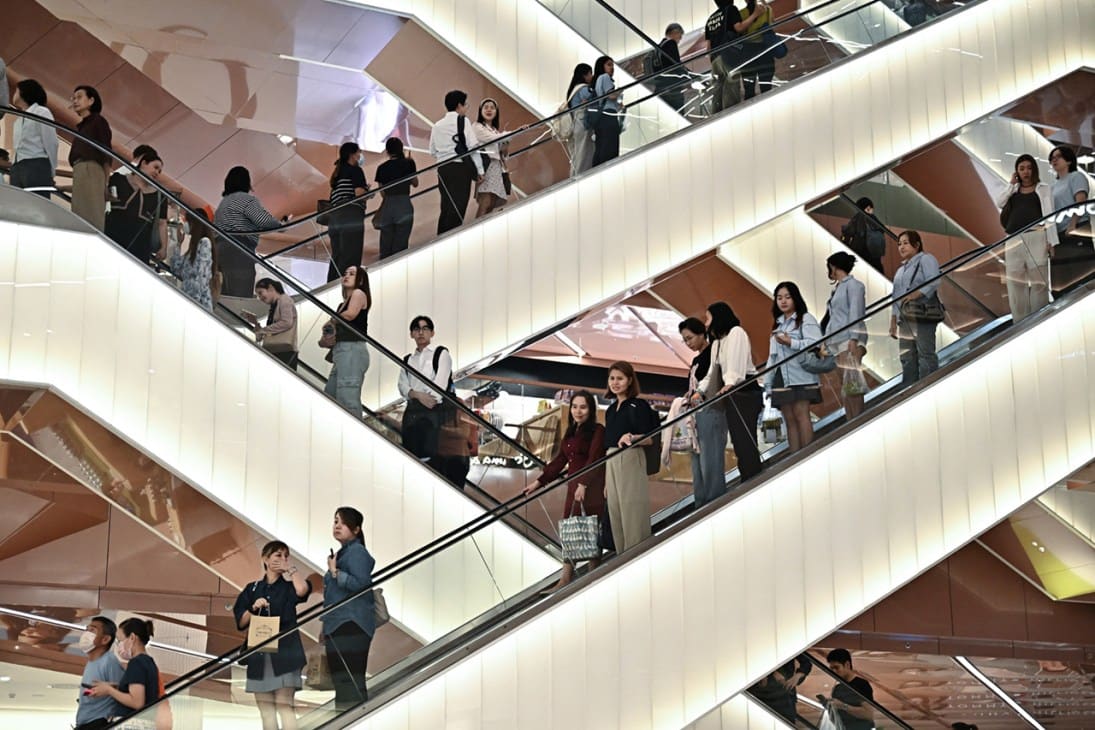
Stand at the intersection of Ratchadamri and Rama I roads on a weekday afternoon and you'll witness something that feels distinctly Bangkok: streams of people disappearing into glass-and-steel towers, not to work but to shop, eat, cool off, and simply exist in air-conditioned splendour. The Thai capital has built an entire urban identity around the shopping centre, turning what might elsewhere be considered suburban infrastructure into the very heart of metropolitan life.
These are not the modest two-storey plazas familiar to other Asian cities. Bangkok's retail complexes operate at a scale that defies easy navigation. Central World alone sprawls across multiple city blocks, a labyrinth of corridors and atriums where even long-time residents occasionally find themselves turned around. Yet locals move through these spaces with practiced fluidity, treating them less as destinations than as extensions of the public realm.
The phenomenon speaks to something deeper than consumer culture. In a city where summer temperatures regularly push past thirty-five degrees Celsius and the rainy season brings torrential downpours, these climate-controlled environments have become essential urban infrastructure. They house not just boutiques and department stores but supermarkets, cinemas, medical clinics, automobile showrooms, children's play centres, and in at least one inspired case, a rooftop waterpark that transforms a retail visit into a family outing.
The Economics of Expansion
At Global Chic Voyage, we've watched Thailand's retail property sector evolve from a domestic phenomenon into a sophisticated engine of regional development. Central Pattana, the development arm of Central Group, now operates more than forty shopping complexes across the country. Each new opening functions as a catalyst for broader transformation. When the company launches a project in a second-tier city like Khon Kaen or Nakhon Sawan, the ripple effects are immediate: hotel construction accelerates to house corporate visitors, residential towers multiply, and entire neighbourhoods reconfigure themselves around the new anchor.
The financial performance tells its own story. Central Pattana reported net profit growth of eighteen per cent in early 2026, according to the company, a remarkable achievement in an economic environment weighed down by household debt and a tourism sector still recovering from pandemic-era disruptions. That kind of expansion suggests something more resilient than retail trends alone can explain.
The company's recent projects reveal both ambition and confidence. Central Park Bangkok opened in September 2025 adjacent to Lumpini Park, the city's green lung, as part of a mixed-use collaboration with Dusit Hotels & Resorts. The location is strategic: placing a major retail destination directly across from one of Bangkok's most treasured public spaces creates a symbiotic relationship between nature and commerce, parkland and pavilion. Later this year, Central Pattana is scheduled to open another complex in the city's established residential zones, a return to the neighbourhood where the company built its first project in the early nineteen-eighties.
Looking ahead, Central Central is slated to begin construction in 2027 in Siam Square, developed in partnership with Japan's Mitsubishi Estate. The joint venture signals not just capital investment but a blending of Thai retail expertise with Japanese precision in mixed-use development.
The Competitive Landscape
Bangkok's retail boom has attracted new players eager to claim their share of the market. The Mall Group is preparing to open Bangkok Mall in 2028, a project positioned to surpass even Central World in scale and continue the city's steady eastward expansion toward Suvarnabhumi Airport. The trajectory is clear: as infrastructure improves and land values shift, retail follows, pulling residential and hospitality development in its wake.
Yet scale alone does not guarantee success. Property developer MQDC has entered the sector with significant resources and creative ambition, enlisting Snøhetta to design its Cloud 11 project and partnering with The Commons, a respected Bangkok retail curator, to conceptualize the shopping experience. The company's second venture, Happitat, is scheduled to open in August with a stated focus on customer satisfaction, even proposing an index to track visitor happiness.
These are bold experiments, infused with festival energy and design pedigree. But the retail property business rewards more than creativity. It demands deep industry knowledge, long-cultivated brand relationships, and an almost alchemical ability to transform concrete and glass into spaces people genuinely want to inhabit. Profit margins remain modest even when foot traffic is high, and competition is relentless.
One Bangkok, a massive mixed-use project backed by a beverage conglomerate, has illustrated the challenges that await newcomers without established retail expertise. Meanwhile, Central Park has slotted seamlessly into the city's existing ecosystem, drawing crowds from its first weeks of operation. The difference lies not in investment capital but in understanding how Bangkok's residents actually use these spaces.
What Makes a Mall Work
The most successful shopping centres in Bangkok function less as retail machines than as urban living rooms. They accommodate the rhythms of daily life: morning coffee before work, lunch meetings in climate-controlled food courts, after-school gatherings for teenagers, weekend family outings that blend shopping with entertainment. In a city where public space is often contested or poorly maintained, these privately managed environments have filled a civic void.
This is not unique to Bangkok. Across Southeast Asia, shopping centres have become de facto community centres, particularly in rapidly developing cities where traditional public squares and parks have been slow to materialize. But Bangkok has refined the model to an unusual degree, integrating retail with transit, hospitality, and residential development in ways that blur the boundaries between commercial and civic space.
The architectural language has evolved as well. Early shopping centres in Bangkok tended toward the hermetic, windowless boxes designed to seal occupants inside an artificial environment. More recent projects embrace transparency and permeability, incorporating atriums, skylights, and terraces that acknowledge the city beyond. Central Park's location opposite Lumpini Park is no accident; it creates a dialogue between two kinds of public space, each enhancing the other.
The Path Ahead
As Bangkok continues to build, questions about saturation and sustainability inevitably arise. Can a city support this many large-scale retail complexes? What happens when economic headwinds intensify or consumer preferences shift toward e-commerce? The answers are still unfolding, but the sector's resilience through recent challenges suggests a staying power rooted in something more fundamental than shopping alone.
These complexes have become woven into the social fabric of Bangkok, serving functions that extend well beyond transactions. They are meeting points and cooling stations, entertainment hubs and transit nodes. In a city where heat, traffic, and density shape daily decisions, they offer refuge and convenience in equal measure.
For travellers passing through, Bangkok's shopping centres provide a window into how modern Asian cities negotiate the tension between tradition and acceleration, between public life and private enterprise. They are not merely places to acquire goods but spaces where the city reveals its priorities, its aesthetics, and its vision of what urban life can be. As new projects rise and older ones reinvent themselves, the story of Bangkok's retail landscape continues to unfold, one gleaming tower at a time.
Credit: Lillian Suwanrumpha / AFP
Spot something wrong? Email editors@globalchicvoyage.com. We log every correction publicly.
RELATED
SEE ALL →
2 Jun 2026 / 5 min
9 May 2026 / 5 min
6 May 2026 / 5 min
6 May 2026 / 5 min