
The Quiet Peninsula Where Chesapeake Time Moves Slower
Three decades in Virginia taught one traveler that the state's most graceful corner isn't where the guidebooks send you.
CG
21 Jun 2026 · 5 MIN READ · UPDATED 17 AUG 2026
The Geography of Forgetting
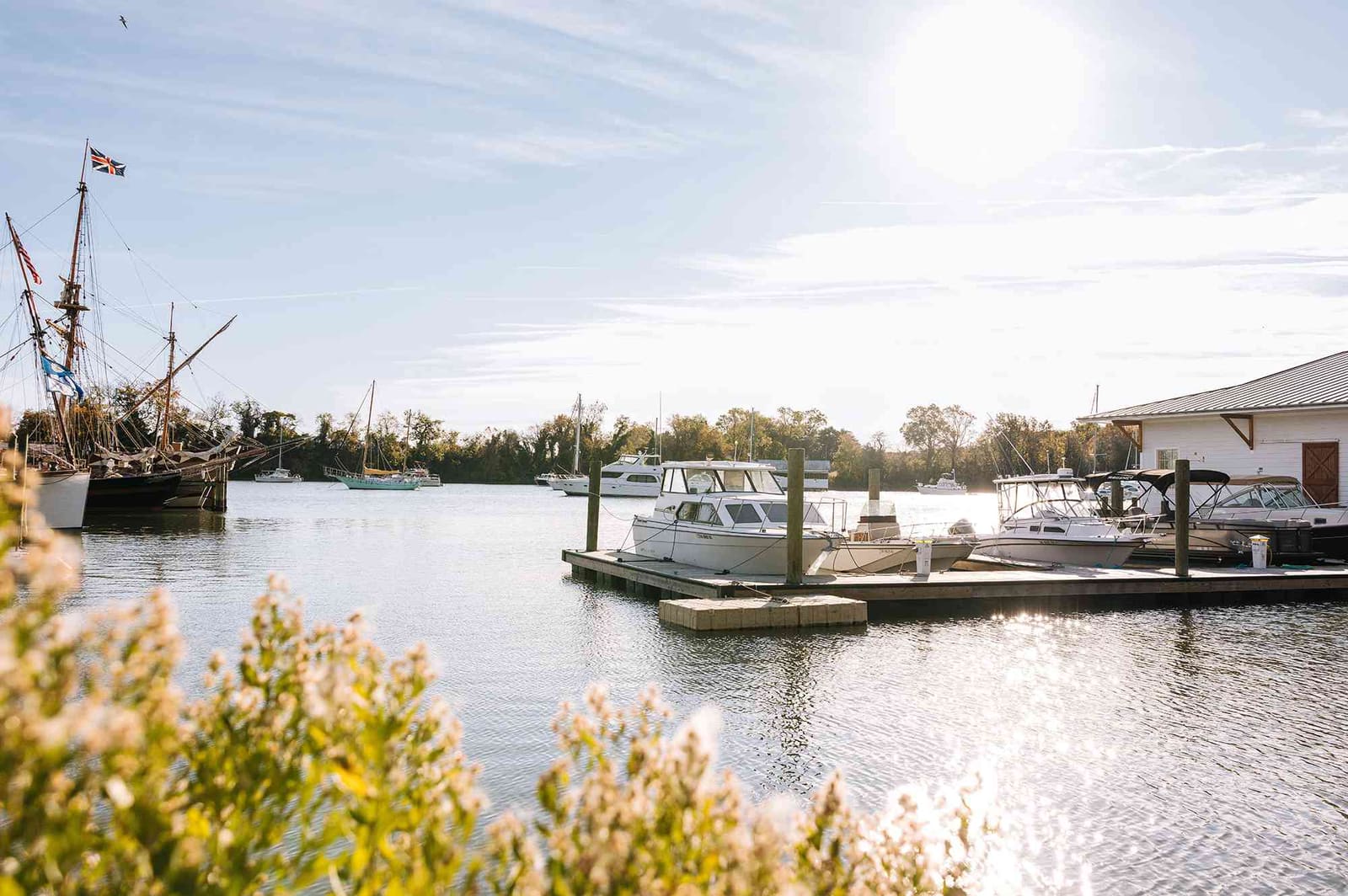
There is a particular quality of light that arrives in early autumn along Virginia's tidal rivers, a slant of gold through hickory and oak that makes the water look older than it is. We have spent three decades watching that light return each September to a narrow spit of land bounded by the Rappahannock and Potomac rivers, a place that most travelers pass without noticing on their way to louder, more insistent destinations. The Northern Neck, as locals call it, does not announce itself. It does not need to.
This is a peninsula of roughly seventy-five miles, stretching eastward from Fredericksburg toward the Chesapeake Bay, where the land flattens into marshland and the roads narrow to two lanes that wind past colonial brick and clapboard farmhouses. At Global Chic Voyage, we have returned to this corner of the state again and again, drawn less by what is here than by what is not: the absence of crowds, the refusal of haste, the stubborn preservation of a rhythm that belongs to another century. It is a place that rewards the patient traveler, the one willing to trade spectacle for subtlety.
The Northern Neck has never courted fame. While Williamsburg reconstructs the past as theater and Charlottesville markets Jefferson's legacy, this peninsula simply continues, its history embedded in the soil rather than mounted behind glass. George Washington was born here, as was James Monroe and Robert E. Lee, yet their birthplaces remain modest sites along quiet roads, marked by small signs that are easy to miss if you are driving too fast. The region's identity is not built on monuments but on continuity, on families who have farmed the same land for generations, on watermen who still work the rivers their grandfathers worked.
A Landscape Shaped by Water
To understand the Northern Neck is to understand that water is not merely scenery here but architecture. The peninsula is carved by rivers and creeks that reach inland like fingers, creating a coastline far longer than the land's narrow width would suggest. Every settlement, every plantation, every country store orients itself toward water. Before highways, the rivers were the highways, and the old estates still face the water as a manor house faces its drive.
We have walked the grounds of Stratford Hall, the Lee family seat, where the brick mansion sits on a bluff above the Potomac, its twin chimneys visible for miles across the river. The house was built in the 1730s, a monument to plantation wealth and enslaved labor, and it carries that weight visibly. The rooms are spare, almost severe, furnished with the kind of restraint that speaks to function over ornament. What lingers after a visit is not the grandeur but the silence, the sense of a place that has outlasted the ambitions of those who built it.
Farther downriver, the town of Irvington offers a different vision of waterside life, one calibrated to leisure rather than legacy. The Tides Inn, a low-slung resort that has anchored the town since the 1940s, sits along Carter's Creek with the kind of unassuming elegance that characterizes the best of mid-century American hospitality. Guests arrive by car or boat, spend their days sailing or golfing, and gather in the evening for cocktails on terraces that overlook the water. It is not opulent, but it is entirely sufficient, a reminder that luxury need not shout.
The Cadence of Small-town Commerce
The Northern Neck's towns are small, most of them no more than a few blocks clustered around a courthouse or a creek landing. Warsaw, the county seat of Richmond County, has a main street lined with nineteenth-century storefronts, a handful of antique shops, a café that serves breakfast until early afternoon. Kilmarnock, slightly larger, offers a modest downtown with a bookstore, a wine shop, a restaurant or two. These are not destinations in the conventional sense. They are places where errands unfold slowly, where conversations happen on sidewalks, where the cashier at the grocery store knows your name.
What strikes us most about these towns is their resistance to reinvention. There are no artisanal coffee roasters trying to evoke Brooklyn, no farm-to-table restaurants with Edison bulbs and reclaimed wood. The Northern Neck has not been discovered in that way, and the result is a landscape that feels less curated, more lived-in. The restaurants serve crab cakes and fried oysters, the kind of food that belongs to this place and nowhere else. The inns are often family-run, their rooms furnished with antiques that have been there for decades, not sourced from a vintage dealer last season.
We have eaten at The Tavern in Heathsville, a low-ceilinged room in a building that dates to the eighteenth century, where the menu changes with what the watermen bring in and the kitchen closes when the food runs out. We have browsed the shelves at Book Nook in Kilmarnock, where the owner knows the stock by heart and will pull down a novel you did not know you were looking for. These are the experiences that define travel in the Northern Neck, encounters that depend on presence rather than itinerary.
The Working Waterfront
The Northern Neck remains, at its core, a working landscape. The rivers and creeks are not merely scenic backdrops but sites of labor, where watermen harvest oysters and crabs, where fishing boats depart before dawn and return in late afternoon. The oyster industry, in particular, has seen a resurgence in recent years, as aquaculture operations have taken root along the tidal creeks, producing oysters that are prized for their salinity and sweetness.
We have watched the oyster boats at work from the docks in Reedville, a fishing village on the western shore of the peninsula that was once the wealthiest town per capita in the United States, its fortunes built on menhaden, a bony fish rendered into oil and fertilizer. The grand Victorian houses that line Main Street are relics of that brief prosperity, their gingerbread trim and wraparound porches speaking to an era when Reedville's fleet was the largest on the East Coast. Today the town is quieter, its economy more modest, but the water still sustains it.
The watermen themselves are a particular breed, men and women who have inherited their trade and who speak of the rivers with a familiarity that borders on intimacy. They know the tides, the shoals, the seasons of the fish. They work alone or in pairs, their boats small and practical, built for function rather than show. To spend time among them is to understand that the Northern Neck's identity is not constructed for visitors but lived by those who have never left.
Why the Quiet Endures
There are reasons the Northern Neck remains largely unknown to the broader traveling public, and most of them are geographic. The peninsula is not on the way to anywhere. It requires intention to visit, a willingness to drive an extra hour or two off the interstate, to navigate roads without much signage, to arrive at a place that offers no immediate reward beyond itself. There are no major attractions, no theme parks or outlet malls, nothing designed to capture the attention of the casual passerby.
This lack of infrastructure is both the region's vulnerability and its protection. Without the engines of tourism, the Northern Neck has no incentive to reshape itself for outsiders. It remains a place where locals outnumber visitors, where the economy still rests on agriculture and fishing, where development proceeds slowly if at all. For travelers weary of destinations that have been polished and packaged, this absence of contrivance is precisely the appeal.
At Global Chic Voyage, we have watched as other corners of Virginia have been transformed by tourism, as vineyards proliferate in the Piedmont and boutique hotels multiply in the mountains. The Northern Neck, by contrast, has remained largely itself, a landscape that does not perform its identity but simply inhabits it. This is not to say the region is immune to change; rising sea levels and economic pressures are reshaping the peninsula in ways both visible and subtle. But for now, the Northern Neck endures as a place where time moves at the speed of tides, where the past is present without being precious.
Traveling the Peninsula Today
To visit the Northern Neck is to accept a slower tempo, to trade the efficiency of highways for the meander of back roads, to spend days rather than hours in a place that reveals itself gradually. We recommend beginning in the western portion of the peninsula, where the towns are slightly larger and the historic sites more concentrated, then moving eastward toward the Bay, where the land opens into marshland and the horizon stretches wide.
Accommodations range from historic inns to waterfront cottages, most of them modest in scale and family-run. The food is straightforward, centered on seafood pulled from local waters, prepared without fuss. The activities are largely self-directed: driving the country roads, walking the river bluffs, visiting the small museums and historic houses that dot the landscape. There are kayak outfitters for those who want to explore the creeks, charter boats for fishing, golf courses for those inclined. But the real pleasure of the Northern Neck is in the unstructured hours, the time spent simply being in a place that does not demand anything of you.
We have found that the best visits to the Northern Neck are those that resist the urge to fill every moment, that allow for long afternoons on a porch, for drives that have no particular destination, for conversations that unfold without hurry. This is not a place for ticking off sights or collecting experiences. It is a place for slowing down, for remembering what travel felt like before it became an industry, before every destination was optimized for maximum engagement.
The Light Returns
Each autumn we return to the Northern Neck, drawn by that particular slant of light through the trees, by the way the water turns silver in the late afternoon, by the quiet that settles over the peninsula as the days grow shorter. It is a landscape that does not change much from year to year, and that constancy is part of its appeal. In a world that seems to accelerate with each passing season, the Northern Neck offers the rare gift of stillness, a place where the rhythms of water and weather matter more than the churn of news and novelty.
For travelers willing to seek it out, this narrow peninsula remains one of Virginia's most graceful secrets, a reminder that the best destinations are often the ones that do not try too hard, that trust in their own sufficiency, that allow you to arrive and simply be.
Spot something wrong? Email editors@globalchicvoyage.com. We log every correction publicly.
RELATED
SEE ALL →24 Jul 2026 / 5 min
29 Jul 2026 / 5 min
27 Jul 2026 / 5 min
27 Jul 2026 / 5 min