
The Weight of Centuries in Tamil Nadu's Stone and Silence
Where ancient dynasties carved devotion into granite, and the boundaries between human, divine, and timeless blur beneath the South Indian sun.
SI
7 Jul 2026 · 5 MIN READ · UPDATED 17 AUG 2026
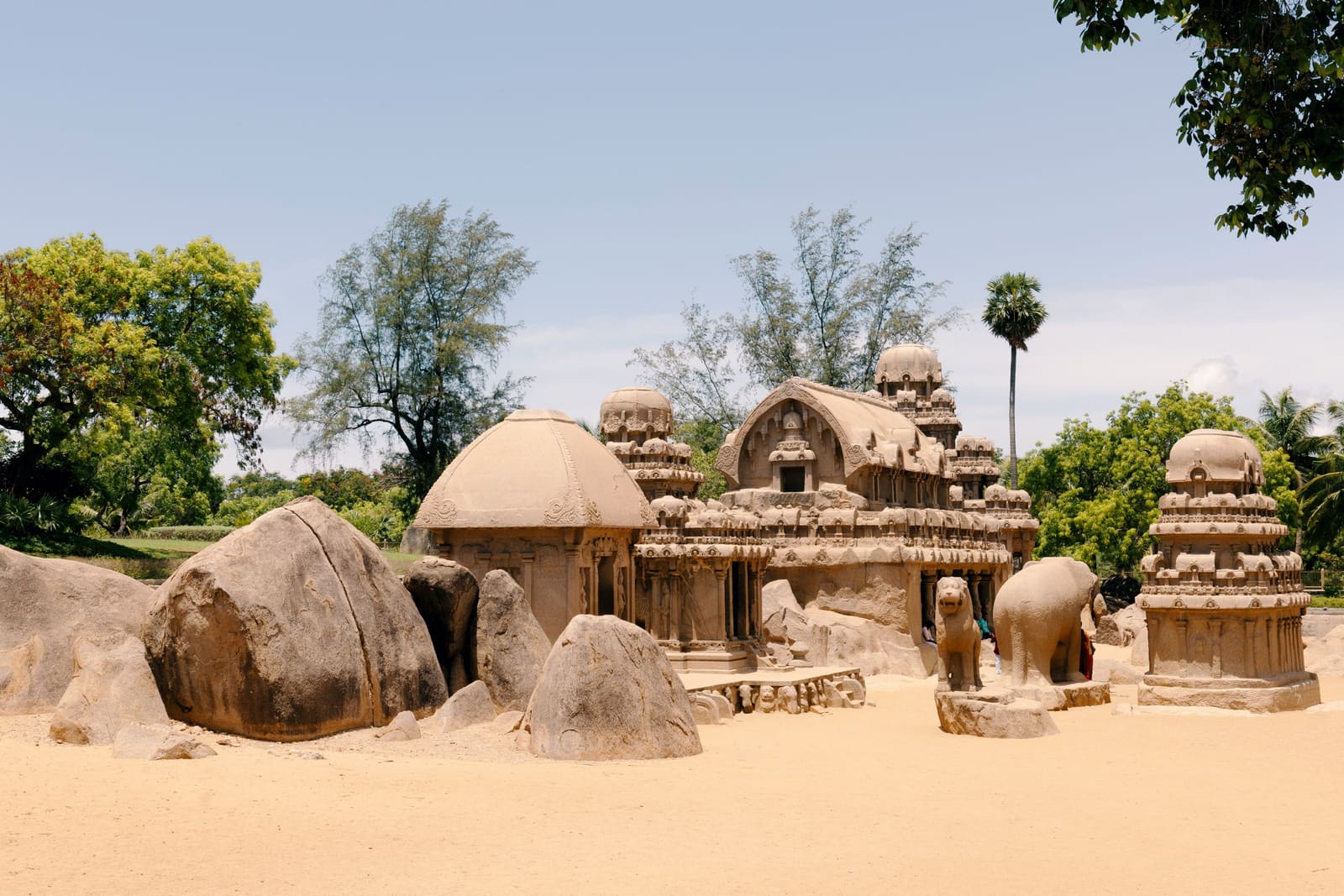
A Bull Carved From Forever
The granite is warm beneath my palm, sun-baked and strangely alive. At Mahabalipuram, on the tapering edge where Tamil Nadu meets the Bay of Bengal, I lean against the flank of a sacred bull named Nandi, hewn from a single boulder more than thirteen centuries ago. Its makers worked with nothing but hand tools and patience, coaxing sinuous form from unyielding stone, and what they left behind is both ancient and oddly modernist. The bull has no eyes, only empty sockets that lend it an air of meditation, as if it has been thinking the same thought for a millennium and has not yet finished.
At Global Chic Voyage, we have long argued that luxury travel is less about the gilded and more about the unrepeatable. Here, touching stone that predates nations and borders, feeling its retained heat as afternoon light slants across the shore, I understand that argument in my body. This is the first flowering of the Pallava dynasty, a Tamil-speaking civilization that learned to make rock speak. Submerged for centuries by sand and tide, rediscovered by colonial excavators, Nandi emerged twice: once from granite, once from forgetting.
The Architecture of Devotion
Travel through Tamil Nadu and you notice an inversion. In North India, the great monuments tend to be fortresses and palaces, testaments to royal power and military might. Here in the south, the monumental energies of the Pallavas, the Cholas, the Pandyas went not into defending territory but into building bridges between earth and heaven. Their temples are not museums but living institutions, daily filled with offerings of fruit and incense, music and sandalwood smoke, the shuffle of barefoot pilgrims and the chanting of priests.
In Madurai, the temple complex dedicated to Meenakshi, the fish-eyed goddess, shelters more than thirty thousand statues. Walk its flagstone courtyards and you move through a population of celestials, frozen in stone but somehow animated by devotion. In Thanjavur, the Brihadeeswara Temple rises with an eighty-ton cupola perched improbably atop its summit, said to have been hauled skyward by elephants on a ramp stretching over four miles. It was commissioned by the eleventh-century Chola monarch Rajaraja, whose name means "king of kings," and it remains one of the most audacious feats of engineering and faith on the subcontinent.
These were not merely religious sites. They functioned as universities, conservatories, refuges in times of invasion. They were centers where poetry was composed, where classical dance was codified, where the accumulated knowledge of centuries was both preserved and transmitted. The temple was the beating heart of civic life, and in many Tamil towns, it still is.
Time as Texture
Hinduism, particularly in its Tamil expression, resists the linear. Events do not simply happen and recede into the past; they exist in an eternal present, constantly re-enacted through ritual and story. Every morning in Madurai, women crouch at their thresholds drawing kolams, intricate patterns made with rice flour. By evening, footsteps and weather will have erased them. The next dawn, they will be redrawn. This is not futility but cosmology: a daily affirmation that the universe requires human participation, that the boundary between sacred and mundane is porous, that the eternal is found in repetition, not escape.
You can tell a devotee of Siva by the three horizontal white lines on their forehead, a follower of Vishnu by two vertical ones. So simple, so legible. The visual language here is both maximalist and minimalist, capable of swinging between extremes. A temple gopuram, or gateway tower, might be encrusted with thousands of painted figures, a riot of color and narrative. But the philosophical insight it represents can be distilled to a single gesture, a single mark.
Walking the open-air frieze at Mahabalipuram, a forty-three-foot-tall relief carved around the year 600, I stand before a life-sized elephant rendered with such anatomical precision and tender observation that it seems about to step free from the rock. This is street art from the ancient world, monumental and intimate at once, and it reminds me that the boundary between high art and everyday life was never as rigid here as it became in the modern West.
Palaces and Paradoxes
Not everything in Tamil Nadu is temple. In Madurai, the seventeenth-century Thirumalai Nayak Palace offers a jolt of contrast: white stucco, foliated arches, colonnaded pavilions that speak of Italy and Rajasthan rather than the Dravidian south. The king is said to have employed an Italian architect, and the result is a cosmopolitan provocation, an assertion that tradition need not mean stasis.
Further along, in the experimental township of Auroville, we encounter the Matrimandir, a meditation space free of idols and religious iconography, its nearly hundred-foot facade shimmering with more than fourteen hundred golden discs. Even austerity in India, it seems, comes plated in gold. Auroville was founded in the late 1960s as a utopian commune dedicated to the teachings of Sri Aurobindo, and today it houses some thirty-five hundred residents from more than sixty countries. It is a reminder that Tamil Nadu has always been a crossroads, a place where the local and the global have long been in conversation.
Hands That Remember
The soul of Tamil Nadu, though, resides not only in its monuments but in the hands of its artisans. In the village of Athangudi, I meet a tile-maker named Selvam, waif-thin and weathered, who can reproduce fifty traditional motifs from memory, freehand, without hesitation. In Srinivasapuram, bronze casters work as their ancestors did, using the lost-wax method to create statues of deities that will be installed in temples across the south. In Dharasuram, silk weavers bend over wooden looms, their shuttles clacking in hypnotic rhythm, producing fabric that will be worn at weddings and festivals.
These artisans are old in a double sense. Many began working as children, learning at the feet of parents or grandparents. But they also carry within them the accumulated knowledge of dozens of generations, techniques refined over centuries. They are personifications of deep time, humble and generally hard up, yet radiating a dignity that comes from daily communion with creation.
In the art village of Vilachery, a woman named Sheela paints jewels and peacock feathers onto statues of gods. "Every day we work directly with the gods," she tells me. "That is a source of happiness." She is reluctant to have her photograph taken, an old belief that one's image contains one's soul. In her workshop, I see an unusual statue: Vishnu reclining with his head in the lap of Andal, a ninth-century mystic poet and devotee, recognizable by her distinctive off-center hair bun, a style still worn by Tamil brides today. It is a tender image, suggesting that through devotion, the human and divine can meet in quiet beatitude.
The Chettiar Renaissance
In the arid region of Chettinad, far from river and sea, a paradox unfolds. This was once home to the Nattukottai Chettiars, a wealthy seafaring merchant community who abandoned the coast after a tsunami destroyed their capital. As the great royal dynasties faded, the Chettiars created a new vision of prosperity in the eighteenth and nineteenth centuries, building opulent mansions that showcased their cosmopolitan reach.
These homes are essays in eclecticism. Chessboard floors of Italian marble. Belgian stained glass in clerestory windows. Heavy teak doors from Burma, their keys the size of bananas. Pillars of Sri Lankan satinwood, dining halls with colorful tiled ceilings. Each mansion is fronted by a statue of Gajalakshmi, goddess of wealth, a declaration that worldly success and spiritual devotion need not be opposed.
After decades of emigration and decline, Chettinad is experiencing a renaissance, as locals convert heritage homes into boutique hotels and restaurants. At Chidambara Vilas, lunch arrives on a banana leaf: a painter's palette of robustly spiced fish and chicken, crisp vegetable fritters, fiery curried eggs. Even the puddings are cosmopolitan, made from a glutinous black "forbidden rice" once reserved for Chinese royalty.
The Abundance of the Everyday
Tamil is one of the world's few classical languages still in daily use, spoken by more than seventy million people. This continuity is not merely linguistic but sensory. It is the startling green of paddy fields around Thanjavur, steeped in water and reflecting clouds. It is the scent of frangipani and coffee, bushels of bananas and coconuts in the street markets. It is women with gold nose rings and hair braided with jasmine, men in pink with hands on hips. It is polysyllabic names, bashful smiles that brighten when reciprocated, goggle-eyed protector spirits in village shrines, peacocks fanning their tails, creamy mangoes blushing toward ripeness.
The Tamil sage Thiruvalluvar, who lived some two thousand years ago, wrote that a good country is one where unfailing yields, people of integrity, and compassionate wealth are found. It is a definition that privileges abundance over mere accumulation, generosity over possession. Traveling through Tamil Nadu, encountering Siva and his consort Parvati in their Tamil forms of Sundareswarar and Meenakshi, their limbs splayed in eternal dance or conjoined into a single androgynous figure representing the harmony of masculine and feminine energies, I sense that this abundance is not accidental. It is the fruit of a civilization that understood devotion as a form of nourishment, that saw the divine not as distant but as woven into the fabric of the everyday.
Departure and Return
Time in Tamil Nadu is not linear but cyclical, a waxing and waning on a scale larger than individual lives. Leaving is difficult because the place teaches you to perceive differently. You begin to see the eternal in the ephemeral, the sacred in the mundane. You understand that the past is not dead but dormant, waiting to be awakened by attention and devotion. And you carry with you the warmth of that granite bull, the memory of stone that has outlasted empires and will outlast you, patient and eyeless, still thinking its ancient thought beneath the unrelenting sun.
Photo: Rahul Kizhakke Veettil
Spot something wrong? Email editors@globalchicvoyage.com. We log every correction publicly.
RELATED
SEE ALL →
31 Jul 2026 / 5 min
29 Jul 2026 / 5 min
23 Jul 2026 / 5 min
22 Jul 2026 / 5 min