
Valley Stone and Quiet Hours: The Bucolic Soul of Menorca
Where 800 hectares of untouched countryside meet 18th-century agricultural memory, one restored farmstead redefines the rhythm of island escape.
SI
17 Aug 2026 · 6 MIN READ · UPDATED 18 AUG 2026
A Landscape That Demands Recalibration
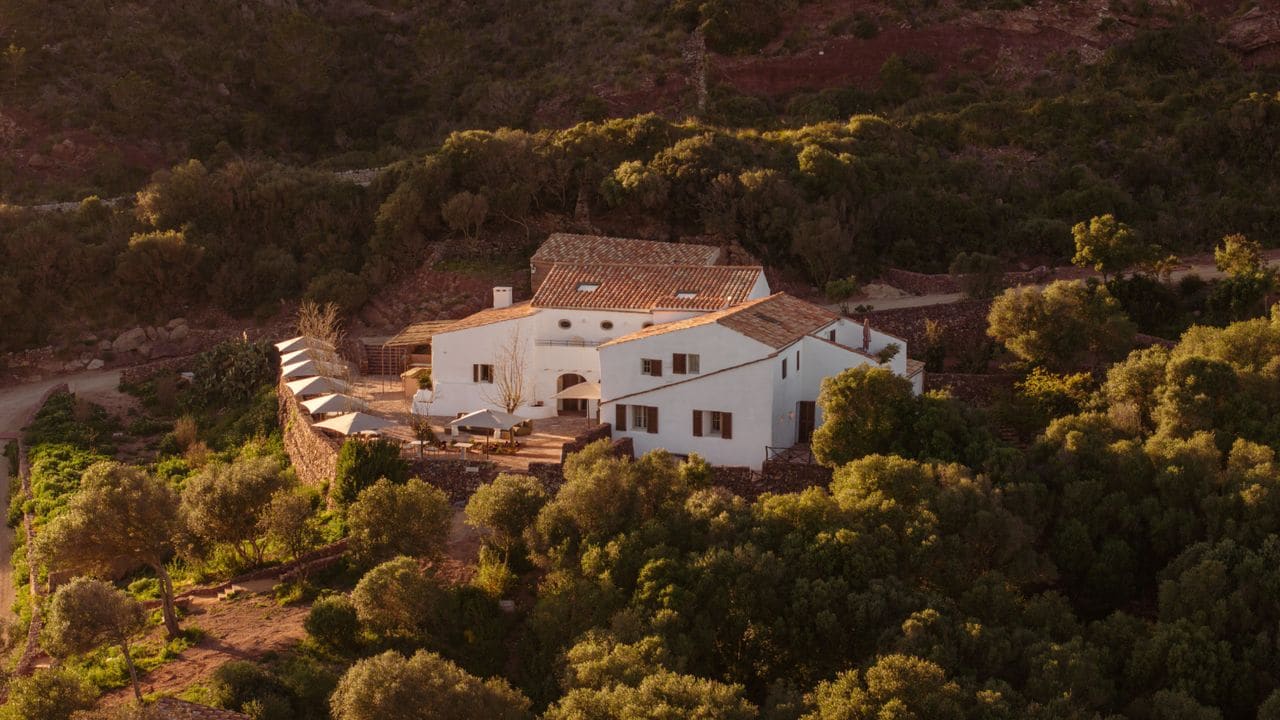
The silence arrives first. Not the manufactured hush of a soundproofed suite, but the kind that settles into your bones after decades of uninterrupted tenure over red earth and dry-stone walls. City dwellers accustomed to the white noise of urban life may find themselves momentarily disoriented here, in the valley cradle of Menorca's northwestern interior, where the loudest interruption comes from native cattle moving through orchard shade.
This is the territory claimed by Vestige Binidufà, the valley counterpart to Son Ermità, its hilltop sibling. Together, the pair forms a twin-refuge system spread across 800 hectares of private Menorcan countryside, linked by a discreet lane and a shared philosophy: that the island's truest luxury lies not along its postcard coves, but inland, where agricultural memory still shapes the rhythm of days. At Global Chic Voyage, we've watched the Balearics tilt toward ever-louder spectacle; what strikes us about Binidufà is its refusal to follow.
The property occupies a restored 18th-century finca, its red stone walls rooted in a working estate that once depended on pragmatic relationships with water, soil, and season. Eleven rooms now inhabit the farmhouse and its outbuildings, each shaped by the bones of the original structure rather than imposed uniformity. The Madera Fernández family, who steward Vestige Collection, opened Son Ermità in 2025; Binidufà arrived this year to complete the vision from below, trading pale sandstone grandeur for something earthier, slower, more intimate with the valley floor.
The Architecture of Restraint
Vestige Estudio, the in-house design arm led by Maria Obdulia Fernández, approached the restoration not as an exercise in recreation but as an act of reinterpretation. Architect Enrique Motilla oversaw the structural work; Marta Delgado and her team handled interiors; Inés Martínez shaped the landscape. The guiding principle, according to the studio, was to honor the intelligence embedded in traditional Menorcan farm design without freezing it in museum amber.
That intelligence reveals itself in details easily overlooked: historic rainwater channels coaxed back into service, cisterns and drainage systems restored to function, original wellheads and thresholds repaired rather than replaced. The material vocabulary remains deliberately narrow. Local limestone, reclaimed timber, limewashed walls, raw plaster, linen, cotton. Thick masonry tempers the midday heat; shaded terraces extend living space outdoors. The effect is less about decoration than about continuity, a conversation between past utility and present comfort that never tilts into nostalgia.
Menorcan carpenters built wardrobes, doors, and fixed seating; local stonemasons carved bathroom basins and exterior benches from the same limestone that forms the estate's boundary walls. Lighting came through collaboration with MC Lighting, while art and objects draw from the family's own collection of contemporary works, ceramics, and antiques. The result feels less curated than inhabited, as though the house has always contained these things.
Rooms Shaped by Place, Not Hierarchy
Binidufà's eleven accommodations resist the tiered logic of most hotel room categories. Spread between the main farmhouse and converted agricultural buildings, each carries its own proportions, orientation, and relationship to the land. Some open onto private gardens; others face terraces or valley views. Those within the farmhouse retain a stronger sense of the original structure, with walls that remember their former purpose.
The interiors continue the material restraint established elsewhere: bespoke timber furniture, handcrafted joinery, limestone details, textiles in linen and cotton. Rowse amenities bring a botanical clarity to bathrooms designed for long soaks. The Terrace Suite, set within the main building near the restaurant, spans 70 square meters. A master bedroom opens onto a private terrace; a living area accommodates a third guest via sofa bed; a skylit bathroom invites the kind of unhurried bathing that becomes ritual after a day spent walking the estate's trails.
The northwest corner of Menorca carries a tougher beauty than the island's southern reaches, less postcard-perfect and more weather-carved. Binidufà's design reflects that moodier register, grounding itself in red earth and agricultural memory rather than chasing Mediterranean cliché. Guests can move freely between valley and hilltop properties via electric buggy, accessing both the intimate scale of Binidufà and the elevated expansiveness of Son Ermità. The best stays, we suspect, make deliberate use of both.
A Table Rooted in Orchard and Field
Mesura, Binidufà's restaurant, sits beneath tree shade overlooking gardens, pool, and valley. The menu leans plant-forward, drawing from the estate's own orchard and neighboring farms for vegetables, herbs, grains, dairy, and eggs. Middle Eastern spices and herbs nod to the property's Arabic agricultural origins; fish or meat can be added to dishes on request. Executive chef Joan Bagur, who also oversees Brisa at Son Ermità, frames the offering as a natural extension of the estate's working-farm history.
Service begins with Raynaud Limoges nesting bowls bearing olive oil from Son Felip, butter, and salt. A tomato and cucumber starter arrives finely chopped, bright, lightly pickled, its simplicity revealing rather than concealing ingredient quality. The signature vegetable tagine layers fennel, pumpkin, green olives, and dried fruit in a dish that feels both Menorcan and inflected by the island's centuries-long Mediterranean cross-pollination. At the pool, the menu relaxes into salads, sandwiches, ice cream, and fresh lemonade delivered on arrival.
The approach here differs markedly from Brisa, where Bagur's French-inflected Menorcan cooking emphasizes crudos, seafood, and seasonal vegetables. The contrast underscores Vestige Estudio's assertion that the twin properties offer two distinct ways to experience the same landscape: one rural and intimate, the other elevated and expansive.
The Infrastructure of Slowness
Binidufà's pool ranks among its finest assets, a simple rectangle open to the valley with none of the DJ-booth theatrics that have colonized other Balearic retreats. A yoga deck occupies woodland shade nearby; massage treatments employ locally infused oils. Guests also have access to Son Ermità's hillside gym, a glass-fronted space looking across fields toward coastline and rocky islets.
The estate itself provides the primary infrastructure for deceleration. Eight hundred hectares of native woodland, walking routes, cycling trails, orchards, and land running toward wild calas. Dry-stone walls mark boundaries older than most European nation-states; Vermell cattle, a Menorcan breed, graze in patterns established over generations. Vestige can arrange encounters with local artisans, farmers, and producers, as well as mountain-bike tours, beekeeping experiences, jeep safaris, horse riding, and visits to nearby cultural sites, including Hauser & Wirth Menorca.
But the property's real offering is simpler: permission to move at a pace dictated by landscape rather than itinerary, to spend hours under trees with a book, to walk until legs tire and then return to a farmhouse that has stood in this valley for two and a half centuries. The infrastructure of slowness, it turns out, requires less construction than we've been led to believe.
What Remains Unspoiled
The buzz that electrifies Ibiza each summer has not yet reached this corner of Menorca, and one senses the island intends to keep it that way. The northern coast retains a certain remoteness, a quality of being slightly harder to reach and therefore slightly less trampled. Binidufà capitalizes on that geography not through exclusion but through careful attention to what already exists: stone, water, orchard, silence.
At Global Chic Voyage, we've traced the Mediterranean's luxury trajectory as it swings between spectacle and restraint, volume and intimacy. Properties like Binidufà represent a counter-movement, a return to the unglamorous intelligence of vernacular architecture and the recognition that some landscapes improve when left largely alone. Whether that ethos can withstand the pressure of its own success remains to be seen. For now, the valley holds its quiet, and the farmhouse continues the work it began three centuries ago: sheltering those who seek refuge in red earth and the long, slow arc of agricultural time.
Spot something wrong? Email editors@globalchicvoyage.com. We log every correction publicly.
RELATED
SEE ALL →
30 Jul 2026 / 5 min
27 Jul 2026 / 5 min
12 Jun 2026 / 5 min
29 Jul 2026 / 5 min