
Where the Termite Mounds Teach You to Dine Among the Stars
At Mokuti Etosha, the border between lodge and wilderness dissolves - and with it, every assumption about what a safari should feel like.
SI
16 Jun 2026 · 5 MIN READ · UPDATED 17 AUG 2026
A Herd That Outnumbered Us
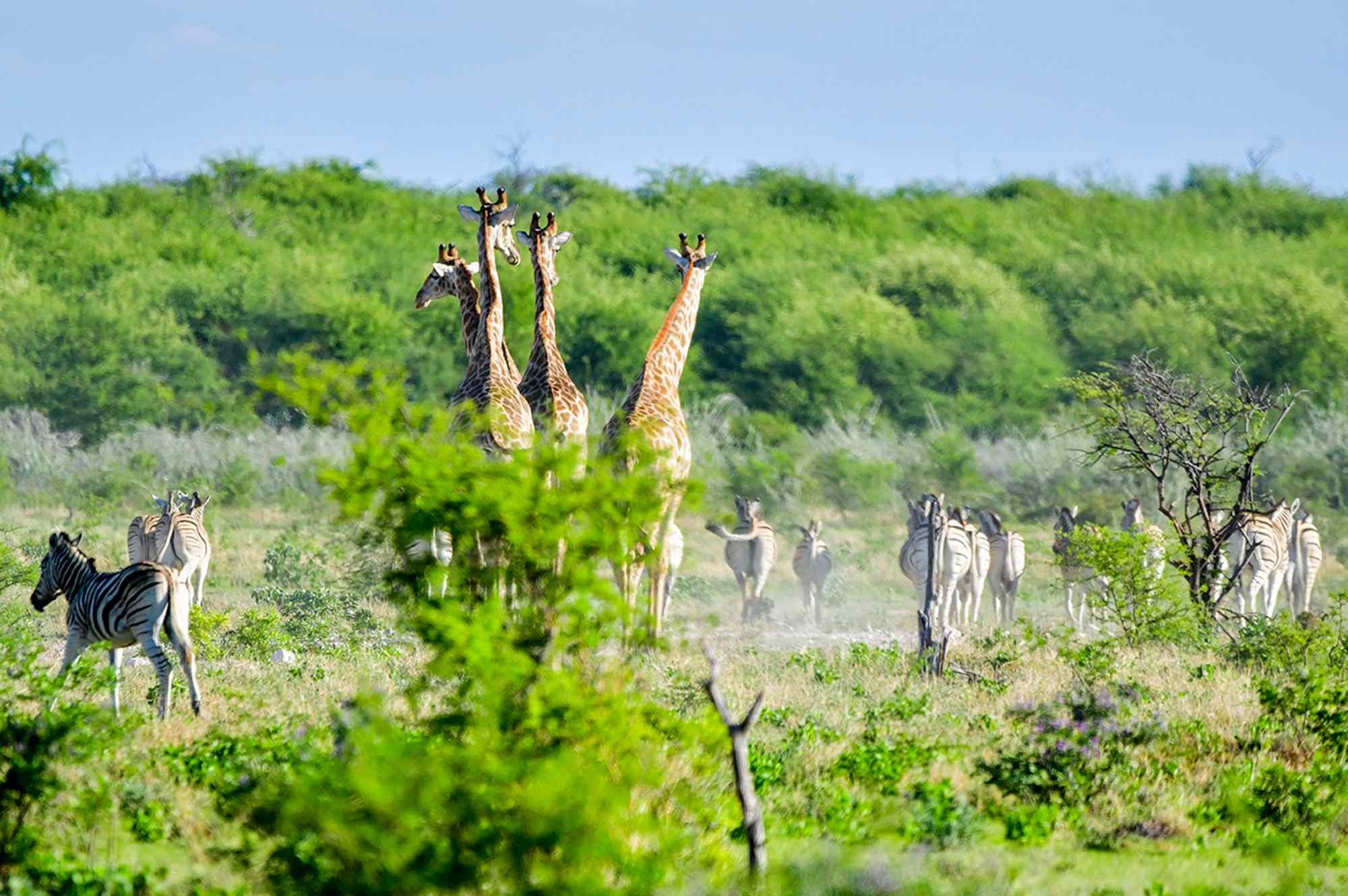
The necks rose above the scrub in a rhythm that felt choreographed, a dozen giraffes moving as one organism against a sky the color of milk glass. We counted seven humans in the vehicle; the animals had us outnumbered, and the knowledge settled into my chest with a quiet thrill. This was not a zoo visit. This was not even a classic game drive. This was proximity without pretense, a morning when the wild showed up on its own terms and we were simply allowed to watch.
At Global Chic Voyage, we've spent years cataloging the world's safari lodges, and we return to the ones that resist formula. Mokuti Etosha, perched at the eastern threshold of Etosha National Park in northern Namibia, is one of those places. It sits so close to the reserve's gate that the boundary feels theoretical. Bontebok - a rare antelope species native to southern Africa - wander the property as if they hold shares in the place. Towering trees cast shadows across pathways built from local stone. The architecture borrows its palette from the earth: ochre, sienna, the pale gray of dried riverbeds.
OL Leisure operates this lodge, and the design philosophy is clear. You are not visiting nature here. You are embedded in it, a guest in a system that was functioning long before the first villa went up.
The Geometry of Termites, Translated Into Dining
SkyBoma, the property's newest addition, is a restaurant modeled after the termite mounds that punctuate Namibia's landscape like ancient sculptures. The structure rises roughly thirty feet above the bush, its stone-toned exterior mimicking the texture and silhouette of those insect-built towers. Guests ascend a spiraling ramp supported by wooden beams, the path winding upward until it deposits you into an open-air dining pavilion suspended above the canopy.
We arrived as the sun began its descent. The staff brought out small plates of local cuisine - delicate, artful, nothing overworked - and cocktails that tasted of citrus and something faintly herbal. The sky performed its nightly opera: gold bleeding into coral, then a violent orange that stretched across the horizon where the vegetation met the void. I felt the heat of that final light on my skin, and my heart beat in a way that felt both primal and slightly ridiculous. It was the kind of joy that embarrasses you later when you try to describe it.
After dark, the stars arrived. Namibia is recognized internationally as an astrotourism destination, its skies among the clearest on the continent. SkyBoma's elevation and its position over the unbroken bush offer celestial views that feel less like observation and more like immersion. You are not looking up at the stars; you are inside the same system, rotating together.
The Civility of Wild Things
Late November is late spring in the southern hemisphere. The bontebok at Mokuti lounged near the villas in the mid-morning heat, their coats a study in contrast: dark chocolate broken by patches of bright white. They moved slowly, unbothered by our presence, their behavior neither tame nor aggressive. There was a familial quality to their interactions, a sense of social structure that felt oddly recognizable.
Shepherd Chinhoi, OL Leisure's general manager of operations, spoke about this during my visit. Namibia, he explained, is a country built on contrasts. The national anthem references it explicitly: "contrasting beautiful Namibia." Travel from north to south, and the landscape transforms entirely. Move east to west, and you encounter a different climate, different vegetation, different light. The nation is home to thirteen ethnic groups, each with distinct culinary traditions and cultural identities. Even on the smallest scale - the hide of a single animal, the rhythm of a herd - that layered quality persists.
The country is one of the least densely populated on Earth, yet its biodiversity is staggering. Etosha National Park is famous for its concentration of species and for the Etosha Pan, a salt flat so vast it is visible from space. The park's eastern gate opens onto a terrain where elephants, lions, zebras, and black rhinos share waterholes in an uneasy but functional coexistence. The wildlife here is not performing for visitors. It is simply living, and we are allowed to witness that life if we stay quiet and pay attention.
The Other Property, Where Horses Replace Land Cruisers
Two nights at Mokuti felt insufficient, but Namibia's scale demands movement. Midgard Otjihavera Windhoek, another OL Leisure property, sits in the central highlands, roughly equidistant between the capital and the northern reserves. The aesthetic here is entirely different: part equestrian estate, part Bavarian fairytale, steeped in the country's German colonial heritage. Warthogs trotted past rose gardens. Horses grazed near turquoise pools. The architecture leaned into European tradition, red roofs and stone walkways framed by indigenous trees.
At Midgard, the safari happens on horseback. I mounted an ivory Arabian named Chayenne before sunrise, following Phil-John Hochtritt, my guide, along the base of rocky hills. The light was still thin, the air cool. Hochtritt pointed out movement in the shadows above us: baboons, he said, watching from the ridgeline. They communicate through a complex system of calls, he explained, and their survival depends on vigilance. They have eyes all around.
Riding through that landscape, I felt the shift in perspective that comes from moving at a different speed. On horseback, you are not insulated by a vehicle. You are part of the terrain, subject to the same wind and dust and sun. The baboons tracked us with indifference. We were neither threat nor prey, just another species passing through.
The Logic of Layered Landscapes
Namibia's magnificence does not reside in a single vista or a single animal encounter. It resides in the way disparate elements coexist without friction. The bontebok grazing near a luxury villa. The termite mound architecture housing a fine-dining restaurant. The warthogs sharing space with Arabian horses. The baboons coordinating their movements through vocalizations that predate human language by millennia.
At Global Chic Voyage, we've learned to measure a destination not by its highlights but by its coherence. Does the place make sense on its own terms, or is it a collection of imported ideas stitched together for tourist consumption? Mokuti Etosha and Midgard both pass that test. They are embedded in their environments, shaped by local materials and local knowledge, responsive to the rhythms of the animals and the weather.
The lodge accommodations at Mokuti range from standard suites to a Presidential Suite with a private pool and outdoor seating that opens directly onto the bush. The interiors are understated: natural textiles, wooden furniture, large windows that frame the landscape rather than compete with it. There is no need for ornament when the view includes giraffes at dawn and bontebok at dusk.
What We Carry Back
I left Namibia with a camera full of images - giraffes silhouetted against pale sky, bontebok resting in the shade, warthogs with their absurdly expressive faces - but the photographs are insufficient. They capture the what, not the why. The why is harder to articulate. It has something to do with the feeling of being outnumbered by a giraffe herd and finding that reassuring rather than unsettling. It has something to do with eating dinner thirty feet above the ground while the sky ignites and the stars take over. It has something to do with riding a horse through baboon territory and realizing that you are the one being observed.
Travel, at its best, recalibrates your sense of scale. Mokuti Etosha and Midgard both accomplish that recalibration, not through spectacle but through immersion. You are not a visitor watching nature from a safe distance. You are inside the system, subject to its rules, humbled by its complexity. The termite mounds, after all, were here first. The restaurant built in their image is simply a gesture of respect, a way of saying: we learned from you, and we are trying to build something worthy of the lesson.
Spot something wrong? Email editors@globalchicvoyage.com. We log every correction publicly.
RELATED
SEE ALL →
31 Jul 2026 / 5 min
27 Jul 2026 / 5 min
8 Aug 2026 / 5 min
8 Aug 2026 / 5 min