
The Unchanging Heart of the Riviera Maya
How one twelve-hectare estate has resisted the tide of development swallowing Mexico's Caribbean coast
SI
27 Jul 2026 · 5 MIN READ · UPDATED 17 AUG 2026
A Different Kind of Arrival
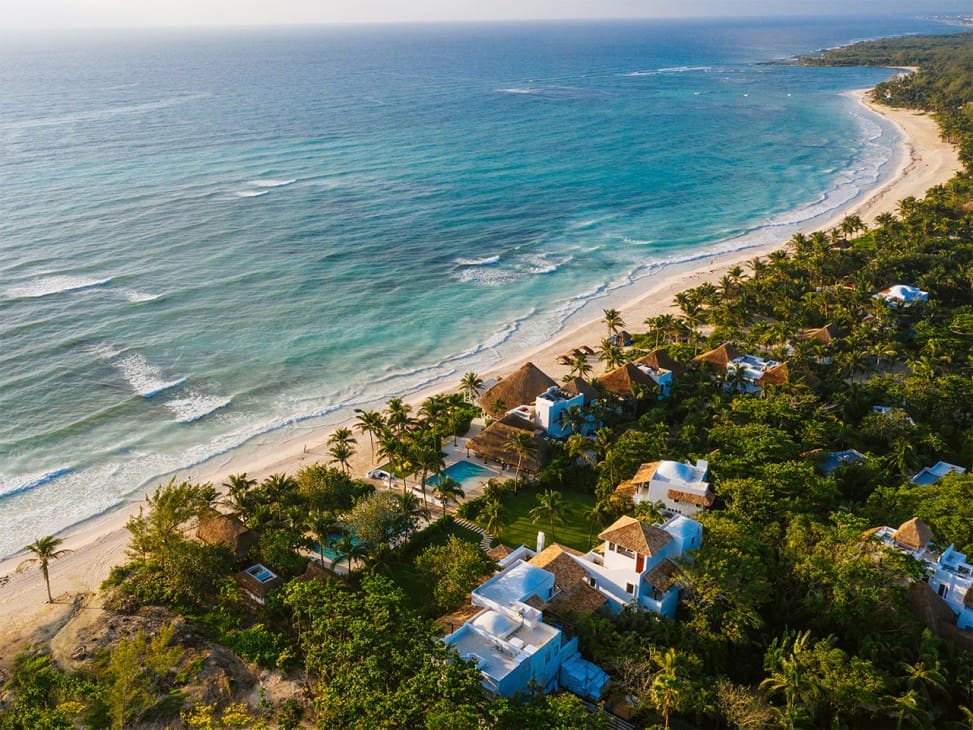
The palms arch overhead, their fronds filtering sunlight into scattered coins of gold on the limestone path. Behind you, the highway hums with shuttle vans ferrying tourists to their all-inclusive compounds. Ahead, through a canopy so dense it feels like entering a cave, lies a stretch of beach that somehow escaped the fate of its neighbors. No waterslides pierce the sky here. No spring-break anthems echo from open-air clubs. Just the percussion of waves against sand, and the occasional cry of a frigatebird wheeling overhead.
This is the peculiar magic of arriving at a place that has chosen stillness over spectacle. At Global Chic Voyage, we've watched the Riviera Maya transform from a collection of fishing villages into a sprawl of concrete and glass, each new resort tower casting longer shadows over what remains of the mangroves. Yet certain properties have held the line, not through isolation, but through deliberate, almost stubborn intention. The twelve-hectare estate we found ourselves on this summer is one such holdout, a former duchess's retreat that has been reimagined as a luxury hotel without losing the thread of what it once was.
The Geography of Restraint
The numbers tell part of the story. Roughly three million travelers pass through this corridor annually, most bound for the beach clubs of Tulum or the high-rises of Playa del Carmen. Tulum's international airport opened recently, funneling even more visitors into a town that, two decades ago, was known mainly to backpackers and mystics. The transformation has been swift and, to many, brutal. Where there were once dirt roads and palapas, there are now traffic jams and velvet ropes.
The property in question sits south of this chaos, shielded by jungle on one side and the Caribbean on the other. Its owner acquired it in 2014, after an eighteen-month search that initially focused on Tulum itself. When that search yielded nothing suitable, he widened his radius and stumbled upon a beachfront home that had once belonged to Italian aristocracy. The structure was intact but underused, a relic of an earlier era when this coast was still a secret.
Over the following year and a half, he undertook a renovation that prioritized restraint over reinvention. The original architecture remained, its bones too graceful to discard. White-washed walls were preserved, then accented with handmade rugs and mid-century furniture. Pieces from contemporary studios, including work by Ceramic Suro and Studio Giancarlo Valle, were introduced not as showpieces but as quiet complements to the existing aesthetic. The result feels less like a hotel and more like a private home that happens to welcome guests.
The Philosophy of Incremental Change
What strikes us most about this property is not what has been added, but what has been resisted. In an industry that chases trends with the fervor of a day trader, this estate has moved slowly, almost cinematically. A gym was added when guests requested it. Additional casitas were built, some overlooking the water, others nestled deeper into the jungle. A spa arrived. A restaurant partnership brought in a pizzaiolo from Naples and sushi guidance from a respected Miami establishment. But these additions unfolded over years, not months, each one tested against a single question: Does this enhance the feeling of the place, or does it dilute it?
The owner, who answers to no investors, has spoken publicly about his frustration with hotels that overhaul themselves every decade, erasing the very qualities that made them beloved. His approach has been the opposite: small, considered adjustments. Faucets are swapped out. Lighting is refined. Menus evolve based on guest feedback and seasonal availability. The cumulative effect is a property that feels both timeless and lived-in, as though it has always been this way.
His artistic director, a Mexico-born graphic designer who once worked at Chanel in New York, has become the guardian of this aesthetic continuity. Trained in visual storytelling, he approaches each design decision with a curator's eye, insisting that everything be handmade or custom-crafted. Nothing arrives from a catalog. Every object must carry weight, both literal and metaphorical. The tension between the owner's impulse toward innovation and the director's preference for constancy has, paradoxically, kept the property balanced. One pushes forward; the other anchors. Together, they have created a place that evolves without losing its center.
When Guests Stop Leaving
A decade ago, visitors to this stretch of coast would use their hotel as a base camp, venturing into Tulum for dinner or nightlife. That pattern has reversed. As Tulum's restaurants became overcrowded and its beaches cluttered with influencers angling for content, guests began to stay on the estate, rarely venturing beyond its borders. The owner noticed the shift and responded by deepening what the property could offer. If guests were no longer leaving for meals, then the meals needed to become destinations in themselves.
The brick pizza oven, imported along with its Neapolitan operator, was one answer. The sushi program, developed with input from Miami restaurateurs, was another. A partnership with an international steakhouse brand brought a full-service restaurant to the grounds, eliminating any remaining reason to brave the traffic and crowds beyond the gate. What began as a necessity, keeping European travelers engaged without forcing them into Tulum's chaos, has become a defining feature. The property is now a self-contained universe, its boundaries marked not by walls but by a shift in atmosphere.
The Landscape Beyond the Gate
Yet isolation has never been the goal. The owner is clear on this point: proximity to Cancún's airport, with its nonstop flights to New York, London, and other major hubs, remains a strategic advantage. Unlike more remote retreats that require chartered boats or puddle-jumpers, this estate is accessible by a ninety-minute drive on paved roads. The convenience is part of the appeal, particularly for guests who value their time as much as their privacy.
And despite the overdevelopment that has scarred much of the Riviera Maya, pockets of natural beauty persist. Cenotes, those limestone sinkholes filled with crystalline water, are scattered throughout the region, many still reachable by short drives. Nature reserves protect stretches of jungle and coastline from further encroachment. Just a brief walk from the estate lies a secluded lagoon where manatees drift through the shallows, oblivious to the resort towers rising miles away. The Mayan ruins that first drew archaeologists and adventurers to this coast remain, their stone pyramids and ceremonial platforms standing as reminders of a much older civilization.
The question the owner posed to himself, looking back on the decade since he acquired the property, was whether he would make the same choice again. His answer, delivered without hesitation, was yes. The region's challenges, its traffic and construction and relentless growth, have not erased the reasons he fell in love with it. They have only made the work of preservation more urgent.
What Endures
At Global Chic Voyage, we return to certain properties not because they have changed, but because they have not. In an era when hotels rebrand themselves with alarming frequency, chasing whatever aesthetic is trending on social media, there is something profoundly reassuring about a place that knows what it is and refuses to apologize for it. The estate we spent time at this summer is such a place. Its rooms are still white-washed. Its furniture is still a mix of handmade and vintage. The jungle still presses close, and the sea still rolls in, indifferent to the chaos unfolding up the coast.
What has changed, if anything, is the context. As the Riviera Maya grows louder and more crowded, this twelve-hectare enclave grows quieter by contrast. It has become a refuge not through isolation, but through intention. The owner and his artistic director have built something rare: a hotel with a clear point of view, one that values substance over spectacle and continuity over novelty. In a region defined by its willingness to tear down and rebuild, they have chosen to hold steady.
The birds still call from the canopy. The waves still crash just beyond the casitas. And somewhere down the highway, another shuttle van is pulling up to another resort, its passengers eager to begin their vacation. Here, though, the vacation looks different. It is slower, quieter, more deliberate. It is, in the truest sense, an escape, not from the world, but from the version of the world that has forgotten how to sit still.
Credit: Hotel Esencia
Spot something wrong? Email editors@globalchicvoyage.com. We log every correction publicly.
RELATED
SEE ALL →
11 Jun 2026 / 5 min
7 Jul 2026 / 5 min

31 Jul 2026 / 5 min
9 Jul 2026 / 5 min