
Where the World Slows: Eleven Islands That Rewrite the Meaning of Escape
From Crete's olive-draped coastlines to the bioluminescent shores of the Andamans, these reader-chosen sanctuaries prove that the best journeys begin where the map splinters into archipelago.
SI
15 Jul 2026 · 5 MIN READ · UPDATED 17 AUG 2026
The Geography of Forgetting
There is a particular quiet that descends when you cross water to reach land again. Not silence, exactly, but a softening of the world's edges. The ferry's engine cuts. The seaplane's pontoons kiss lagoon. And in that threshold moment, the mainland and all its urgencies become a memory you half-remember, like a dream from childhood.
At Global Chic Voyage, we've watched travelers return from islands changed, not by what they did there, but by what they allowed themselves to stop doing. The world holds roughly 11,000 inhabited islands, scattered like punctuation across oceans, seas, and lakes. Yet only a handful possess that alchemy of place and pace that transforms a vacation into something closer to restoration. These are not merely destinations with good weather and better beaches. They are geographies of forgetting, where volcanic rock and coral sand conspire to make you lose track of what day it is, and why that ever mattered.
The eleven islands we've gathered here span six continents and a dozen climate zones. What unites them is harder to quantify: a quality of light, perhaps, or the way time bends differently when you're surrounded by water. They are places where cliffside villages cling to limestone, where rainforest meets reef, where the distance between your room and the sea can be measured in heartbeats rather than steps.
The Mediterranean's Quiet Giant
Crete unfolds like a novel you can't put down. Greece's largest island stretches 160 miles east to west, long enough to contain multitudes: olive groves that have been tended for millennia, gorges that slice through mountains like geological scars, beaches where the sand holds a blush of pink feldspar. Most travelers land in Heraklion or Chania and immediately flee to Santorini's Instagram-ready caldera. The ones who stay discover something rarer.
In Kissamos, on Chania's northwest shoulder, the rhythm of days follows the fishermen's schedule. Mornings begin with strong coffee and mezedes, those small plates of marinated octopus, fava, and dakos that constitute breakfast, lunch, and philosophy seminar all at once. The shore here invites free diving, that meditative practice of descent and return, where the only equipment required is breath and nerve. Coastal paths wind between coves, each one a pocket universe of turquoise water and limestone.
A ferry from Kissamos carries you to Balos Lagoon, where the sea splits into gradients of blue and green so distinct they seem Photoshopped. The water is shallow enough to wade for a quarter mile, warm as bathwater from May onward. Falassarna, to the south, hides its pink-flecked sands behind a landscape of scrub and wildflower. These are not beaches for selfies. They are beaches for the slow work of watching light change on water, for reading a book until you fall asleep, for remembering that doing nothing is, in fact, doing something.
Where Atlantic Meets Acadia
Cape Breton Island sits at Nova Scotia's northeastern tip like a clenched fist of rock and forest. The Cabot Trail, a 185-mile loop through Cape Breton Highlands National Park, has earned its reputation as one of the world's great coastal drives not through superlatives but through accumulated moments: a moose crossing the road at dawn, fog lifting off the Gulf of St. Lawrence, the sudden reveal of a valley plunging toward the sea.
The Skyline Trail, a four-mile hike that ends at a clifftop boardwalk, offers what the locals call "the money shot," though no photograph adequately captures the scale of it. Below, the coastline fractures into headlands and coves. Above, hawks ride thermals. Between, you stand at the edge of the continent, feeling very small and oddly content about it.
Timing matters here. October brings the fiery crescendo of fall foliage, when the hardwood forests ignite in shades of amber and crimson. Early summer, from June through August, is whale-watching season. Humpbacks and pilots feed in the nutrient-rich waters, their blows visible for miles. The island is accessible by car via the Trans-Canada Highway or by air through Sydney, which connects through Toronto and Halifax. Either way, arrival feels like crossing into a parallel Atlantic, one where the 21st century hasn't quite taken hold.
The Archipelago That Rewrote Evolution
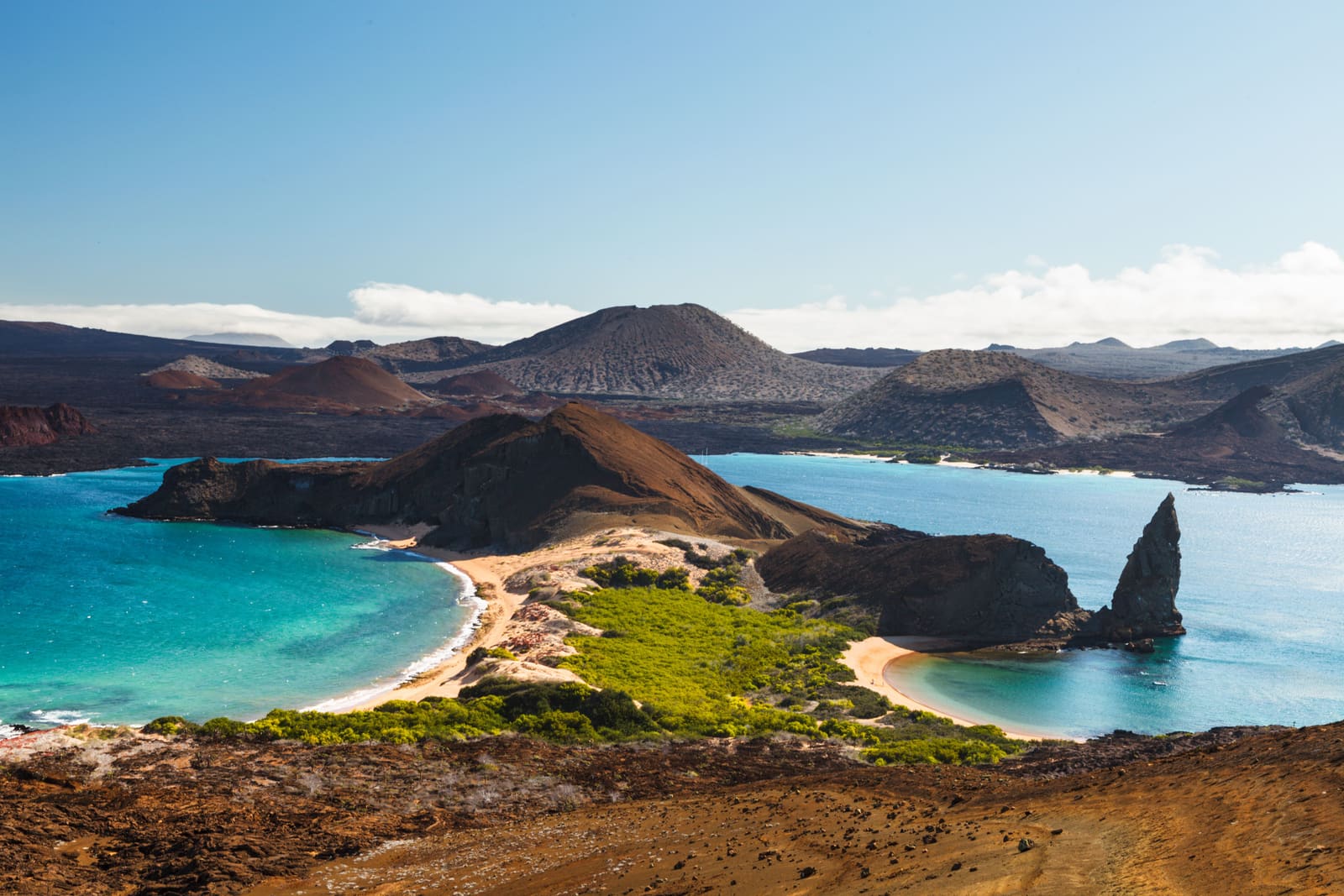
Six hundred miles off Ecuador's coast, the Galapágos Islands exist in their own temporal dimension. Volcanic peaks rise from the Pacific like the spines of sleeping dragons. Ninety-seven percent of the archipelago is protected national park, a designation that has preserved not just the landscape but the peculiar innocence of its inhabitants. Here, animals haven't learned to fear humans. Sea lions nap on park benches. Marine iguanas sunbathe on lava rock. Blue-footed boobies perform their courtship dance, a ritual of sky-pointing and foot-lifting that looks like avian comedy but is, in fact, deadly serious mate selection.
The islands number thirteen major landmasses and dozens of smaller islets, each with its own microclimate and endemic species. Santa Cruz serves as the de facto hub, accessible by ferry from Ecuador's mainland airports in Quito and Guayaquil. Isabela, the largest island, stretches like a seahorse along the equator, its western coast battered by cold Humboldt Current swells. Bartolome offers the iconic Pinnacle Rock, a volcanic spire that has appeared in more nature documentaries than any other stone formation in the Pacific.
We've long believed that the best way to experience the Galapágos is by water. Small-ship expeditions allow you to wake in a different anchorage each morning, to snorkel with sea lions before breakfast, to kayak through mangroves at sunset. The wet season, December through May, brings afternoon rains and calmer seas. The cool season, June through November, draws massive schools of fish and the predators that follow them. Either window offers encounters that feel less like wildlife viewing and more like visiting another planet where humans are, for once, the visitors.
Low-Country Rhythms
Hilton Head Island has been filing the top slot in reader polls for years now, a consistency that speaks to something deeper than name recognition. Yes, the golf courses are world-class. Yes, the 12 miles of Atlantic coastline offer reliable sun and surf. But the island's real gift is its low-country character, that particular Carolinian blend of wetland and maritime forest, of egrets in the shallows and live oaks dripping with Spanish moss.
Sea Pines Nature Preserve spans 600 acres of boardwalked wetlands and shell-ring archaeological sites. Pinckney Island National Wildlife Refuge, which straddles the causeway between the island and the mainland, draws birders in search of herons, ibises, and the occasional roseate spoonbill. The beaches range from the family-friendly bustle of Coligny Beach Park to the quieter sands of Alder Lane Beach, where the summer water temperature climbs into the low 80s and the only soundtrack is surf and laughing gulls.
The island is accessible by car via Highway 278 or by air through Savannah/Hilton Head International Airport. It is not a place of dramatic topography or exotic wildlife. It is, instead, a place of reliable pleasures: morning bike rides along tree-canopied paths, afternoon swims in bathwater-warm Atlantic, evenings that fade into the kind of soft, humid dark that makes you want to sit outside long after dinner has ended.
Pink Sand and Shipwrecks
Bermuda floats in the North Atlantic like a punctuation mark, a tiny archipelago 650 miles east of North Carolina. Its proximity to the Eastern Seaboard, a 90-minute flight from New York, belies its otherness. This is a British Overseas Territory where pastel-painted houses cluster on hillsides, where limestone caves honeycomb the interior, where pink-sand beaches and turquoise coves have been drawing travelers since the age of steamships.
Horseshoe Bay is the postcard beach, a crescent of coral-pink sand backed by dunes and rock formations. But Bermuda's real allure lies offshore, in the reefs and wrecks that encircle the island. More than 300 shipwrecks rest in Bermuda's waters, from 17th-century merchantmen to 20th-century freighters. For divers and snorkelers, these submerged hulls have become artificial reefs, encrusted with coral and patrolled by schools of sergeant majors and blue tangs.
The culinary scene has evolved beyond rum swizzles and fish sandwiches, though both remain essential experiences. Wahoo ceviche, spiny lobster, and Bermuda fish chowder laced with dark rum and sherry peppers appear on menus that increasingly draw from Caribbean, Portuguese, and contemporary techniques. March and April bring migrating humpback whales and low humidity. Late May through Labor Day is prime swimming season, when the Gulf Stream warms the surrounding waters into the mid-70s and the island takes on the languid pace of an endless summer.
Three Hundred Islands, One Philosophy
Fiji is not a single island but a constellation of more than 300, scattered across the South Pacific like a shattered mirror reflecting every shade of blue. Viti Levu, the main island, hosts the international airport at Nadi and serves as the launching point for the archipelago's smaller gems. The Mamanuca Islands draw surfers to breaks that peel across coral reefs with mechanical precision. The Yasawa Islands, a chain of twenty volcanic peaks, offer grassy hillsides and villages where the old ceremonies, the sevusevu welcome ritual, still matter.
Malolo Island has become synonymous with a particular brand of barefoot luxury, where solar-powered resorts and overwater bungalows exist in careful balance with reef ecosystems. The country's cyclone season, November through April, brings afternoon thunderstorms and the risk of tropical systems. May through September offers the driest weather, calm seas, and visibility that can exceed 100 feet for divers exploring Fiji's famously healthy coral gardens.
What sets Fiji apart is not its beauty, which is considerable, but its cultural warmth. The concept of "Fiji time" is not a cliché but a lived philosophy, a deliberate rejection of hurry in favor of presence. Meals stretch. Conversations meander. Sunsets are not photographed but witnessed, often with a shell of kava in hand, that mildly narcotic root drink that has been the social lubricant of Pacific cultures for millennia.
Vietnam's Coral Kingdom
Phú Quốc rises from the Gulf of Thailand like a secret the mainland forgot to mention. Vietnam's largest island sits closer to Cambodia than to Ho Chi Minh City, a geographic quirk that has kept it off the mass-tourism circuit until recently. The beaches along the western and southern coasts, Bai Sao and Long Beach especially, unfold in that particular shade of white that comes from pulverized coral and shell. Offshore, coral reefs host some of Southeast Asia's most vibrant snorkeling, with visibility that peaks from November through April.
Inland, the island reveals a different character. More than 900 acres are dedicated to black pepper plantations, the vines trained up wooden posts in geometric rows. Farms like Duc Ninh offer tours that demystify the process from flower to peppercorn, a reminder that the spice we take for granted requires patience and climate and soil. The Sun World Hon Thom cable car, which opened in recent years, stretches across open water to connect Phú Quốc with the smaller Hon Thom Island, offering a perspective on the archipelago usually reserved for seabirds.
The island is accessible by direct flight from Ho Chi Minh City, a journey of just over an hour. It remains, for now, a place where development and preservation coexist uneasily, where luxury resorts share coastline with fishing villages, where the future is arriving but hasn't yet rewritten the past.
California's Mediterranean Mirage
Santa Catalina Island floats 22 miles off the Southern California coast, close enough to Los Angeles that the city's glow is visible on clear nights, far enough that it feels like a different country. One of the five Channel Islands, Catalina has been a weekend escape for Angelenos since the 1920s, when steamships and big bands made Avalon a Jazz Age destination. Today, high-speed ferries from San Pedro, Long Beach, Dana Point, and Newport Beach make the crossing in 60 to 90 minutes, depositing passengers into a landscape that could pass for the Greek Isles if not for the bison roaming the interior hills.
Avalon Bay curves in a perfect crescent, lined with sailboats and backed by terraced houses painted in Mediterranean pastels. The town itself is walkable, car-free by regulation, its streets steep enough that golf carts serve as taxis. Beyond Avalon, the island turns wild. Mount Orizaba, the highest peak, offers views that stretch from the Palos Verdes Peninsula to San Clemente Island on clear days. The interior, much of it protected as part of the Catalina Island Conservancy, shelters endemic species found nowhere else: the Catalina fox, the island night lizard, the Catalina mahogany.
Year-round temperatures hover between 50 and 70 degrees, making Catalina a rare four-season island destination. Winter brings migrating gray whales close to shore. Spring sees the hillsides erupt in wildflowers. Summer is peak beach season, though the Pacific remains brisk even in August. Fall offers the best weather and the fewest crowds, those golden weeks when the marine layer burns off early and the light turns everything amber.
India's Bioluminescent Edge
The Andaman Islands stretch in a 500-mile arc between the Bay of Bengal and the Andaman Sea, a bridge of coral and volcanic rock that once connected mainland Asia to Southeast Asia. Of the archipelago's 200-plus islands, only a handful are open to visitors. Havelock Island, recently renamed Swaraj Dweep, serves as the primary destination, accessible by ferry from the capital Port Blair. Radhanagar Beach and Elephant Beach offer the white sand and clear water that have become the islands' calling cards. But the Andamans reveal their strangeness after dark.
Kayaking through mangrove channels at night, paddlers disturb bioluminescent plankton that glow blue-green in the water, each stroke of the paddle leaving a trail of cold light. The phenomenon peaks from October through May, when water temperatures and plankton blooms align. Inland, the Baratang Limestone Caves twist through karst formations that took millions of years to form, their chambers lit by shafts of tropical sunlight.
The Andamans remain one of India's least-visited destinations, protected by both geography and regulation. Permits are required for some islands. Infrastructure is limited. But for travelers willing to navigate the logistics, direct flights from Kolkata, Chennai, Bengaluru, and Delhi connect to Port Blair, the archipelago offers a rare combination of pristine reef ecosystems and cultures that have remained largely isolated from the subcontinent's mainland currents.
The Maldives' Coral Cathedral
The Maldives is not one place but 1,000, an archipelago so dispersed that the distance between its northernmost and southernmost atolls spans nearly 600 miles. Baa Atoll, designated a UNESCO Biosphere Reserve, hosts one of the Indian Ocean's largest coral reef systems, the seventh largest in the world. From July to October, manta rays and whale sharks congregate at Hanifaru Bay, drawn by plankton blooms that turn the water into a feeding frenzy. Snorkelers float above the spectacle, witnessing a dance of filter-feeders that has repeated itself for millions of years.
The dry season, November through April, brings the clearest skies and calmest seas, conditions that make the Maldives a diver's paradise. Visibility regularly exceeds 100 feet. Water temperatures hover in the low 80s. Many of the atolls' islands are privately owned, accessible only by seaplane or speedboat, home to resorts where overwater villas extend on stilts above lagoons so clear you can count the fish from your deck.
The Maldives has become synonymous with a particular vision of tropical luxury, one where the journey from room to reef requires no shoes and less than a minute. But beneath the postcard aesthetics lies a more complex story. These islands sit, on average, less than six feet above sea level. Climate change is not an abstraction here but a rising tide, a future written in coral bleaching and coastal erosion. To visit the Maldives now is to witness both paradise and its fragility, to understand that some places exist on borrowed time.
Mexico's Whale Shark Highway
Isla Mujeres stretches like a finger pointing north from Cancún, close enough to the mainland that the ferry from Puerto Juárez takes barely twenty minutes, far enough to shed the resort strip's frenetic energy. The island, whose name translates to "Island of Women," measures just four miles long and less than a mile wide. Yet within that small geography it contains some of the Caribbean's most distinctive experiences.
From June through September, whale sharks, the world's largest fish, congregate in the waters north of the island, drawn by plankton blooms and nutrient upwellings. Swimming alongside these gentle giants, creatures that can reach 40 feet in length, ranks among the ocean's most humbling encounters. Musa, the underwater museum, takes a different approach to marine interaction. More than 500 sculptures rest on the seafloor, slowly being colonized by coral and sponges, art transforming into reef in real time.
Playa Norte, on the island's northern tip, curves in a shallow arc of crushed coral sand. The water here is bathtub-warm and turquoise in that particular Caribbean way, a color so saturated it seems unreal. Garrafon Natural Reef Park, on the southern end, offers snorkeling over coral gardens where parrotfish and angelfish move through the water like tropical birds through air.
The island has retained a village feel despite its proximity to Cancún's mega-resorts. Golf carts outnumber cars. Restaurants serve fresh ceviche and lionfish, the invasive species that has become a menu staple as a form of ecological control. Evenings bring that slow Caribbean fade, when the heat relents and the sky cycles through shades of orange and pink before settling into star-scattered darkness.
The Coordinates of Restoration
These eleven islands share no common latitude, no unified climate or culture. What they offer instead is permission. Permission to slow down, to let schedules dissolve, to measure days by tides rather than meetings. They are places where the distance from shore to horizon becomes a kind of meditation, where the work of travel is not seeing more but seeing differently.
At Global Chic Voyage, we have come to understand that the best islands are not the ones with the most amenities or the clearest water or the most Instagram-worthy sunsets. They are the ones that change how you move through time, that make you reluctant to check your phone, that inspire you to wade into warm water at midnight just because you can. They are the places you return from already planning your return, knowing that some geographies are not meant to be visited once but revisited, each trip peeling back another layer of understanding.
The world's 11,000 inhabited islands will still be there tomorrow, scattered across oceans and seas like an invitation written in land and water. But these eleven, chosen by travelers who have learned to recognize the difference between a destination and a transformation, offer something harder to quantify and impossible to forget. They offer the gift of islands: not escape from the world, but a better way of being in it.
Photo: Getty Images
Spot something wrong? Email editors@globalchicvoyage.com. We log every correction publicly.
RELATED
SEE ALL →
6 Jul 2026 / 5 min
17 Jul 2026 / 5 min
29 Jul 2026 / 5 min
23 Jul 2026 / 5 min