
Ayutthaya's Next Chapter: How Thailand's Ancient Capital Is Redefining Heritage Tourism
As visitor expectations evolve, the Unesco-listed city is pivoting from volume to value — testing whether mass tourism and preservation can finally coexist.
AM
2 Jun 2026 · 5 MIN READ · UPDATED 17 AUG 2026
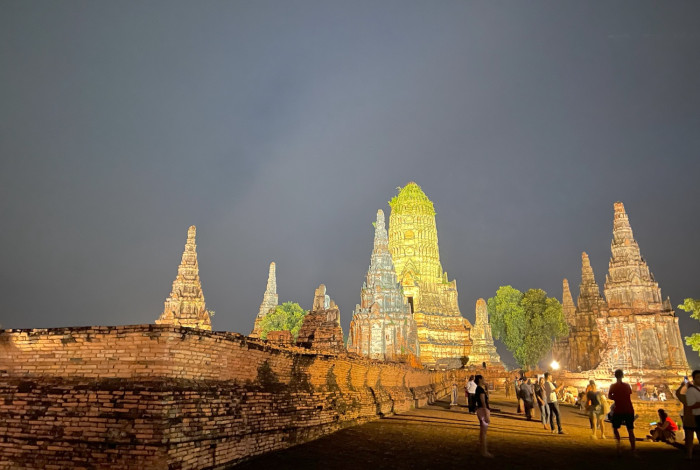
The Morning After the Tour Buses Leave
Walk through Wat Mahathat at dawn, before the first tour groups arrive, and you'll find Ayutthaya as it was meant to be experienced: silent save for the rustle of bodhi leaves, the stone Buddhas catching the first slant of light, the Chao Phraya slipping past like history itself. By mid-morning, the spell breaks. Coaches idle outside the gates. Selfie sticks multiply. The ancient capital, once the heart of a kingdom that ruled Southeast Asia for four centuries, becomes a checkbox on an itinerary between Bangkok and Chiang Mai.
But that rhythm may be shifting. Thailand's Ministry of Tourism and Sports recently unveiled plans to transform Ayutthaya into what it calls a "high-value, sustainable tourism destination" — a recalibration that prioritizes depth of experience over volume of arrivals. At a public hearing convened with government agencies, tour operators, and cultural stewards, Tourism and Sports Minister Surasak Phancharoenworakul outlined a strategy that leverages the province's Unesco World Heritage status not as a marketing hook, but as a conservation mandate.
The language is telling. Instead of "smart tourism" as a buzzword, the ministry is proposing infrastructure upgrades — integrated road, rail, and water transport networks linking key sites — designed to ease congestion and redistribute visitor flow. Instead of chasing arrivals, the focus is on niche segments: faith-based or "Sai Mu" spiritual tourism, wellness retreats anchored in traditional Thai medicine, and community-based initiatives that channel revenue directly to villages stewarding the ruins.
From Product to Demand: A Structural Pivot
For decades, heritage destinations across Asia have wrestled with a paradox: the very tourism that funds preservation also accelerates decay. Ayutthaya is no exception. The sprawling temple complexes — Wat Phra Si Sanphet, Wat Chaiwatthanaram, the haunting tree-entwined Buddha head at Wat Mahathat — draw millions annually, yet much of that visitation has been superficial. Tour buses disgorge passengers for photo stops; souvenir stalls proliferate; interpretation remains thin.
According to the ministry, the new approach pivots from a product-centric model — where destinations package what they have and hope visitors buy — to a demand-driven framework attuned to what international travelers increasingly seek: authenticity, cultural immersion, and environmental stewardship. It's a shift visible across Southeast Asia, from Luang Prabang's guesthouse moratoriums to Borobudur's timed-entry ticketing, but Ayutthaya's version is notable for its emphasis on local agency.
Community-based tourism, long a policy aspiration in Thailand, is being positioned here as the engine of sustainability. The ministry envisions villages adjacent to heritage sites not as passive backdrops but as active participants — guiding cycling tours through rice paddies, hosting cooking classes in family kitchens, curating temple festivals that double as living heritage events. The logic is twofold: distribute income more equitably, and embed conservation in the economic self-interest of those who live among the ruins.
Niche Markets as a Hedge Against Overtourism
The strategy's focus on "Sai Mu" or spiritual tourism is particularly shrewd. Thailand has long been a magnet for Buddhist pilgrims from across Asia, but Ayutthaya — home to hundreds of active and ruined temples — has not fully capitalized on that devotional traffic. By formalizing meditation retreats, monastic stays, and pilgrimage circuits, the ministry is courting a visitor profile that skews longer-stay, lower-impact, and higher-spending.
Wellness tourism, too, fits the mold. Ayutthaya's proximity to Bangkok (80 kilometers north) and its quieter, more contemplative atmosphere make it a logical anchor for spa resorts and holistic retreats drawing on traditional Thai massage, herbal medicine, and riverine tranquility. These are not mass-market segments; they are, by design, selective — travelers who come for a week, not a photo op.
What's less clear is how the ministry intends to manage the tension between selectivity and accessibility. Ayutthaya's designation as a Unesco World Heritage Site in 1991 was predicated on universal value — the idea that these ruins belong, in some sense, to everyone. Shifting toward high-value tourism risks pricing out the very backpackers and regional visitors who have long formed the cultural lifeblood of Southeast Asian travel. The challenge will be ensuring that "sustainable" does not become a euphemism for "exclusive."
Infrastructure as Conservation
One of the more concrete proposals is the integration of transport networks — road, rail, and crucially, water. Ayutthaya sits at the confluence of three rivers, and for centuries, the city was navigated by boat. Today, most visitors arrive by coach or train, bypassing the waterways entirely. Reviving river transport — not as a tourist novelty but as functional mobility — could ease road congestion, reduce emissions, and restore a mode of movement intrinsic to the city's identity.
The ministry's emphasis on "smart tourism" also hints at digital infrastructure: real-time crowd monitoring, advance booking systems, augmented-reality interpretation tools. Done well, these can enhance visitor experience while protecting fragile sites. Done poorly, they risk turning heritage into spectacle, the kind of gamified tourism that privileges Instagram virality over genuine engagement.
At Global Chic Voyage, we've watched heritage destinations across Asia experiment with similar tools — QR codes at Angkor Wat, virtual docents at the Forbidden City — and the verdict is still out. Technology can amplify storytelling, but it cannot replace the serendipity of wandering a ruin at your own pace, of encountering history without mediation. The question for Ayutthaya is whether infrastructure serves conservation or merely manages crowds more efficiently.
Why It Matters: A Test Case for Mainland Southeast Asia
Ayutthaya's pivot is significant not just for Thailand, but for the broader region. Mainland Southeast Asia is thick with Unesco-listed sites — Luang Prabang, Hoi An, Bagan, Vat Phou — all grappling with similar pressures. As international arrivals rebound post-pandemic, the old model of volume-driven tourism is showing its cracks: overcrowded temples, strained infrastructure, cultural erosion disguised as preservation.
If Ayutthaya can demonstrate that heritage tourism can be both financially viable and ecologically sound — that "high-value" need not mean "high-priced," and that community participation is more than a slogan — it could offer a template. The ministry's approach, grounded in stakeholder consultation and multi-agency coordination, suggests a seriousness of intent often missing from top-down tourism plans.
But intent is not outcome. The real test will come in implementation: whether transport upgrades materialize, whether community-based initiatives receive sustained funding, whether niche markets can absorb enough visitors to justify the pivot. And whether, five years hence, that dawn walk through Wat Mahathat still feels like a privilege rather than a performance.
The Ruins We Inherit
There is a photograph, famous in Thailand, of Ayutthaya in the 18th century: a sprawling metropolis of gilded spires and canal-lined streets, a city that rivaled any in Asia. Then came the Burmese sack of 1767, and the capital moved south to Bangkok. What remains are the bones — laterite foundations, headless Buddhas, the ghost of an empire.
Tourism, in a sense, is a second life. But it is also a second siege, slower and more insidious. The question Ayutthaya now faces is whether it can turn that siege into stewardship — whether the same forces that threaten the ruins can be harnessed to protect them. The ministry's plan is ambitious, and in places, idealistic. But idealism, in the context of heritage conservation, is not a weakness. It is a starting point.
We've returned to Ayutthaya often over the years, always at dawn, always before the buses. And each time, we've wondered how long that quietude will last. Perhaps, if the new strategy takes hold, the answer is: indefinitely. Not because the tourists stop coming, but because they come differently — slower, more attuned, more willing to leave something behind besides footprints.
Spot something wrong? Email editors@globalchicvoyage.com. We log every correction publicly.
RELATED
SEE ALL →
28 Jul 2026 / 5 min
9 May 2026 / 5 min
6 May 2026 / 5 min
6 May 2026 / 5 min