
Beyond the Casinos: How Macao's Outer Harbour Is Rewriting the City's Travel Narrative
A strategic partnership between Agoda and Macao's tourism office aims to shift focus from glittering gaming floors to waterfront boutiques and neighborhood textures—just as traveler interest from unexpected markets surges.
SI
30 May 2026 · 5 MIN READ · UPDATED 17 AUG 2026
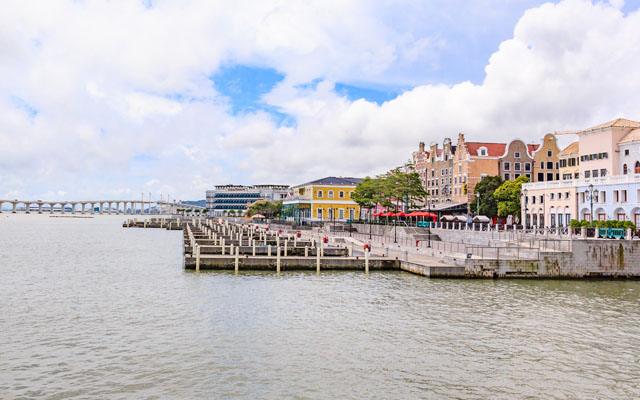
The View from ZAPE
Stand at the edge of the ZAPE waterfront on a late afternoon in May, and the skyline tells two stories. Behind you: the vertical shimmer of integrated resorts, their LED skins cycling through color. Ahead: the low-slung geometry of the Outer Harbour District, where boutique hotels occupy mid-century blocks, their lobbies opening onto streets lined with dai pai dong and Portuguese bakeries. For decades, the former dominated Macao's tourism script. Now, quietly, the latter is being rewritten into the narrative.
At Global Chic Voyage, we've watched destinations wrestle with the tyranny of their own icons—Venice and its gondolas, Dubai and its towers. Macao has long faced a similar challenge: how to expand a story that the world has already decided is about baccarat tables and Cotai spectacle. The answer, it seems, lies not in abandoning that identity but in layering it with something older, smaller, and decidedly less neon.
A Partnership Built on Diversification
Agoda's expanded collaboration with the Macao Government Tourism Office marks a deliberate pivot toward properties that don't appear in skyline photographs. The 2026 agreement zeroes in on the Outer Harbour District—a waterfront zone encompassing ZAPE and NAPE, where boutique and independent hotels operate within walking distance of the city center yet feel a world removed from the gaming floors. The partnership builds on campaigns launched in 2025 across Southeast Asia, Northeast Asia, and the Middle East, but this iteration sharpens the geographic and experiential focus.
Selected hotels in the district will gain visibility in markets that have only recently begun to engage with Macao in meaningful numbers: Brazil, Vietnam, Central Asia. The logic is sound. If a destination wants to diversify its visitor profile, it must first diversify where—and how—it tells its story. Boutique properties, by definition, resist monoculture. They occupy adaptive-reuse buildings, employ local design vocabularies, and root themselves in neighborhood rhythms rather than resort ecosystems. In Macao's case, that means Portuguese tile work, Cantonese shophouse proportions, and the kind of street-level dining culture that thrives on repeat visits, not first impressions.
The Numbers Behind the Shift
Travel interest in Macao has spiked across source markets that were, until recently, peripheral to its tourism strategy. According to Agoda, year-on-year accommodation searches from the Middle East surged 247 percent. India followed at 70 percent, Japan at 62 percent, Thailand at 56 percent, the Philippines at 39 percent, and Singapore at 25 percent. These figures suggest more than seasonal fluctuation; they indicate a structural shift in how certain traveler segments perceive the city.
The Middle Eastern surge is particularly telling. It aligns with broader regional travel patterns—improved connectivity via Gulf carriers, visa facilitation measures, and a growing appetite for East Asian destinations that offer both urban density and cultural specificity. For these travelers, Macao's Portuguese-Cantonese hybridity presents a compelling alternative to the more homogenous luxury circuits of Southeast Asia. The boutique hotel becomes, in this context, a curatorial device: a way to experience layered heritage without the mediating presence of a mega-resort.
Japan's 62 percent increase, meanwhile, reflects renewed outbound momentum post-pandemic and a preference for short-haul destinations with cultural texture. Thai and Filipino growth tracks with expanded low-cost carrier routes and rising middle-class travel spend. Singapore's more modest uptick likely reflects market maturity—Singaporeans have long visited Macao, but the boutique angle offers a fresh lens.
Why Boutique, Why Now
The emphasis on boutique and independent properties is not incidental. It responds to a broader industry trend: the fatigue with sameness. We've observed this across markets—travelers who once prized consistency now seek differentiation, properties that function as portals into a place rather than buffers against it. In Macao, that translates to hotels where the concierge knows the best congee vendor, where the lobby bar sources Portuguese wine from family estates, where the architecture acknowledges the street rather than turning inward.
The Outer Harbour District, with its waterfront access and proximity to both heritage sites and contemporary dining, offers the kind of walkable, layered experience that boutique hotels amplify. It's a geography of accretion: colonial-era churches, mid-century apartment blocks, new museums, old markets. The boutique hotel, by virtue of its scale and ethos, fits this mosaic better than a 1,000-room tower ever could.
Agoda's role in this equation is infrastructural. The platform's distribution reach—spanning accommodation, flights, and activities—allows smaller properties to compete for visibility in markets where they lack direct sales presence. For a 20-room boutique in NAPE, access to Brazilian or Central Asian travelers isn't a matter of brand power; it's a matter of algorithmic placement and targeted marketing. The partnership with MGTO provides both.
What This Signals for Macao's Tourism Architecture
Macao's pivot toward boutique hotels and neighborhood narratives reflects a broader recalibration within the Special Administrative Region's tourism strategy. The city has long grappled with over-concentration—too many visitors funneled into too few districts, too much economic reliance on gaming revenue. Diversification, in this context, is both experiential and economic. By promoting the Outer Harbour District, MGTO is effectively redistributing visitor flows, reducing pressure on core zones, and creating new revenue streams for independent operators.
This approach also hedges against volatility. Gaming revenue is subject to regulatory shifts, geopolitical friction, and macroeconomic cycles. Boutique tourism, while smaller in scale, tends to attract higher-spending, longer-staying visitors who engage more deeply with local businesses. It's a bet on quality over volume, on narrative over transaction.
The involvement of markets like Brazil and Central Asia is equally strategic. These are not mass-market source countries for Macao—yet. But they represent growth frontiers, regions where awareness of the destination is still being shaped. By introducing Macao through boutique properties and neighborhood experiences rather than casino imagery, MGTO is seeding a different kind of brand association, one that may prove more durable as these markets mature.
The Platform as Collaborator
Damien Pfrisch, Agoda's chief commercial officer, framed the partnership as an example of how tourism authorities and travel platforms can co-create destination narratives. The phrasing is corporate, but the implication is significant. Platforms like Agoda wield considerable influence over how travelers discover and evaluate destinations. Their algorithms prioritize certain properties, their interfaces shape search behavior, their promotional mechanics determine which hotels gain traction in emerging markets. When a platform aligns its commercial interests with a destination's strategic priorities, the result can be more coherent than traditional advertising campaigns.
In Macao's case, that alignment manifests as targeted marketing for Outer Harbour properties, preferential placement in search results for specific source markets, and bundled offers that combine accommodation with flights and activities. It's a form of destination design executed at the level of digital infrastructure.
Why It Matters
The Agoda-MGTO collaboration is, on one level, a marketing agreement. But it also represents a template for how second-tier districts within established destinations can gain traction without relying solely on organic discovery. The Outer Harbour District is not unknown—it has always been there, across the water from the casinos—but it has lacked the narrative and distribution muscle to compete for attention. This partnership provides both.
For other destinations wrestling with over-tourism, monoculture, or geographic imbalance, Macao's approach offers a case study in strategic layering. The goal is not to replace the iconic (casinos will remain central to Macao's identity) but to expand the frame, to give travelers a reason to stay longer, explore further, and return with a different story.
The boutique hotel, in this framework, becomes more than accommodation. It becomes a rhetorical device, a way of saying: there is more here than you thought. And if the search data is any indication—247 percent growth from the Middle East, double-digit increases across Asia—more travelers are beginning to listen.
Spot something wrong? Email editors@globalchicvoyage.com. We log every correction publicly.
RELATED
SEE ALL →
10 Jul 2026 / 5 min
8 Aug 2026 / 5 min
7 Aug 2026 / 5 min
31 Jul 2026 / 5 min