
Beyond the Silk Road: How Azerbaijan Is Courting Asia's New Wanderlust
With a Beijing office, bilateral visa waivers, and direct flights multiplying, the Caucasus crossroads is betting on Asia's appetite for destinations that defy easy categorization.
SI
30 May 2026 · 5 MIN READ · UPDATED 17 AUG 2026
The Crossroads Opens a New Door
There is a particular kind of city that exists only at the edges of empires: places where minarets share skylines with Soviet brutalism, where the scent of saffron drifts past glass-and-steel towers, where the past is not preserved so much as lived alongside the present. Baku is one such city. And now, as Azerbaijan's national tourism board plants its flag in Beijing—complete with a visitor experience centre designed to immerse Chinese travelers in the Caucasus before they ever board a plane—the country is making a calculated wager: that Asia's travelers, particularly those from China, are ready for destinations that resist tidy categorization.
The move comes amid a broader recalibration of Azerbaijan's tourism strategy. With bilateral visa-free arrangements now in place between China and Azerbaijan, the opening of the Beijing office signals more than logistical convenience. It marks a recognition that physical presence matters in a market where relationships are built over tea, not email chains. Florian Sengstschmid, CEO of the Azerbaijan Tourism Board, has been forthright about the rationale: being on the ground in China is essential when the goal is not just visibility but trust.
At Global Chic Voyage, we've watched destinations pivot toward Asia before—often with more ambition than infrastructure. What distinguishes Azerbaijan's approach is its timing. The country is leveraging a moment when air connectivity is expanding, when Chinese outbound travel is rebounding with more discernment than before, and when travelers across Southeast Asia, Japan, and South Korea are increasingly drawn to narratives that complicate the familiar binaries of East and West.
Building the Architecture of Access
Connectivity is the unglamorous scaffolding on which aspirational tourism is built. Azerbaijan Airlines and China Southern Airlines already operate direct flights between Baku and China, and China Eastern Airlines is set to launch summer services to Shanghai. These routes are not accidents; they are the result of years of diplomatic groundwork and commercial negotiation. But flights alone do not guarantee arrivals. The Azerbaijan Tourism Board has been preparing the ground in other ways: partnerships with Trip and Fliggy, two of China's dominant travel platforms, ensure that Azerbaijan appears in the digital itineraries of millions. Meanwhile, a China-ready training programme has been rolling out across Azerbaijan's hospitality sector, equipping hoteliers, guides, and restaurateurs with the cultural fluency required to serve Chinese guests—everything from understanding dietary preferences to navigating payment systems.
This is not window dressing. In our experience covering luxury and cultural travel across Asia, the gap between a destination's ambitions and its on-the-ground readiness is often where goodwill evaporates. Azerbaijan seems to understand that the first Chinese guest to arrive in Baku is an ambassador—or a cautionary tale—for thousands more.
Beyond China, the board's roadmap extends across Malaysia, Indonesia, Vietnam, South Korea, and Japan. Sengstschmid and his team have been regulars at regional trade shows and conferences, a presence that reflects a longer game. Over the past eight years, Asia's importance to Azerbaijan's tourism ecosystem has grown in tandem with improved connectivity. The board is now in active conversations with Asia-Pacific carriers, pitching Azerbaijan not as a stopover but as a primary destination—a narrative shift that requires both infrastructure and imagination.
The Post-Soviet Narrative, Rewritten
For much of the past three decades, Azerbaijan has been burdened by the post-Soviet label—a shorthand that flattens complexity into Cold War nostalgia or economic transition narratives. But the country's recent hosting of high-profile global events has begun to rewrite that script. The United Nations Climate Change Conference COP29, held in Baku two years ago, brought thousands of delegates, journalists, and NGO representatives into the city. The World Urban Forum, which convened in the capital this May, did the same. These events do more than generate headlines; they create a visual and experiential vocabulary that positions Baku as a city capable of hosting the world.
Sengstschmid has noted that such gatherings help situate Azerbaijan on the global map—not as a relic, but as a participant in contemporary conversations about climate, urbanism, and governance. For travelers, particularly those from Asia's rapidly urbanizing capitals, this matters. The question is no longer whether Azerbaijan meets international standards, but what kind of experience it offers beyond those standards.
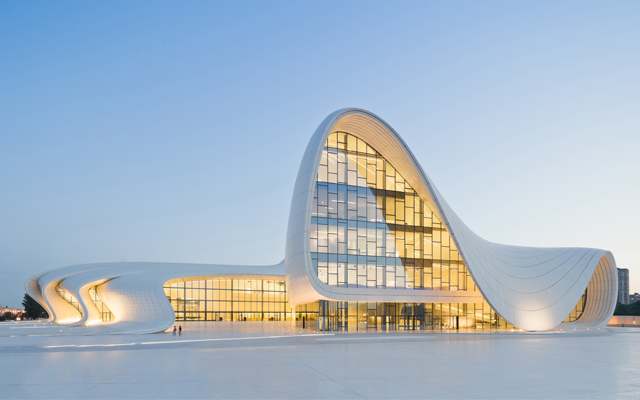
The answer, increasingly, is cultural layering. Azerbaijan sits at the crossroads of East and West, a geographic truism that becomes more interesting when you examine what that means in practice. The Walled City of Baku, a UNESCO World Heritage Site, is a labyrinth of stone alleyways and caravanserais that once sheltered Silk Road traders. A few kilometers away, the Heydar Aliyev Center—designed by Zaha Hadid—curves and flows like frozen liquid, a monument to architectural ambition. The Flame Towers, three skyscrapers clad in LED screens, dominate the skyline at night, their surfaces flickering with digital fire.
This is not heritage versus modernity; it is heritage and modernity in conversation, sometimes tension, always proximity. For Asian travelers accustomed to similar juxtapositions in their own cities—Seoul's palaces shadowed by glass towers, Jakarta's kampungs abutting luxury malls—Azerbaijan's urban fabric may feel less foreign than European observers often assume.
The Edible Landscape
Azerbaijan's climate allows for year-round fresh produce, a fact that shapes its culinary identity in ways both subtle and profound. The country's location along the Caspian Sea, combined with microclimates ranging from subtropical lowlands to alpine highlands, means that saffron, pomegranates, walnuts, and herbs appear in dishes with a seasonality that feels less like a trend than a way of life. For travelers from Asia, where food is often the lens through which culture is first understood, this is a point of entry that requires little translation.
Beyond the table, Azerbaijan's natural and heritage sites offer textures that resist the flattening effect of Instagram. Yanar Dag, the Burning Mountain, is a hillside where natural gas seeps through porous rock and ignites in perpetual flame—a phenomenon that has burned for centuries, long before the oil industry turned the country's economy. The Gobustan Rock Art Cultural Landscape, another UNESCO site, contains petroglyphs dating back 40,000 years, images of hunting scenes and rituals etched into stone by people who knew this land as a corridor between continents.
Then there are the villages: Lahij, known for its copper craftsmanship, and Basqal's Silk Village, both once vital nodes on the ancient Silk Road. These are not reconstructed heritage parks but living communities, places where artisans still hammer copper vessels by hand, where silk is still woven on wooden looms. For travelers weary of curated authenticity, the lived continuity of these villages offers something harder to find: the sense that history is not behind glass, but underfoot.
Why It Matters for Asia's Next Chapter
Azerbaijan's courtship of Asian travelers arrives at a moment when outbound travel from the region is diversifying. The post-pandemic traveler—whether from Shanghai, Jakarta, or Tokyo—is less interested in bucket-list monuments and more curious about destinations that offer narrative depth, cultural complexity, and the possibility of surprise. The Caucasus, long overshadowed by Europe's more familiar circuits, is beginning to register as a region worth exploring, not as an addendum to a European itinerary but on its own terms.
What Azerbaijan offers is a kind of cultural bilingualism: a destination that speaks both to Asia's historical memory of the Silk Road and to its contemporary appetite for modernity, design, and urbanity. The country's efforts to meet Chinese travelers on their own digital and experiential terms—through platforms like Fliggy, through China-ready training, through direct flights—suggest a level of intentionality that goes beyond marketing. It is an acknowledgment that hospitality, at its best, is a form of translation.
For the Azerbaijan Tourism Board, the Beijing office is not an endpoint but a beachhead. If the strategy succeeds, it will be because the country has managed to position itself not as exotic or undiscovered—those tired tropes of travel marketing—but as a place that makes sense in the context of Asia's own complexity. A place where the past and present coexist without apology, where the architecture of empires and the infrastructure of globalization share the same streets, and where travelers from one crossroads of the world can recognize themselves in another.
The Long Game
We are in the early chapters of this story. The success of Azerbaijan's Asia strategy will depend not only on flights and visa waivers but on whether the destination can sustain the interest it is now courting. Can Baku's hotels and guides meet the expectations of travelers accustomed to the service standards of Tokyo or Singapore? Will the culinary scene evolve to accommodate dietary preferences without losing its distinctiveness? Can the country's natural and heritage sites withstand increased visitation without becoming sanitized?
These are questions that will be answered in the coming years, not in press releases but in the experiences of travelers who arrive with curiosity and leave with stories. For now, Azerbaijan is doing what any destination serious about Asia must do: showing up, building relationships, and recognizing that the journey from awareness to arrival is long, nuanced, and never linear. The crossroads, after all, has always been a place of encounter—and sometimes, of transformation.
Spot something wrong? Email editors@globalchicvoyage.com. We log every correction publicly.
RELATED
SEE ALL →
27 Jun 2026 / 5 min

8 Aug 2026 / 5 min
8 Aug 2026 / 5 min
7 Aug 2026 / 5 min