
Dolomites, Italy: Alpine Drama Beyond Ski Season
Dolomites
ES
24 Mar 2026 · 5 MIN READ · UPDATED 17 AUG 2026
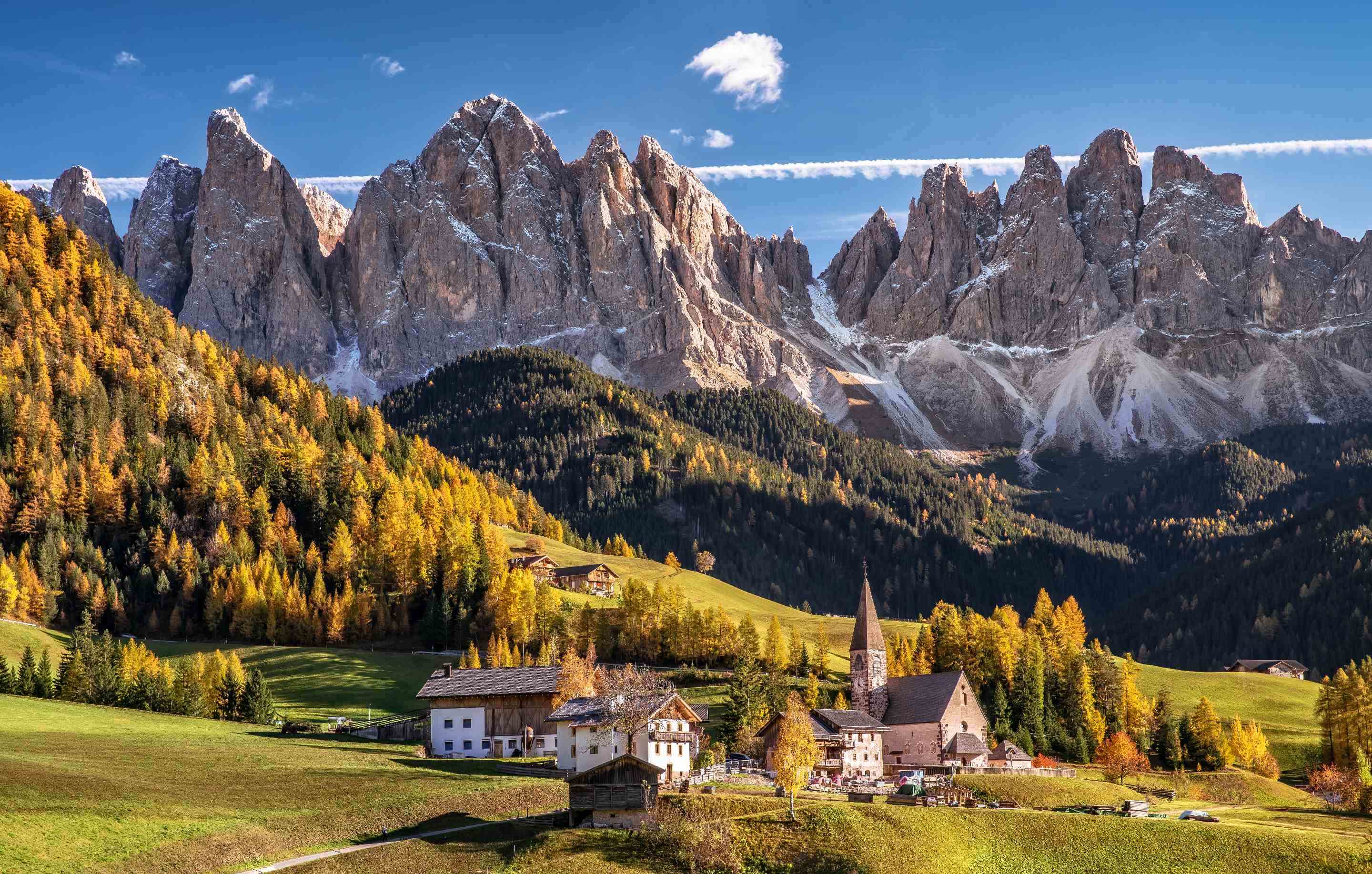
There is a moment in the Dolomites when the light turns pink - enrosadira, the locals call it - washing sheer limestone peaks in a surreal glow. While winter draws skiers to its famed slopes, the Dolomites reveal a quieter, more poetic identity once the snow recedes. Here, summer and autumn unfold in layers of alpine meadows, crystalline lakes, and architectural refuges perched between sky and stone. It is a landscape that invites not just movement, but pause - a slower, more intentional way of experiencing the mountains.
The Landscape
A UNESCO World Heritage Site, the Dolomites stretch across northern Italy, bridging regions like South Tyrol, Trentino, and Belluno. Unlike the rounded peaks of other Alpine ranges, these mountains rise dramatically in jagged formations - cathedrals of pale rock shaped by ancient coral reefs dating back over 200 million years.
The geological uniqueness of the Dolomites gives the range its distinctive pale hue, shifting from chalky white to warm amber throughout the day. Iconic landmarks such as Tre Cime di Lavaredo stand like sculptural monoliths, while the still waters of Lago di Braies reflect the surrounding peaks with near-perfect symmetry. Elsewhere, the sweeping plateau of Alpe di Siusi offers a gentler counterpoint - expansive, pastoral, and dotted with wooden chalets that feel suspended in time.
Seasonality adds further nuance: summer brings wildflowers and long daylight hours, while autumn transforms larch forests into golden tapestries, with crisp air and heightened clarity across the peaks.

Tre Cime di Lavaredo
Photo Credit: The Photo Hikes

Lago di Braies
Photo Credit: Berghotel

Alpe di Siusi
Photo Credit: Val Gardena
Things to Do
Hiking & Via Ferrata
The Dolomites are interwoven with one of Europe’s most extensive trail networks. Multi-day treks such as the Alta Via routes guide hikers across dramatic ridgelines and through quiet valleys. For a more immersive experience, via ferrata routes, originally developed during World War I, allow climbers to scale exposed rock faces using fixed cables and ladders, blending history with adrenaline.

Photo Credit: Marta
Cycling Through Mountain Passes
Cyclists can trace the same roads used in the Giro d'Italia, including the legendary Passo dello Stelvio and Passo Gardena. The rhythm of ascent and descent reveals shifting perspectives - dense forests giving way to open panoramas with every turn.

Photo Credit: Rolling Existence
Lake-hopping & Slow Exploration
Beyond the well-known Lago di Carezza, smaller alpine lakes offer quieter moments of reflection. Early mornings are particularly atmospheric, when mist lingers above the water and the mountains appear almost weightless.

Photo Credit: Avventure Bellissimes
Wellness & Thermal Experiences
The region has embraced wellness as an extension of its landscape. Forest bathing, open-air saunas, and panoramic infinity pools, often carved into the mountainside, transform relaxation into a sensory ritual grounded in nature.

Photo Credit: Rosalyn Wikeley
Cultural Immersion & Gastronomy
In villages like Ortisei and Cortina d'Ampezzo, culture is layered and distinct. The Ladin heritage coexists with Italian and Austrian influences, evident in language, architecture, and cuisine. Dining becomes a highlight, from rustic mountain huts to Michelin-starred restaurants, where local ingredients - game, mushrooms, alpine herbs - are reinterpreted with contemporary finesse.

Photo Credit: Ker & Downey World Travel
Accommodations
Alpine Design Retreats
The Dolomites have become a destination for design-led hospitality. Forestis exemplifies this approach, with minimalist architecture oriented toward the horizon, emphasizing silence, light, and elemental materials.

Forestis Dolomites Hotel
Photo Credit: Forestis
Elevated Boutique Escapes
Properties like Adler Lodge Alpe offer chalet-style suites with expansive glazing, blending rustic warmth with contemporary comfort. Interiors often feature local timber, stone, and handcrafted details that echo the surrounding landscape.

Adler Lodge Alpe
Photo Credit: Adler Resorts
Traditional Rifugi
Staying at a high-altitude refuge such as Rifugio Lagazuoi offers a more elemental experience. Evenings are simple yet memorable, shared meals, candlelight, and the vast silence of the mountains.

Rifugio Lagazuoi
Photo Credit: Cortina Dolomiti
Historic Grand Hotels
In Cortina d'Ampezzo, historic hotels evoke a sense of old-world glamour, recalling the region’s legacy as a retreat for European aristocracy and creatives.
How to Travel
Reaching the Dolomites requires a layered journey that enhances their sense of remoteness. International travelers typically arrive via Venice, Verona, or Innsbruck. From these gateways, a scenic drive into the mountains becomes part of the experience, with winding roads revealing ever-changing vistas.
Rail connections lead to Bolzano or Bressanone, where regional buses and private transfers provide access to alpine villages. During summer, cable cars and funiculars extend mobility, allowing visitors to reach high-altitude viewpoints with ease.
Travel Tips
+ Timing Your Visit: July and August bring vibrant energy but also crowds; June and September offer a more tranquil, design-forward travel experience.
+ Book Ahead: Design hotels and rifugi often have limited rooms and fill quickly during peak months.
+ Altitude Awareness: Take time to acclimatize, especially when planning high-elevation hikes.
+ Mobility Strategy: A car offers flexibility, but combining it with cable cars reduces driving fatigue.
+ Sustainable Travel: The Dolomites are a protected landscape - opt for eco-conscious accommodations and respect local conservation guidelines.
Beyond ski season, the Dolomites reveal a different kind of luxury - one defined not by speed or spectacle, but by stillness, scale, and sensory depth. It is a place where architecture dissolves into landscape, where every path leads to a view, and where time stretches in rhythm with the mountains.
In the Dolomites, the drama is not confined to winter’s slopes, it lives in the glow of evening light, the quiet of alpine mornings, and the enduring dialogue between nature, culture, and design.
Spot something wrong? Email editors@globalchicvoyage.com. We log every correction publicly.
RELATED
SEE ALL →24 Jul 2026 / 5 min
15 Jul 2026 / 5 min
14 Jul 2026 / 5 min
9 Jul 2026 / 5 min