
The Lagoon Town Italy Forgot to Mention
Comacchio offers the same waterways and bridges that made Venice famous, without the crowds that now define it
SI
15 Jul 2026 · 5 MIN READ · UPDATED 17 AUG 2026
A Different Kind of Water Music
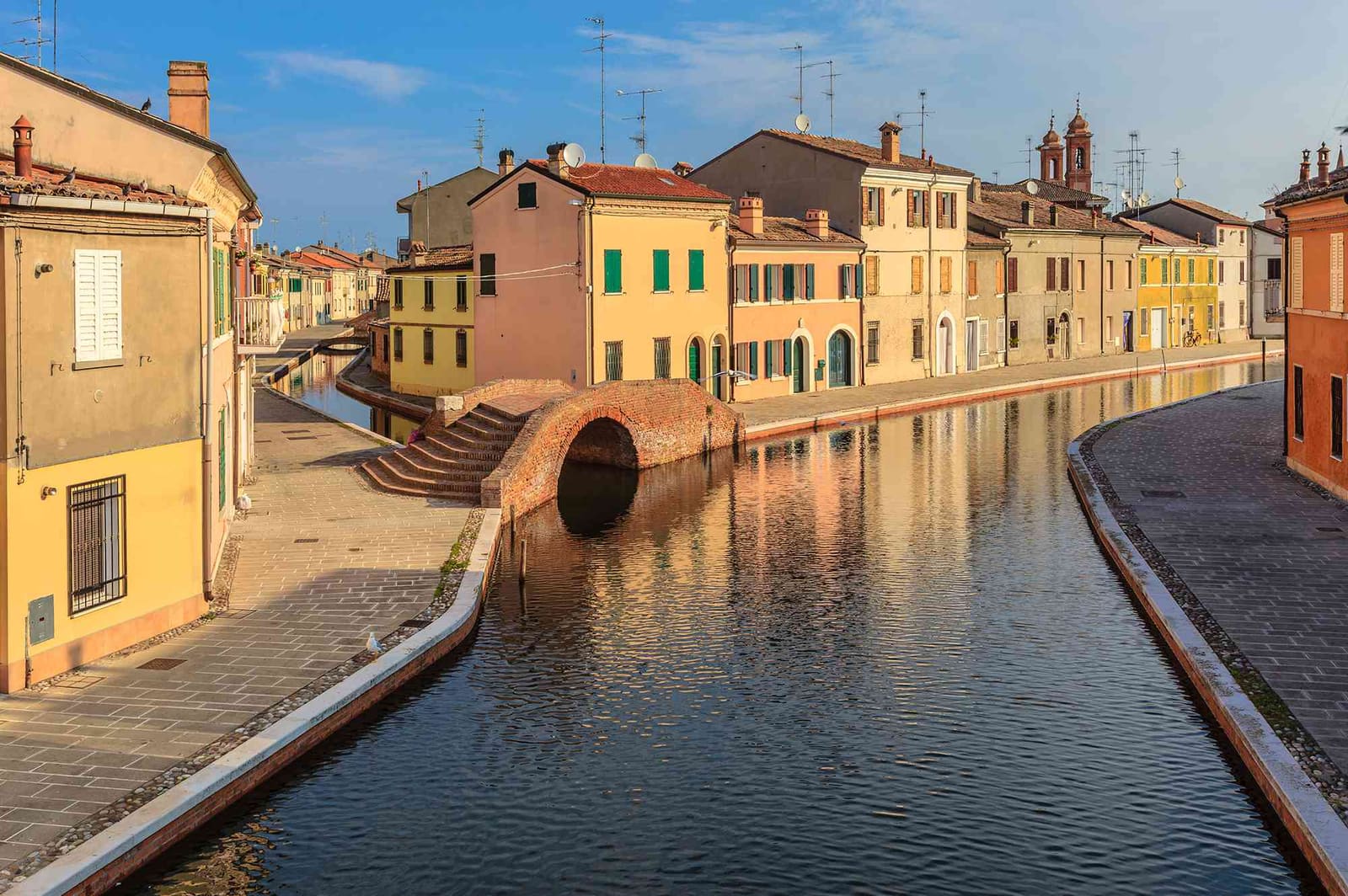
The morning light in Comacchio arrives in slants, catching the edges of brick façades and spilling across narrow canals that curve between buildings like sentences left unfinished. There are no cruise ships here, no queues snaking toward basilicas. Instead, a fisherman moors his boat beneath a stone bridge, his movements practiced and quiet, the kind of choreography that belongs to a place still living its original life rather than performing it.
At Global Chic Voyage, we have watched Venice become a city almost too beloved for its own good, its beauty now inseparable from the effort required to experience it. Which is why Comacchio, tucked into the wetlands of Emilia-Romagna's eastern edge, feels less like an alternative and more like a rediscovery of what made the Venetian model so compelling in the first place: a settlement shaped entirely by water, where architecture and daily rhythm bend to the logic of tides and channels.
The Architecture of Adaptation
Comacchio's canal system is not a replica but a cousin, born from similar necessities. Built across thirteen small islands within the Po Delta, the town emerged in the early medieval period as a hub for salt production and eel fishing, industries that demanded an intimate negotiation with the lagoon. The Trepponti, a seventeenth-century bridge complex designed by architect Luca Danese, remains the town's most photographed monument: five arched staircases converging at a central platform, a piece of infrastructure that doubles as sculpture.
What distinguishes Comacchio from its more famous relative is scale and function. The canals here are narrower, the bridges lower, the palette quieter. The buildings lean toward each other in faded ochres and siennas, their shutters weathered by salt air. This is not a town that ever aspired to empire; it aspired to survival, and the humility of that ambition is written into every sightline.
The Rhythms That Remain
Walking Comacchio means following routes dictated by water. The town's layout resists grids, preferring instead a network of footbridges and fondamente that require constant reorientation. It is easy to become momentarily lost, which is perhaps the point. The disorientation is gentle, almost pastoral, punctuated by the sight of wooden boats moored along the canal walls and the occasional heron picking its way through the shallows.
Boat tours depart from the central quays, threading through the town's waterways and out into the surrounding wetlands of the Valli di Comacchio, a protected nature reserve that spans more than eleven thousand hectares. These tours move slowly, conducted in flat-bottomed vessels that recall the batana boats of the northern Adriatic. The guides, many of them third-generation fishermen, speak of eel migrations and reed beds with the specificity of people whose livelihoods depend on reading the landscape.
The Eel and the Economy
Comacchio's identity has long been inseparable from the eel. For centuries, the town's economy revolved around the cattura, the seasonal eel harvest that took place each autumn as the fish migrated from the lagoon toward the open sea. The Manifattura dei Marinati, a former eel-processing factory now converted into a museum, offers a glimpse into this vanished industrial culture. The building's long brick halls, once filled with workers grilling and marinating eels for export, now house exhibitions on the delta's ecology and the town's maritime history.
Today, the eel trade has diminished, a victim of overfishing and changing migration patterns, but the town's restaurants still serve anguilla marinata as a matter of heritage. The preparation is simple: the eel is grilled, then marinated in vinegar, garlic, and bay leaves, a technique developed to preserve the catch before refrigeration. It is not a dish designed to seduce tourists; it is a dish designed to survive the winter.
The Case for Smaller Canals
There is a broader question embedded in Comacchio's appeal, one that extends beyond the specifics of any single town. It asks what we want from places that resemble famous destinations. Are we seeking the same experience with fewer inconveniences, or are we looking for something else entirely: a different relationship to beauty, one less mediated by spectacle and more rooted in the ordinary textures of a place still inhabited by people who are not performing hospitality but simply living?
Comacchio does not try to be Venice. It lacks the palazzos, the grand ceremonial spaces, the accumulated weight of Renaissance power. What it offers instead is a quieter proposition: that the interplay of water and stone, of bridges and boats, can be experienced at a human scale, in a town where the primary audience is still the town itself.
Practical Considerations for the Curious
Reaching Comacchio requires intention. The nearest major city is Ferrara, roughly fifty kilometers to the west, accessible by regional train. From there, a bus completes the journey in under an hour. The town's accommodations are modest, concentrated in small hotels and agriturismi scattered through the delta. This is not a destination with luxury resorts or rooftop bars; it is a destination with early mornings and long walks.
The best months to visit are late spring and early autumn, when the wetlands are alive with migratory birds and the summer heat has softened. Winter, while stark, offers its own rewards: the canals reflect the low light in shades of pewter, and the town empties further, returning fully to its residents.
What Comacchio Teaches
If Venice is a lesson in how beauty can become its own burden, Comacchio is a lesson in what happens when beauty remains incidental to function. The town's canals were never built to enchant visitors; they were built to move salt and fish, to connect islands, to survive in a landscape that offered little solid ground. That they enchant anyway is almost beside the point.
We return to places like Comacchio not because they offer everything Venice does without the crowds, but because they remind us that the vocabulary of canals and bridges, of boats and tides, is not the exclusive property of any single city. It is a language spoken across the Adriatic and the lagoons of the Po Delta, in towns that never sought fame and so were never required to manage it. In that modesty, there is a kind of luxury all its own.
Photo: Flavio Vallenari / Getty Images
Spot something wrong? Email editors@globalchicvoyage.com. We log every correction publicly.
RELATED
SEE ALL →24 Jul 2026 / 5 min
14 Jul 2026 / 5 min
9 Jul 2026 / 5 min
24 Mar 2026 / 5 min