
Milan's Embrace of Tomorrow: How Italy's Working City Rewrites the Rules of Urban Beauty
While Rome and Florence trade on Renaissance grandeur, the Lombard capital is building a polycentric metropolis that values progress over preservation
SI
22 Jul 2026 · 5 MIN READ · UPDATED 17 AUG 2026
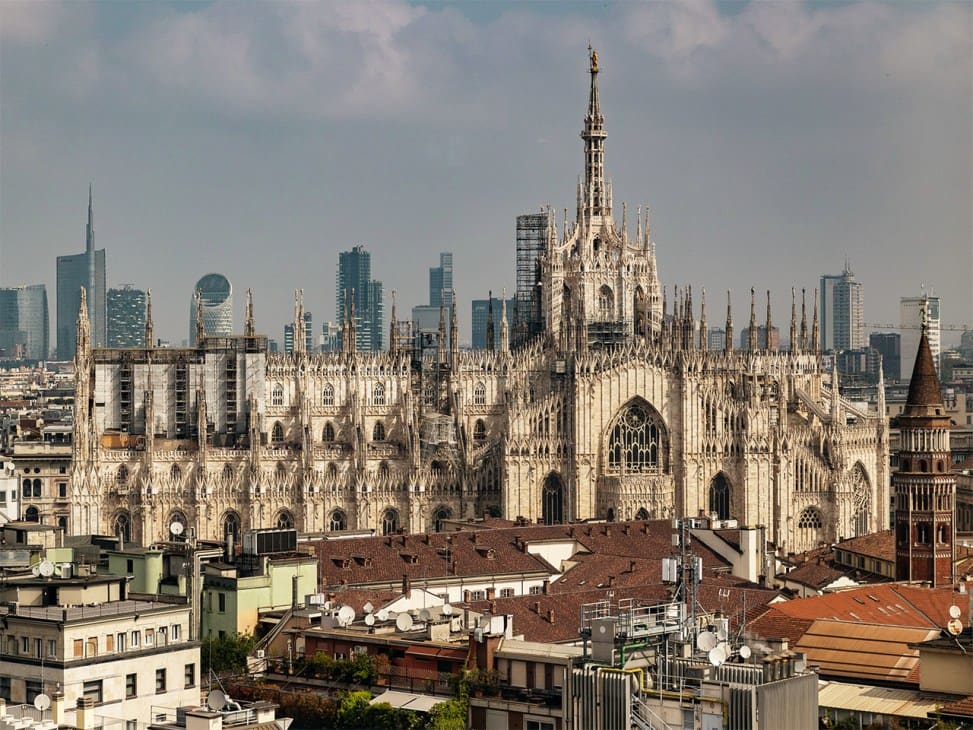
The City That Asks You to Look Twice
Stand in Piazza del Duomo at dusk and you'll see what makes Milan different. Behind you, the cathedral's Gothic spires reach skyward, marble lace against fading light. Ahead, glass towers catch the last sun, their reflections rippling across facades that remember the Second World War. A tram rattles past, graffiti blooming on a Liberty-era building to your left. It's not the seamless historical tableau of Florence, not Rome's layered antiquity. It's messier, more honest, less concerned with charming you immediately.
At Global Chic Voyage, we've always believed that the most compelling cities are those unafraid to show their working. Milan has never pretended to be an open-air museum. The Lombard capital earned its living through industry, commerce, fashion, design. When wartime bombs left gaps in the urban fabric, the city rebuilt with an eye toward utility rather than nostalgia. Where other Italian cities curate their Renaissance palazzi like precious artifacts, Milan plants mid-century apartment blocks next to art nouveau gems and calls it progress.
The criticism leveled most often against Milan is that it lacks conventional prettiness. Fair enough. But beauty here requires a recalibrated lens. It lives in the geraniums spilling from sixth-floor balconies, in the sudden cool of a hidden courtyard, in the terrazzo patterns of a 1950s lobby. This is a city that rewards the observant traveler, the one willing to look past the scuffed edges and see ambition in motion.
Building the Polycentric Dream
Over the past fifteen years, Milan has undertaken a transformation few Italian cities could match in scale or nerve. CityLife and Porta Nuova, two entirely new-build neighborhoods, have reshaped the skyline with contributions from Stefano Boeri, Daniel Libeskind, Zaha Hadid, and Mario Cucinella. These aren't isolated trophy buildings but mixed-use districts blending retail, residential towers, and substantial green space.
The appetite for reinvention continues. Snøhetta recently completed Pirelli 35, reimagining a 1960s block in Porta Nuova as a mixed-use development that invited beloved local bakery Pan to anchor its ground floor. The Oslo-founded practice is also involved in transforming the site of the city's former slaughterhouse into an ambitious new quarter. Porta Romana and Scalo Farini, both occupying former industrial land, remain works in progress.
What distinguishes Milan is not just the presence of celebrated international architects but the capital and political will to welcome them. Italian cities are rarely short on architectural pedigree; they're often short on the courage to let contemporary design share the stage. Milan possesses both the space and the appetite.
Beyond the Three Rings
The real test, however, lies not in individual high-profile projects but in whether Milan can achieve its stated ambition of becoming a truly multicentric city. For generations, Milanese identity has been defined by the three circonvallazioni, concentric rings that demarcate the central districts. As property values climb and residents seek more space, the question becomes whether Milan can knit its once-industrial peripheries into a coherent metropolitan fabric.
Several districts are vying for relevance. Santa Giulia gained attention recently through its David Chipperfield-designed sports arena, which hosted events during the Milano-Cortina Olympics. The Milano Certosa District, a project led by Italian real-estate developer RealStep in the city's northwest, is positioning itself as a food and entertainment hub. Then there's NOM (North of Milan), a branding exercise that echoes the earlier rebranding of Nolo (north of Loreto).
The nomenclature can feel borrowed, even forced. But the underlying infrastructure gives these ambitions a fighting chance. Milan's tram network remains one of Europe's most extensive. The metro, while not as vast as those of Paris or London, connects key nodes efficiently. The Passante urban rail, despite needing investment beyond the cosmetic upgrades applied for the 2026 Winter Games, still threads through neighborhoods that might otherwise remain isolated.
The Mechanics of Connection
What Milan understands, perhaps better than any other Italian city, is that urban vitality depends on movement. A multicentric metropolis can't function if its satellites remain disconnected from one another or tethered solely to a historic core. The city's bones, its transit networks and industrial-era rail lines, offer the skeleton upon which a larger organism can grow.
The challenge is ensuring that new districts don't simply become bedroom communities for the wealthy or isolated enclaves of corporate offices. Mixed-use development, the kind that brings bakeries and delis alongside office towers, is essential. So is the preservation of local character, the neighborhood bars and family-run shops that give a district its texture. Milan's graffiti-clad walls and scuffed facades, often seen as flaws, are also markers of lived experience, evidence that a place is inhabited rather than curated.
The Luxury of Forward Motion
There's a particular luxury in a city unburdened by the obligation to preserve every cornice, every cobblestone. Milan's lack of what might be called historical baggage, its wartime destruction and rapid 20th-century expansion, gave it permission to build without guilt. That forward-focused mentality, born of necessity, has become a defining characteristic.
It's what allows Milan to rank consistently high in quality-of-life surveys despite lacking the postcard appeal of Venice or the grand boulevards of Turin. Livability, it turns out, has less to do with Renaissance frescoes than with functional transit, green space, and neighborhoods that evolve to meet contemporary needs.
For the traveler accustomed to Italy's museum cities, Milan can feel disorienting. There's no single historic center to circle on a map, no obvious itinerary that covers the essential sights in a weekend. The city asks for more time, more patience, more willingness to wander beyond the obvious. In exchange, it offers something rarer: a sense of a metropolis still in the process of becoming.
What Lies Ahead
As Milan continues to expand outward, weaving former industrial zones into its urban tapestry, the question is whether it can maintain coherence without sacrificing the grit that makes it distinctive. The risk in any ambitious redevelopment is homogenization, the flattening of local identity into a generic international style.
Yet Milan has advantages. Its design culture runs deep, its appreciation for craft and material quality embedded in everything from fashion to furniture. The city's work-driven mentality, the same impulse that led it to rebuild rather than restore, may also keep it grounded. A metropolis that values function alongside form, that allows a 1960s tower block to coexist with a Liberty facade, is one less likely to erase its own complexity in pursuit of a polished image.
If Milan succeeds in becoming a truly polycentric city, if its various districts develop into desirable places to live and work rather than mere satellites of the center, it will offer a model for other European cities grappling with growth and transformation. The bones are there. The ambition is evident. What remains is the patient work of connection, the knitting together of neighborhoods into a metropolis that honors both its industrial past and its aspirational future.
At Global Chic Voyage, we've returned to Milan repeatedly over the years, each visit revealing new layers, new projects, new reasons to believe in a city that refuses to rest on its laurels. It may never be as immediately seductive as Rome, as picture-perfect as Florence. But for those willing to adjust their lens, Milan offers something more enduring: the luxury of forward motion, the beauty of a city unafraid to build its own future.
Photo: Emanuele Cremaschi / Getty Images
Spot something wrong? Email editors@globalchicvoyage.com. We log every correction publicly.
RELATED
SEE ALL →
28 Jul 2026 / 5 min
9 Jun 2026 / 5 min
31 Jul 2026 / 5 min
29 Jul 2026 / 5 min