
The Case for Traveling With Nothing but a Phone Pouch
When exploring a new city, the lightest carry is often the most liberating - a single slim crossbody that holds only what matters.
CG
22 Jul 2026 · 5 MIN READ · UPDATED 17 AUG 2026
The Weight of What We Carry
There is a particular freedom that arrives the moment you realize you have been carrying too much. It happens on a cobblestone street in Lisbon, perhaps, or during the long walk from the metro to your hotel in Seoul, when the strap of your tote begins to dig into your shoulder and you wonder why you packed a book you haven't opened, a scarf you never wore, a second wallet you didn't need.
At Global Chic Voyage, we have noticed a quiet shift among travelers who move with intention rather than habit. They have traded bulk for precision, opting for a single compact pouch worn crossbody, designed to hold only the essentials: a phone, a card or two, a set of keys, and if traveling internationally, a passport. Nothing more. The result is not deprivation but clarity - a way of moving through the world unencumbered, alert, present.
Why the Phone Pouch Works
The logic is simple. A phone pouch is purpose-built to eliminate decision fatigue. Its dimensions are fixed, its capacity predetermined. You cannot overpack it. You cannot absentmindedly toss in items you will never use. It holds what you need to navigate a city - payment, identification, communication - and it holds it close to your body, away from opportunistic hands in crowded markets or metro platforms.
The design varies, but the principle remains consistent. Some are crafted from supple leather that softens and darkens with age, developing a patina that records the places you have been. Others are cut from technical nylon, water-resistant and feather-light, suited to humid climates or sudden rain. A few clever iterations include transparent windows that allow you to photograph without removing your device, though these tend to sacrifice elegance for function.
What unites them is their refusal to accommodate excess. In a travel culture that often equates preparedness with volume, the phone pouch is a quiet argument for restraint.
The Architecture of Minimalism
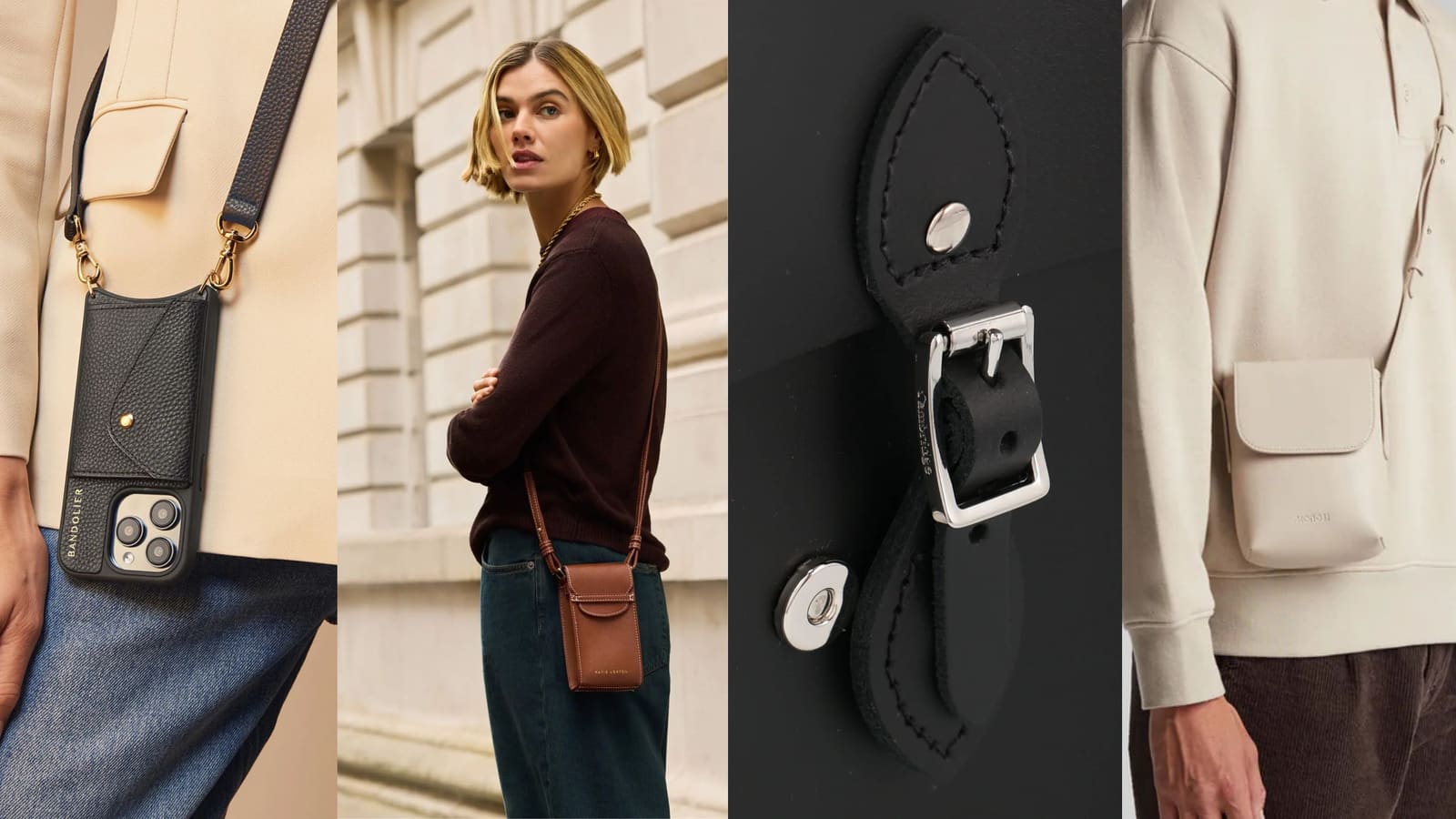
Consider the Monos Mini Metro crossbody, a vegan leather pouch built around a dedicated passport slot that doubles as a snug hold for your phone. When you arrive at immigration, everything you need is in one place. When you leave the airport, the central compartment remains available for a transit card or folded cash. The design is not neutral; it is opinionated, insisting that you travel lighter than you think you need to.
Or take the Bandolier Hailey, a hybrid phone case and wallet that has earned loyalty among frequent travelers. The case itself absorbs shock, protecting your device from the inevitable drops that accompany long days on foot. The integrated wallet holds an ID, a credit card, perhaps a hair tie. The strap is adjustable and removable, allowing you to wear it crossbody through a bustling souk or slip it into a larger bag when the context shifts. One editor at GCV has carried hers for nearly five years, a testament to durability in a category often dominated by disposable accessories.
Then there are the more refined options, like the Aspinal of London Ella pouch, sculpted from full-grain leather and lined with grosgrain. It is designed to age gracefully, the leather developing character as it travels with you. A slip pocket on the exterior holds a card; the interior is reserved almost exclusively for your phone. There is room for a passport if you slide it behind your device, but the space is intentionally constrained. This is not a bag that invites clutter. It is a bag that demands discipline.
When Less Becomes More
The appeal of the phone pouch extends beyond weight. It is also a matter of security and access. Worn crossbody, the pouch sits against your torso, visible and within reach. You cannot forget it on a cafe table or leave it unattended in a museum coat check. It is always with you, which means your most critical items - your means of payment, your identification, your portal to maps and translation and communication - are never out of sight.
This is particularly valuable in cities where pickpocketing remains a genuine concern. A phone tucked into a back pocket or a tote slung over one shoulder is an easy target. A crossbody pouch, positioned at your front and secured with a magnetic or buckle closure, is not. The difference is subtle but meaningful, a small adjustment that allows you to move through crowded train stations and tourist sites with greater ease.
There is also the question of what happens when you are not weighed down. Your hands are free to hold a cup of coffee, to gesture while speaking, to steady yourself on uneven steps. Your shoulders do not ache by midafternoon. You do not spend the evening nursing the dull throb that comes from carrying a heavy bag for hours. The physical relief translates into a kind of mental spaciousness, a sense that you are traveling through a place rather than laboring under the logistics of it.
The Limits of Minimalism
Of course, the phone pouch is not a universal solution. There are days when you need more - a water bottle for a long hike, a layer for shifting weather, a guidebook or journal. On those days, a larger bag is necessary, and the phone pouch becomes an accessory within that larger system, a way to keep your most essential items organized and accessible even when you are carrying more.
But for the vast majority of urban travel - wandering neighborhoods, visiting museums, stopping for lunch, browsing markets - the phone pouch is sufficient. It is, in fact, more than sufficient. It is liberating.
What to Look For
When selecting a phone pouch, consider both material and structure. Leather offers elegance and durability, though it requires care and is less forgiving in wet conditions. Nylon and other synthetic fabrics are lighter and more weather-resistant, though they may lack the tactile richness of natural materials. Some designs incorporate recycled content, appealing to travelers who prioritize sustainability without sacrificing function.
The strap is equally important. It should be adjustable, allowing you to wear the pouch higher or lower depending on your height and preference. It should be sturdy enough to withstand daily use but comfortable enough that you forget it is there. Some straps are removable, which adds versatility - you can wear the pouch as a crossbody when walking and then detach the strap and slip it into a pocket or larger bag when dining or attending an event.
Finally, consider the closure. Magnetic clasps offer speed and convenience, allowing you to access your phone without fumbling. Buckles and zippers provide greater security but require an extra moment to open. The choice depends on your priorities and the environments you are likely to encounter.
A Different Way to Move
There is something almost subversive about choosing to carry less in a culture that constantly encourages us to acquire and accumulate. The phone pouch is not a statement of asceticism; it is a statement of confidence. It says you know what you need and you are not interested in the rest. It says you trust your ability to navigate the world with fewer tools, fewer buffers, fewer contingencies.
At Global Chic Voyage, we have come to see the phone pouch as emblematic of a broader shift in how thoughtful travelers approach movement. It is part of a constellation of choices - packing lighter, staying longer in fewer places, prioritizing experience over itinerary - that reflect a desire not just to see the world but to be present in it. The phone pouch does not make travel possible, but it makes it easier, smoother, more fluid. It removes one small layer of friction, and in doing so, it opens up space for attention, for spontaneity, for the kind of unhurried observation that makes travel meaningful.
You will still need a larger bag for certain trips. But for the days when all you need is your phone, a card, and a key, the phone pouch is not a compromise. It is the answer.
Photo: Hannah Chubb
Spot something wrong? Email editors@globalchicvoyage.com. We log every correction publicly.
RELATED
SEE ALL →
9 Jul 2026 / 5 min

8 Aug 2026 / 5 min

7 Aug 2026 / 5 min

31 Jul 2026 / 5 min