
The Headrest That Might Finally Solve Economy Sleep
Emirates has installed an adjustable leather cradle across its fleet, promising an end to the slumped-head indignity of long-haul coach travel.
SI
22 Jul 2026 · 5 MIN READ · UPDATED 17 AUG 2026
The Economy Sleeper's Dilemma
There is a particular humiliation to waking mid-flight with your head lolled onto a stranger's shoulder, or folded forward at an angle that suggests structural collapse. Economy sleep has long been a negotiation between fatigue and physics, a battle fought with inflatable neck pillows, bundled cardigans, and the vague hope that exhaustion will win out over discomfort. At Global Chic Voyage, we have watched carriers add inches to legroom and upgrade their entertainment systems, but the basic mechanics of keeping a head upright at 38,000 feet have remained stubbornly unsolved.
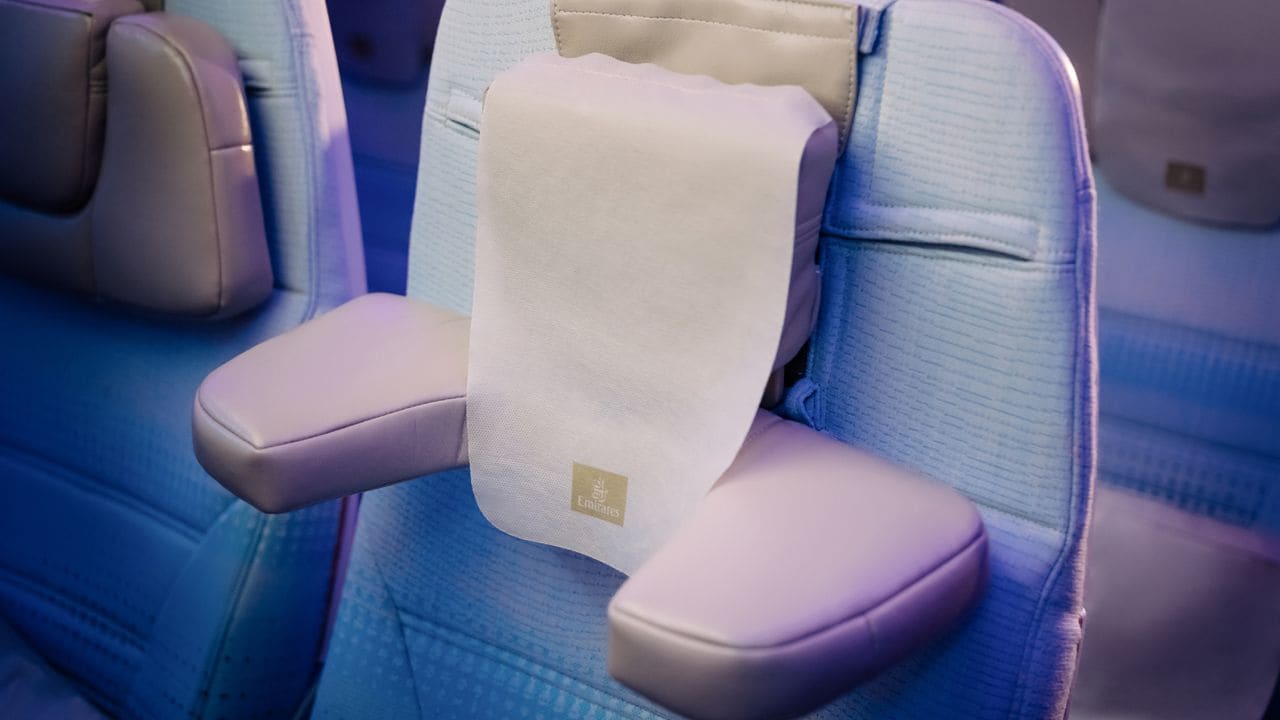
Emirates has now installed what it calls the U-Dream Headrest across its economy cabins, a padded leather fixture with side wings that fold inward to cradle the skull and neck. The design aims to address the fundamental problem: standard airline headrests offer a flat surface against which the head can rest vertically, but nothing to stop it from tipping sideways or forward once sleep sets in. The result is a fitful few hours punctuated by jolts of waking, stiff necks, and the quiet embarrassment of regaining consciousness in an undignified posture.
A Cradle, Not a Pillow
The U-Dream is built into Emirates' Z400 seat, manufactured by Safran Seats, and features flexible side panels that can be adjusted inward to create a U-shaped support. The headrest also moves vertically along a track and tilts to accommodate different heights and sleeping angles. It is upholstered in leather rather than fabric, a material choice that signals durability and ease of cleaning in a high-turnover environment, though it also marks a departure from the cloth-covered foam that defines most economy fittings.
According to Emirates, the headrest has been tested to meet European Union Aviation Safety Agency standards, a regulatory requirement that ensures it will not become a hazard during turbulence or emergency situations. Cabin crew are being trained to demonstrate its adjustment mechanisms, a service that suggests the airline anticipates some learning curve among passengers accustomed to more static seating.
The headrest is currently installed on three Airbus A350 aircraft, with the remainder of that fleet scheduled for completion by year's end. Retrofitting of the carrier's Airbus A380 and Boeing 777 aircraft will begin in 2027, while the 270 Boeing 777X jets Emirates has on order will arrive with the U-Dream pre-installed. It is a fleet-wide commitment, one that positions the headrest not as a trial feature but as a standard element of the airline's economy offering.
The Ergonomics of Long-Haul Coach
The introduction of adjustable head support in economy is less a revolution than an overdue correction. Premium cabins have long offered seats that recline into flat beds, with cushioned headboards and adjustable lumbar supports that treat sleep as a legitimate activity rather than an accidental byproduct of boredom. Economy passengers, by contrast, have been left to improvise, using whatever soft goods they can muster to prop themselves into something approaching rest.
Tim Clark, president of Emirates, described the headrest as eliminating the need for neck pillows, those horseshoe-shaped inflatables that have become both ubiquitous and inadequate. The claim is aspirational but worth examining. A travel pillow wraps around the neck to prevent the head from falling forward, but it does little to stabilize lateral movement, and it adds bulk that can feel stifling on a long flight. The U-Dream, by contrast, is fixed to the seat and adjustable, meaning it does not require passengers to carry additional items or worry about losing support mid-sleep.
Whether the design will prove comfortable over eight or twelve hours remains to be seen. Leather, while easy to wipe down, can become warm and slightly tacky against skin, particularly in cabins where air circulation is uneven. The side wings, while supportive, may feel confining to passengers who prefer to shift positions frequently. And the headrest's effectiveness will depend on how well it integrates with the seat's recline angle and pitch, variables that differ across Emirates' fleet.
A Broader Push Toward Considered Economy
The headrest arrives as part of a wider effort by Emirates to distinguish its economy cabins from the stripped-down offerings that have become standard on many long-haul carriers. The airline operates only widebody aircraft on intercontinental routes, ensuring that even the least expensive seats benefit from the spatial generosity of twin-aisle jets. Its cabins feature mood lighting calibrated to circadian rhythms, large seatback screens, complimentary meals, and amenity kits that include basics like socks and eyeshades. The carrier's ICE entertainment system offers more than 6,500 channels, a library vast enough to accommodate multiple transatlantic crossings without repetition.
Emirates is also rolling out Starlink connectivity across its fleet, allowing passengers to stream video and browse at speeds comparable to ground-based broadband. The move acknowledges that connectivity has shifted from luxury to expectation, particularly among travelers who view flights as extended work sessions or opportunities to maintain contact with home.
These incremental improvements suggest a philosophy: that economy need not be punitive, and that attention to detail in coach cabins can build loyalty as effectively as upgrades to business class. The U-Dream Headrest fits neatly into this framework. It is a small intervention, focused on a single pain point, but one that signals a willingness to rethink assumptions about what economy passengers deserve.
The Limits of Hardware
No headrest, however cleverly designed, can fully compensate for the constraints of economy seating. Pitch remains tight, recline remains limited, and the fundamental challenge of sleeping upright in a shared space persists. The U-Dream may keep heads from lolling, but it cannot add inches to legroom or silence the passenger kicking the seat behind you. It is a tool, not a cure.
Still, tools matter. The difference between waking with a crick in your neck and waking with your head still supported can shape the first hours of a trip, determining whether you arrive ready to explore or in need of recovery. For travelers who have long accepted discomfort as the price of affordable long-haul tickets, even modest improvements register as meaningful.
At Global Chic Voyage, we remain curious to see whether other carriers follow Emirates' lead, or whether the U-Dream remains a signature feature of a single airline. The economics of retrofitting entire fleets are not trivial, and smaller carriers may balk at the expense. But if the headrest proves popular, it could shift expectations around what economy seating should include, nudging the industry toward a baseline that treats sleep as a design priority rather than an afterthought.
For now, the U-Dream is rolling out across Emirates' network, one aircraft at a time. Passengers on select routes will have the chance to test whether adjustable side wings and vertical travel can finally make the slumped-head indignity a thing of the past. The answer will come not from press releases but from the experience of waking mid-flight with your head still upright, your neck still aligned, and the stranger beside you still comfortably out of reach.
Photo: Emirates
Spot something wrong? Email editors@globalchicvoyage.com. We log every correction publicly.
RELATED
SEE ALL →
8 Aug 2026 / 5 min

8 Aug 2026 / 5 min

7 Aug 2026 / 5 min

31 Jul 2026 / 5 min